

Site Search
Search within product
第752号 2023(R05).07発行
Click here for PDF version
§被覆肥料「Jコート® Quick」を用いたドローンによる水稲の局所追肥技術
Agricultural Experiment Station, Ishikawa Prefectural Agricultural and Forestry Research Center
Crop Cultivation Group
専門研究員 有手 友嗣
<Production Area Report
富士伊豆農業協同組合 韮山営農経済センター管内における大玉トマトとイチゴのエコロング施肥体系の紹介
静岡県富士伊豆農業協同組合
韮山営農経済センター 小鹿 浩睦
§土のはなし-第23回原始地球に土はなかった
-こうして地球に土が誕生した
前 ジェイカムアグリ株式会社
北海道支店 技術顧問
松中 照夫
被覆肥料「Jコート® Quick」を用いた
ドローンによる水稲の局所追肥技術
Agricultural Experiment Station, Ishikawa Prefectural Agricultural and Forestry Research Center
Crop Cultivation Group
専門研究員 有手 友嗣
1. use of drones in agriculture
A drone is the common name for an unmanned aerial vehicle (UAV), which is defined in the Civil Aeronautics Law as "an aircraft, rotorcraft, glider, or airship that is structurally inaccessible to humans and can be flown by remote control or automatic flight control (excluding those weighing less than 100 g (the sum of the weight of the main body and the weight of the battery). (excluding those weighing less than 100 grams (the sum of the weight of the main body and the weight of the battery)). There are two types of drones: multicopter drones, which use multiple rotor blades, and airplane drones, which use fixed blades.
Drones are characterized by their high flight stability, mobility, and expandability, including cameras and sensors. The use of drones is progressing in a variety of fields, including video production, disaster site investigation, inspection and maintenance of building structures, surveying and construction management at construction sites, and lightweight cargo transportation. Agriculture is another field where drones are expected to be utilized and are actually being used.
農業で利用されているドローンには大きく分けて,センシング用ドローンと散布用ドローンがある(図1)。センシング用ドローンは,カメラを搭載した比較的小型のドローンで,可視光での撮影の他,近赤外域も撮影可能なマルチスペクトルカメラを搭載した機種もあり,農作物の広域での生育診断や測量などに利用されている1)The following is a list of the most common problems with the "C" in the "C" column.
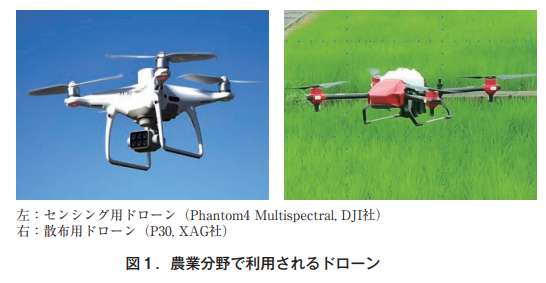
Spray drones are relatively large drones that can be equipped with granular or liquid spraying equipment. Compared to spraying on the ground, spraying can be done at high speeds, thus reducing work time and eliminating the need to enter the field.
Therefore, there is no risk of getting stuck in the mud. In some cases, such as in mountainous areas, where pesticides and fertilizers are applied by hand due to poor workability and uneven terrain, the use of drones for spraying can be expected to reduce labor burdens.
国内では平成28年頃から農薬散布用として導入が始まり,その後,国内メーカーの参入や機体の低価格化等に伴い,急速に普及が進み,令和2年度時点のドローンによる農薬散布面積推計は約12万ヘクタールに至っている2)。農林水産省では,ドローンによる散布面積を100万ヘクタールに拡大することを目標としており,今後も散布用ドローンの利用は拡大していくと見込まれる。
この散布用ドローンを農薬散布だけではなく,他の作業にも活用できれば,作業あたりの機械コスト削減につながり,ひいては生産コストの低減,収益の向上につながると考えられる。このため,石川県農林総合研究センターでは,(株)オプティムとの共同研究により,ドローンによる水稲直播栽培技術3)やドローンにより特定の場所にのみ肥料や農薬を散布する局所散布技術など,ドローンの多機能化・多用途化の研究に取り組んできた。
本稿では,ドローンによる水稲の局所追肥技術について,ジェイカムアグリ社の被覆肥料「Jコート® Quick」を使用した試験結果を交えて紹介する。
Localized fertilization technology using drones
水稲の追肥(穂肥)は,一穂籾数の増加,登熟歩合の向上などを目的として実施されているが,生育ムラのある圃場においては,圃場全面に肥料散布した場合,部分的に窒素過剰となる場所が発生し,倒伏を招くおそれがある。散布用ドローンで生育の劣る場所にのみ追肥すれば,倒伏のリスクを抑えつつ,生育ムラを改善することが可能になる。
The flow of local fertilizer application using drones is shown in Figure 2. The work is divided into growth diagnosis using a sensing drone and fertilizer application using a spreading drone.
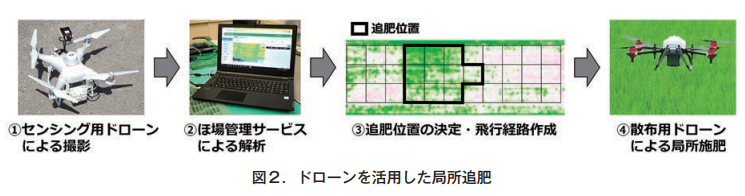
まず,幼穂形成期初期にあたる出穂25~20日前頃に,マルチスペクトルカメラを搭載したセンシング用ドローンで対象圃場を撮影し,生育の指標となる正規化差植生指数(NDVI:Normalized Difference Vegetation Index)の画像を取得する。NDVIとは,近赤外域(NIR)と可視域赤(RED)の反射率から計算される指数で,水稲では,幼穂形成期のNDVIが高いほど窒素含有量が多く,籾数が多くなることが報告されている4), 5)The following is a list of the most common problems with the "C" in the "C" column.
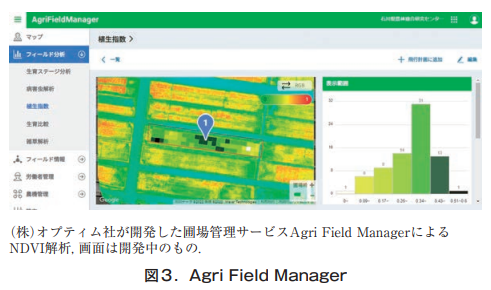
Next, the acquired NDVI images are analyzed by the field management service "Agri Field Manager" (Optim Corporation, Fig. 3) to determine where fertilizer should be applied. The need for additional fertilizer and the amount of fertilizer are comprehensively determined using the NDVI as an indicator, taking into account the variety, soil conditions, and amount of base fertilizer, etc. When a location for additional fertilizer is selected on the Agri Field Manager setting screen, a drone flight path is automatically created. The created flight path can then be input into a drone equipped with an autonomous flight function, which will fly to the selected location and apply fertilizer locally.
Fertilizer application by a drone falls under the category of dropping objects and requires approval from the Minister of Land, Infrastructure, Transport and Tourism under the Civil Aeronautics Law without exception. For details, please refer to the website of the Ministry of Land, Infrastructure, Transport and Tourism.
3.Jコート® Quickを用いた水稲の局所追肥
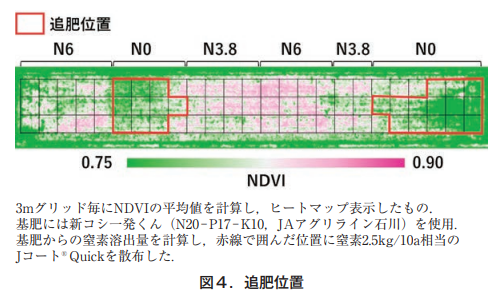
2021年に当センター内で実施した水稲の局所追肥試験の結果について紹介する。基肥の窒素量を10aあたり0kg(N0区),3.8kg(N3.8区),6kg(N6区)と変えることにより,人為的に生育ムラを再現したコシヒカリの栽培圃場で,出穂17日前に局所追肥を行った区と無追肥区(対照)を比較した試験である。出穂24日前にセンシング用ドローン(Phantom4 Multispectral,DJI社)により空撮を行い,NDVIが0.82以下であった地点のうち,基肥からの窒素溶出を考慮して,図4のとおり追肥位置を決定した。追肥量は事前に実施した試験結果から,暫定的に10aあたり窒素2.5kgとした。
追肥にはジェイカムアグリ社の被覆肥料「Jコート® Quick」(図5)を使用した。Jコート® Quickは,従来のLPコート製品と比較して,肥料成分溶出後の被膜崩壊性が高く6), 7),肥料溶出後に残った被膜の用水への流出抑制が期待できる。また,従来の被覆尿素と比べて窒素成分の溶出が早いため,追肥に適した肥料である。散布後の肥料をふるいで選別してもふるい下に落下した粒子は認められず(データ未記載),尿素や硫安等と比べて崩壊による詰まりが起こりにくいため,ドローンでの散布に適している。
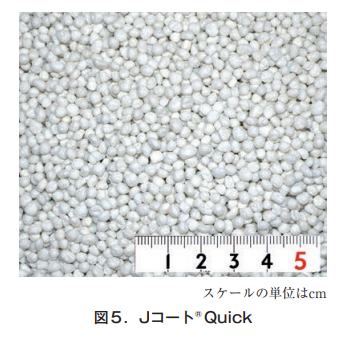
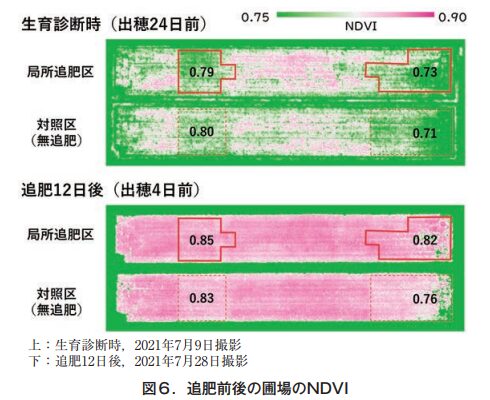
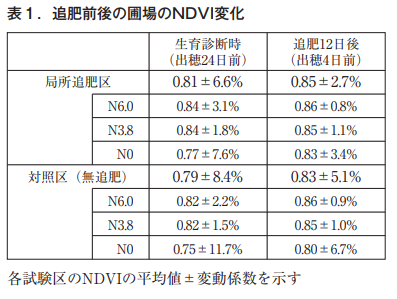
図6及び表1は追肥前後の圃場のNDVIの変化を示したものである。局所追肥区では,対照(無追肥)区よりもN0区のNDVIが上昇,試験区全体の変動係数が低下しており,圃場全体の生育ムラが軽減されたと考えられた。
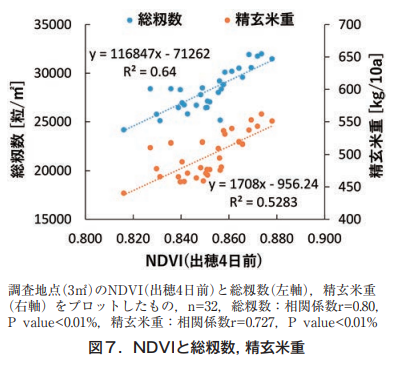
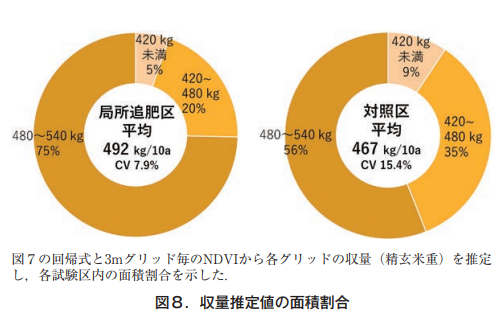
出穂直前のNDVIは㎡当たり総籾数や収量(精玄米重)と正の相関があるため(図7),局所追肥により,低収量の面積が減少し,試験区全体の収量も向上したと推定された(図8)。倒伏程度を0~4の5段階で評価したところ,局所追肥区全体で1.5,局所追肥した地点でも1.5と軽微であった。
Summary
以上のように,ドローンによる局所追肥技術は倒伏のリスクを軽減しながら,生育ムラを軽減することができ,合筆田など,ほ場内の地力差が大きい圃場で特に有効な技術である。全面追肥と比較して肥料投入量も抑えられることから,低コスト化にもつながる。技術的には殺虫・殺菌剤,除草剤などの局所散布にも応用が可能であり,農薬使用量の削減にもつながる技術と期待される。しかしながら,生育診断の時期や必要な追肥量については,品種,土壌条件,基肥量,移植時期等から総合的に判断する必要があり,また年次間差もあるため,更なる検討が必要である。
近年,可変施肥に対応したドローン機種も登場してきていることから,センシング用ドローンによる生育診断,散布用ドローンによる施肥は今後も普及が拡大していくと見込まれる。それに伴い,Jコート® Quickの活用場面も増えていくものと期待される。
References
1)井上吉雄,横山正樹 2017.ドローンリモートセンシングによる作物・農地診断情報計測とそのスマート農業への応用.Journal of The Remote Sensing Society of Japan,37,p.224-235.
(2) Technology Extension Division, Agriculture and Forestry Bureau, Ministry of Agriculture, Forestry and Fisheries, 2022.
3) Uno, F. 2022. direct seeding of paddy rice using drone. Journal of Paddy Direct Sowing Association, 45, p. 24-28.
4)脇山恭行 2005.植生指数と水稲の籾数の関係.Journal of Agricultural Meteorology,61,p.61-67.
5)Tsukaguchi, T.,Kobayashi, H., Fujihara, Y., Chono, S.2022.Estimation of spikelet number per area by UAV-acquired vegetation index in rice(Oryza sativa L.).Plant Production Science,25,p.20-29.
6)松永真,白鳥孝太郎 2019.新型被膜でコーティングされた水稲一発肥料Jコートの実用性の検討.農業と科学,707,p.8-12.
7)松田英樹 2021.被覆肥料「Jコート」の水稲に対する全量基肥施用の効果と被膜崩壊性.農業と科学,732,p.1-4.
<産地レポート>
富士伊豆農業協同組合 韮山営農経済センター管内における
大玉トマトとイチゴのエコロング施肥体系の紹介
静岡県富士伊豆農業協同組合
韮山営農経済センター 小鹿 浩睦
JAふじ伊豆は令和4年4月に静岡県東部8農協(なんすん,富士,富士宮,御殿場,三島函南,伊豆の国,あいら伊豆,伊豆太陽)が合併して発足しました。JA管内の伊豆の国市では様々な園芸作物が栽培,販売されています。中でもミニトマトとイチゴは県内でも有数の産地であり,冬春ミニトマトは出荷量県内1位,イチゴは出荷量県内2位と盛んに栽培されています。今回はトマト,イチゴの栽培体系と使用されている肥料「エコロング」を紹介します。
What is "ecolong"?
作物の生育に合わせて,肥料の溶出を調節した粒状のコーティング肥料です。またエコロングの被膜は光崩壊性と微生物分解性の両方を有しています。
Fertilizer leaching characteristics are largely unaffected by soil pH and soil moisture.
一般的な畑作物によく効く硝酸態窒素を含みます。肥効が持続しますので基肥だけでの栽培ができます。また,局所施肥による肥料の利用効果が高まり,減肥が可能になります。
溶出タイプは,施肥直後から溶出が始まる直線(リニア)型とゆっくりと効果が出てくるシグモイド型があり,25℃の土壌中で窒素が80%溶出する日数を名称に用いています。窒素・リン酸・カリや微量要素,溶出日数,溶出タイプの違いにより畑作物の多くの用途にマッチした銘柄を選択できます。
Tomato Production System in Izunokuni City
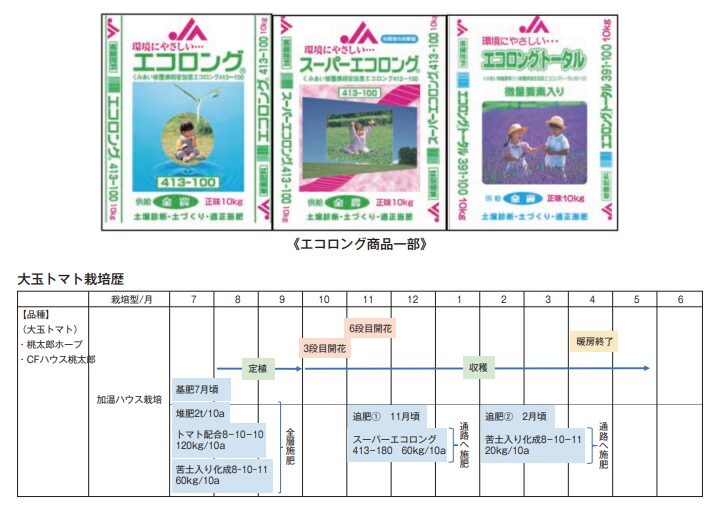
伊豆の国市のトマトは8月~10月に定植を行い,収穫は10月から始まり3月に最盛期を迎え,7月の初旬に終わりを迎えます。おもな栽培品種は大玉トマト(桃太郎ホープ)(CFハウス桃太郎),ミニトマト(サマー千果)(TY千果)となっています。品種的特徴として,耐病性に優れており,シーズンの終盤まで安定生産する事が出来ます。
最後まで収量を維持したまま栽培するために一役買っているのが,今回紹介するエコロングになります。管内は主にスーパーエコロング413(180タイプ)が広く普及しています。
Cultivation system (large tomatoes)
トマトの施肥に関しては,7~8月に基肥を全面散布し,追肥は通路に散布を6段目の開花時と2月の計3回行います。
伊豆の国管内の大玉トマトでは,スーパーエコロング413-180を推奨しています。理由として初期に窒素を効かせ過ぎると,カルシウムの吸収移行が阻害され,尻腐れ果が発生しやすくなるためです。窒素は,着果までの生育初期は抑えめ,その後は適度に効かせるのがポイントです。施肥の基準としては,スーパーエコロング413-180を6袋/10aを通路に施用していただくことで収穫期の終盤まで肥効が続き,安定した収量が望めます。
Strawberry Cultivation System in Izunokuni City
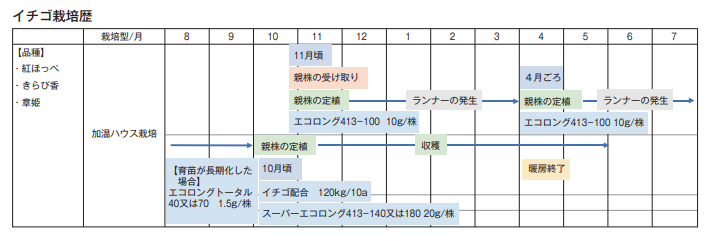
イチゴ栽培は11月に次年度産の親株苗を配布し親株を定植します。子株の切り離しを7~8月,本圃への定植は10月頃に行います。早い方だと11月から収穫が始まり,3月頃最盛期を迎え,6月に作が終了します。栽培品種は(紅ほっぺ)(きらぴ香)(章姫)の三品種です。どの品種も大粒で,甘み・酸味のバランスがよく大人気の品種になります。
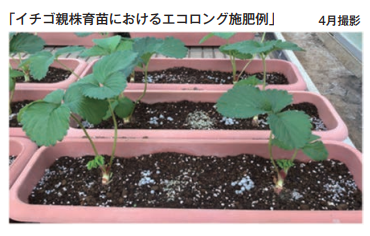
イチゴの施肥は,育苗時期によってエコロングの使い分けをします。親株育苗期にはエコロング413-100を10g/株施用し,葉柄内硝酸態窒素を確認しながら適宜追肥を行い,ランナー発生及び,子苗の品質を充実させます。育苗期間が長期化してしまった際には,エコロングトータル391-40又は70を,定植予定日から逆算をして,花芽分化期に肥料切れを起こさないタイミングで施用します。本圃に定植する際に,土耕栽培での基肥にスーパーエコロング413-140又は180を施用します。定植時に施用することで,春先の肥料切れを防ぎ,安定した生育を促します。秋口に肥料が効いてしまうと,腋花房の分化や初期の根張りに影響を与えてしまうため,溶出抑制期間が長い肥料を施用します。
The nitrogen leaching rate of Ecolong depends on soil temperature. The higher the soil temperature, the more nitrogen is leached out, resulting in a shorter fertilizer effect period. Conversely, the lower the soil temperature, the less leaching occurs, and the longer the fertilizing effect lasts.
よって,肥培管理に十分注意し肥料を途切れさせないことが安定生産する上でのポイントになります。
Therefore, in Izu-no-kuni District, we recommend "Ecolong," which works slowly and for a long time and can also save labor.
No Soil - No Soil on the Primitive Earth
-こうして地球に土が誕生した
前 ジェイカムアグリ株式会社
北海道支店 技術顧問
松中 照夫
All this time we have been talking about soil. This was based on the assumption that soil is all around us. However, has soil been on the earth since the birth of the earth 4.6 billion years ago? The answer is no.
In this issue, I would like to return to the primitive earth and reflect on the story of how soil came to be on the earth and how it supports life.
1. the earth before the appearance of soil
Now, we have soil under our feet. However, those who live in urban areas with asphalt pavement may have forgotten that soil even exists. Yet, when we go out to the suburbs and look at the farmlands and fields, we see the soil. That is our daily life. It is thought that a material similar to the soil we know today (early soil) appeared on the earth about 600 million years ago. And our image of soil appeared about 300 million years ago. The birth of soil on the earth was accompanied by the following dramas (Fig. 1).
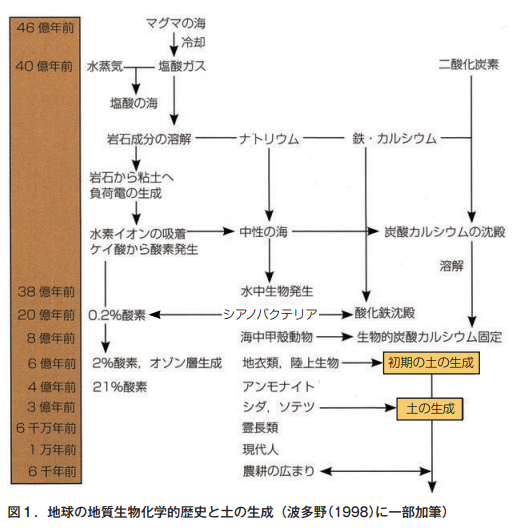
4.6 billion years ago, asteroids in the universe collided with each other, accumulating energy and gradually expanding to form the Earth. Immediately after its birth, the earth was in a state of bare magma, with temperatures reaching over 1,000°C. Later, as asteroid impacts decreased, the magma cooled over time. Later, as the number of asteroid impacts decreased, the magma cooled with the passage of time. When the surface temperature reached about 300°C, water vapor fell to the ground in torrential rain. This became the ocean. This was about 4 billion years ago. This ocean was hot and highly acidic, with hydrochloric acid as its main ingredient. This is because the rain dissolved the gases emitted from the magma.
At that time, the atmosphere was 97% carbon dioxide (carbon dioxide gas). Carbon dioxide could not dissolve into the strongly acidic ocean. However, as the dissolved components from the rocks gradually neutralized the oceans, carbon dioxide gradually dissolved into the oceans, further neutralizing the acidic oceans.
Life was first found in the sea. This is because the sun's ultraviolet rays are harmful to living organisms, and the only place where they could avoid these rays was in the sea. This is thought to have occurred approximately 3.8 billion years ago. It seems that life began with bacteria that could grow in anaerobic conditions, that is, in the absence of oxygen.
2. birth of life and formation of the ozone layer
As time progressed to 2 billion years ago, bacteria that acquired the ability to photosynthesize appeared among life in seawater. These were cyanobacteria (cyanobacteria, once classified as plants but now treated as bacteria). Cyanobacteria react with inorganic substances (minerals) in seawater and calcium carbonate to produce a rock-like substance called stromatolite, which accumulates in layers. The cyanobacteria themselves survived on the surface of the stromatolite and continued to release oxygen through photosynthesis. As a result, the atmosphere gradually began to contain oxygen. About 600 million years ago, when the atmospheric oxygen concentration increased to 2%, an ozone layer began to form (Figure 1).
The ozone layer blocked ultraviolet radiation from the sun. This blockage of ultraviolet radiation, which is harmful to living organisms, has allowed marine life to come ashore. The first organisms to come ashore were lichens. Lichens are organisms in which algae (cyanobacteria, green algae, etc.) coexist inside a structure made of fungal mycelium. The photosynthetic products produced by the algae are used by the fungi to support their life, allowing them to grow even under conditions with limited nutrient sources.
3. birth of soil
The lichens attached themselves to terrestrial rocks and transformed them. At the same time, when the lichens themselves died, their remains not only became organic matter that provided nutrients for the next generation, but also mixed with the altered rocks, beginning the formation of early soil on the earth. This was about 600 million years ago. This process was repeated to slowly create soil. Thus, it is thought that soil was formed on the earth about 300 million years ago. This is evidenced by the fact that huge forests of ferns, such as sealing trees and reed trees, as well as amphibians and insects appeared on the land at that time. They provide the fossil fuels of today (Figure 1).
It took a long journey for soil to be formed by the organisms that came to life on the earth. That path was completed at that time, and it has not ended, but continues to the present day. At first glance, the soil appears to be immovable. However, as an extension of this enormous change over time, the soil is still changing to harmonize with its environment.
4. the earth's "skin" supports terrestrial life
The earth is in the exquisite position of being the third closest to the sun. Too close to the sun and water evaporates and disappears. If it is farther from the sun, it will freeze. The exquisite position means that there was enough distance between the sun and the earth for water to exist stably. This water and the oxygen in the atmosphere made it possible for life to survive on Earth.
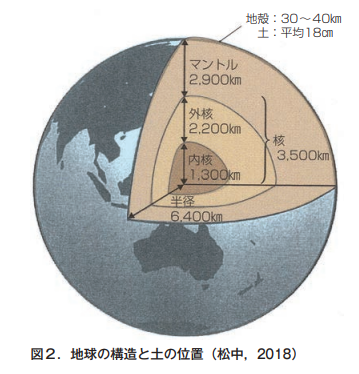
地球は半径およそ6400kmのほぼ球体である(図2)。この球体の中心部が核で,その外側がマントル,そしてマントルの外側に地殻がある。陸地は,地球の表面積の30%程度にすぎない。陸地の地表から30~40kmの厚さで覆われる部分が大陸地殻である。土は大陸地殻の表面のほんの数cmからせいぜい数m,全地球を平均すると18cmの厚みしかないという(陽,1994)。この厚みは,地球の半径の1000万分の1にすぎない。人の皮膚は平均すると2mm,身長2mの人の1000分の1である。つまり土は,地球規模でみると人の皮膚よりもさらに薄い,かすかな皮膚にすぎない。地球を図2のように表現すると,18cmの厚みは,図に示した円の外周線の太さでも厚すぎ,図示すらできないほどの薄さである。
Plants grow in the soil, which is a faint skin of the earth, and microorganisms and animals live on it, and much of our food is produced from the soil. The soil, which is only a small part of the earth as a whole, supports the life of all terrestrial life on earth.