

Site Search
Search within product
第753号 2023(R05).08-09発行
Click here for PDF version
§水稲における高密度播種と育苗箱全量施肥栽培を組み合わせた省力技術
Kumamoto Prefectural Agricultural Research Center, Production Environment Research Institute
Soil Environment Laboratory
田中 一成
§イチゴ「あまおう」の育苗期における省力的施肥法
Fukuoka Prefectural Agriculture and Forestry Experiment Station, Chikugo Branch
龍 勝利
§土のはなし-第24回土は環境の産物である
-風化と生物の作用が岩石から土をつくる
前 ジェイカムアグリ株式会社
北海道支店 技術顧問
松中 照夫
High-density seeding in paddy rice and
育苗箱全量施肥栽培を組み合わせた省力技術
Kumamoto Prefectural Agricultural Research Center, Production Environment Research Institute
Soil Environment Laboratory
田中 一成
Introduction
Rice cultivation in Kumamoto Prefecture is no exception to the recent severe situation, with stagnant rice prices and a growing shortage of rice farmers. One of the agricultural policies to solve these problems is the development and practical application of technology that contributes to the consolidation of farmland through the expansion of management scale and the accompanying reduction of production costs and labor hours, which is expected to lead to improved rice farming management.
Currently, high-density seeding technology and whole seedling box fertilization technology are attracting attention as low-cost and labor-saving cultivation technologies for paddy rice that have been put into practical use. The former is a technology that significantly reduces the number of seedling boxes required by increasing the amount of seeding per seedling box and removing a small amount of fertilizer. The latter is a fertilization method in which the amount of nitrogen necessary for growth is applied in the seedling box at the time of sowing, and the fertilizer is held by the paddy rice seedlings before transplanting. Both of these techniques have already been adopted as low-cost and labor-saving cultivation techniques for paddy rice by some large-scale farmers in the prefecture.
This paper describes the results of research conducted to clarify the effects of the combination of high-density seeding and whole seedling box fertilization on seedling quality, growth, and yield of paddy rice, with the aim of further reducing costs and saving labor by combining these two technologies, which have been separately practiced.
2. Testing Method
(1) Seedling quality test
機械移植を前提とした育苗試験を,熊本県の普通期栽培の標準的な移植時期である6月中下旬を想定して行った。育苗方式は慣行育苗(以下,慣行区という)と高密度播種と育苗箱全量施肥栽培の組み合わせ(以下,高密播苗箱施肥区という)の2水準を設けた。なお,水稲品種は‘ヒノヒカリʼで,試験は2020年から2021年の2ヵ年行った。播種量は慣行区では1箱当たり100g(乾籾換算),高密播苗箱施肥区では1箱当たり250g(乾籾換算)とした。慣行区では一般的に使用されている深さ30mmの中苗用育苗箱を用いた。
一方,高密播苗箱施肥区では深さ40mmの育苗箱(三甲株式会社製)を用い,1箱当たり2,250gの「苗箱まかせ®N400-120」を箱底に施肥した。育苗期間中の潅水法は上面潅水による手潅水とした。なお共通事項として,育苗用培土は市販の人工造粒土(菱東肥料株式会社製ひのくに培土)を用いた。
Seedling height, stem, leaf and root dry matter weights, seedling weight per box, and root mat strength were examined immediately prior to transplanting in both locations.
(2) Measurement of seedling weight per box at sowing and transplanting
The weight of seedlings (including the weight of the seedling box) per box at sowing was measured after filling the seedling box with bedding soil or seedling box material, irrigating, sowing, covering with soil, irrigating again, and allowing the seedlings to rest until gravity water had sufficiently drained out. The weight of seedlings per box at the time of transplanting was measured after irrigating the seedlings before measuring the weight and allowing the seedlings to rest until the gravity water had completely drained out.
(3) Seedling root mat strength survey method
The center of the seedling was cut at right angles to the cross section (28 cm) with a width of 10 cm, and clips (at least 10 cm wide) were fixed to both short sides.
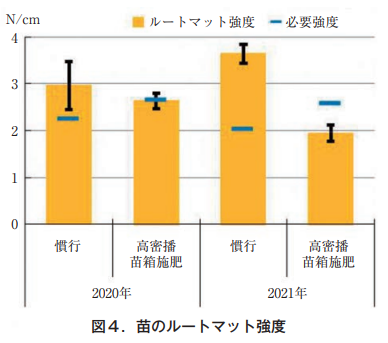
The standard root mat strength that does not interfere with machine transplanting operations is 1.8 N/cm or higher in a normal seedling box with a depth of 30 mm, but this strength varies depending on the weight of the seedlings. However, this strength varies depending on the weight of the seedlings. Since a seedling box with a depth of 40 mm is used here, the weight of the seedlings is heavier, and the root mat strength is considered to be affected. Therefore, it is necessary to check whether the root mat has sufficient strength when transferring seedlings grown in a 40 mm-deep seedling box to the seedling bed of a rice transplanter.
そこで,必要強度(N/cm)=育苗後の苗重量(kg)÷苗横断面の長さ(28cm)×力のモーメント(9.8m/s²)の 関係式から,片手で持った際と同等の苗幅1cm当たりに掛かる苗の必要強度を求め,実際の測定値との比較を行った。
(4) Cultivation test
Cultivation trials were conducted to determine the effects of the technology combining high-density seeding and full seedling box fertilization on the growth and yield of paddy rice in the rice paddies.
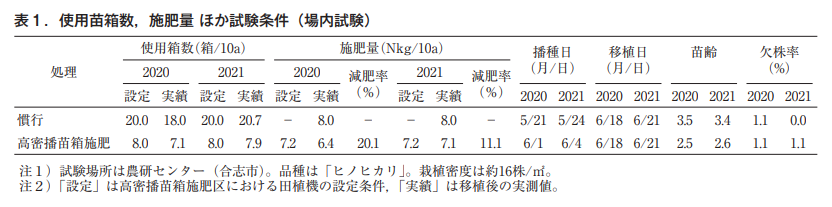
表1に所内試験の内容を示す。試験区の構成は,1箱当たり250g(乾籾換算)の播種量で,2,250gの「苗箱まかせ®N400-120」を箱底に施肥した高密播苗箱施肥区と1箱当たり100g(乾籾換算)の播種量で育苗した慣行区の2水準を設けた。前者では本田への施肥はせずそのまま移植し,後者ではLPコート入り複合肥料を全量基肥施肥したのち中苗で移植した。これらの窒素施肥量は,それぞれ高密播苗箱施肥区では使用苗箱数を8枚と想定して7.2kg/10a,慣行区では8kg/10aに相当する。
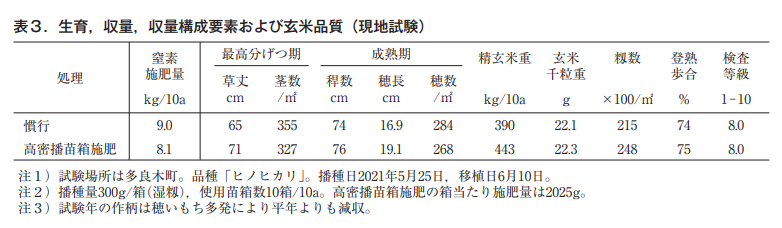
現地での適用性を確かめるために場内試験と同様の栽培試験を行った。試験場所は農事組合法人多良木のびる(熊本県球磨郡多良木町)の水田で,品種は‘ヒノヒカリ’である。播種は2021年5月25日,移植は6月10日に行った。高密度苗箱施肥区は,播種量1箱当たり300g(湿籾)で1箱当たり2,025gの「苗箱まかせ®N400-120」を箱底施肥して育苗した。一方,慣行区は播種量1箱当たり100g(乾籾換算)で育苗し,全量基肥施肥を行った。窒素施肥量は,高密播苗箱施肥区が8.1kg/10a,慣行区が9kg/10aであった。
Results and Discussion
(1) In-situ testing
(1) Seedling length and fullness
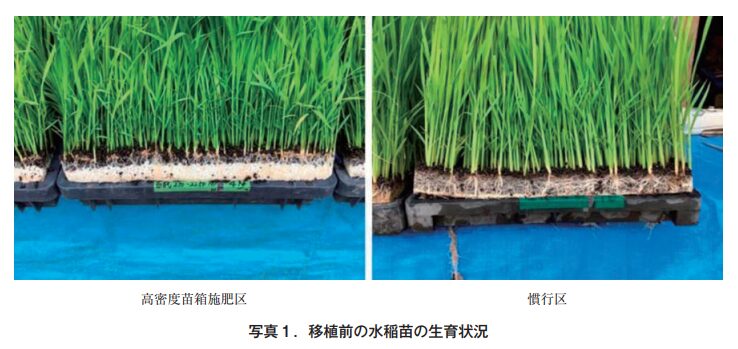
Seedlings were grown for 17 days in the high-density box-fertilized area and for 28 days in the conventional area, and seedlings with no problems in terms of appearance were successfully grown (Photo 1). The most important factors in determining whether paddy rice seedlings are suitable for transplanting by machine are seedling length and rootmat strength.
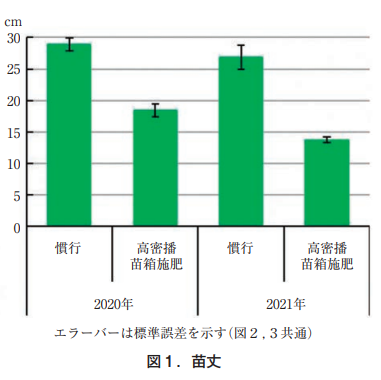
The seedling height range of 10 to 25 cm is considered suitable for machine transplanting, considering that the transplanter can transplant without difficulty and the transplanted seedlings are not submerged in water. As shown in Figure 1, seedling height in the high seeding box fertilized area was lower than that in the conventional area in both years, but seedling height in the high seeding box fertilized area was in the range of 13 to 19 cm, which was sufficient for machine transplanting.
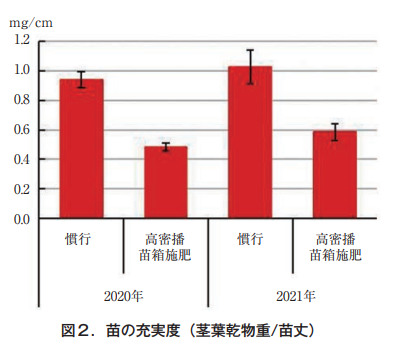
一方,苗の充実度(茎葉乾物重/苗丈)は,2ヵ年とも慣行区より高密播苗箱施肥区が低かったが (図2),これは育苗日数が慣行区よりも10日ほど短いためと推察された。
(2) Seedling weight per box and root mat strength
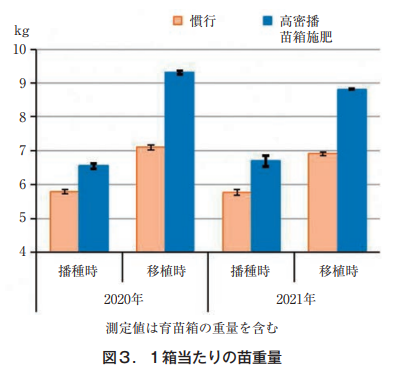
1箱当たりの苗重量は,慣行区と比較して高密播苗箱施肥区は播種時で約1kg,移植時では約2kg重くなった(図3)。これは,高密播苗箱施肥区で使用している育苗箱が慣行よりも深く,充填された床土量や水分保持量が増加したことによると考えられた。
The strength of the root mats was sufficient for the conventional area, but less than the required strength for the area with the high density seedling box fertilizer (Figure 4). In fact, in the conventional area, it was possible to hold a seedling removed from the seedling box with one hand, but in the high-density seedling box fertilization area, it was not possible to hold the seedling even with both hands. This may be because the root mat was not strong enough to withstand the weight of the seedlings themselves due to the increased overall weight of the seedlings in the high-density seedling box fertilization area, where 40 mm-deep seedling boxes were used. However, it was confirmed that the seedlings could be moved to the rice transplanter by using the seedling pick-up board, and there was no problem in transplanting work in the rice field.
(3) Growth and yield in the main field
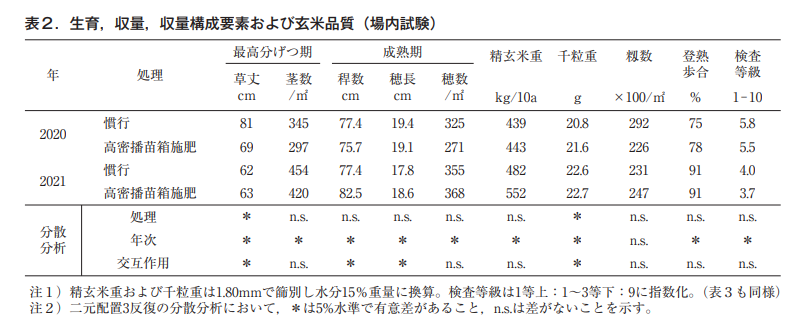
In the 2021 trial, grass height was similar and the number of stems was slightly higher in the conventional treatment than in the high-density seedling box fertilization treatment. Culm length, ear length, and ear number at maturity were similar in both years.
Yield (milled brown rice weight) was higher in the high-density seedling box-fertilized area than in the conventional area in both years. In terms of appearance quality (inspection grade), the high-density seedling box fertilizer application area showed superior quality compared to the conventional area in both years (Table 2).
(2) On-site testing
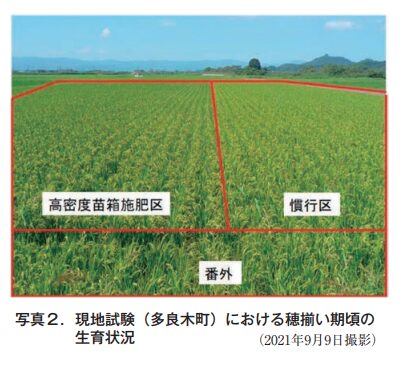
現地(多良木町)においては,最高分げつ期では慣行区の草丈が低かったが,茎数は多かった。穂揃い期頃の立毛の観察では,高密度苗箱施肥区の葉色が慣行区よりも濃い緑色を呈していた(写真2)。成熟期では,穂長は高密播苗箱施肥区が長かったものの,穂数は慣行区のほうが多かった。収量(精玄米重)は高密播苗箱施肥区が慣行区と比べ多くなり,外観品質(検査等級)に差は認められなかった(表3)。
Summary
As described above, using seedling boxes with a depth of 40 mm and combining high-density seeding with total fertilizer application to the seedling boxes (box-bottom fertilization), it was possible to produce seedlings of good quality that would not interfere with transplanting operations. This reduced the number of seedling boxes used per 10a to eight, eliminating the need to apply fertilizer to the rice paddies and suggesting that labor-saving cultivation is possible with a 10% reduction in nitrogen fertilizer compared to the conventional fertilizer application.
The following points should be kept in mind when utilizing the labor-saving technology combining high-density sowing and whole seedling box fertilization introduced in this paper.
(1) It is necessary to confirm that the sowing machine is adaptable to seedling boxes 40 mm deeper than normal.
②水稲根への水と酸素の供給を良くするため,育苗法は畑育苗を推奨する。ただし,慣行育苗よりも床土量が少なく乾燥しやすいため,苗が萎れない程度に1日の潅水回数を増やす必要がある。
③苗の充実度が低くなりやすいので,出芽後の被覆シートを苗丈1cm程度で取り除くなど,充実した苗を作る管理を行う。その他,育苗箱全量施肥栽培に対する基本的な育苗管理を遵守するとともに,初めて取り組む場合には予め小規模で試作することが望ましい。
④高密度苗箱施肥栽培では,苗重量が重いため十分なルートマット強度が得られない場合が予想されるが,苗取板を用いれば移植作業は支障はなく実施できる。
⑤移植に際しては高密度播種対応田植機を用いるとともに,面積当たりの使用箱数が本田施肥量に関係するので,横送り回数とかき取り量(高さ)による面積当たり使用箱数の正確な設定が必要である。
Labor-saving fertilization method for strawberry "Amao" in seedling stage
Fukuoka Prefectural Agriculture and Forestry Experiment Station, Chikugo Branch
龍 勝利
Introduction
福岡県農林業総合試験場で育成されたイチゴ「あまおう」(品種名「福岡S6号」)は,福岡県内のみで生産され,作付面積は約300ha(2022年)で,系統共販の100%が「あまおう」となっている。「あかい,まるい,おおきい,うまい」という名前の由来のとおり,果実は赤く艶があり,大きく,甘みと酸味のバランスが良いのが特長である。このため,全国の消費者だけでなく,プロの料理人にも絶大な人気を博しており,安定した生産・供給が市場から強く求められている。
Compared to other fruits and vegetables, strawberries require more seedlings to be planted and more labor for seedling production due to their nutritional reproduction. In addition, it is necessary to control the growth and flowering of seedlings during the seedling growth period through fertilizer management. Specifically, it is necessary to supply sufficient nitrogen for growth during the first half of the seedling training period, while in the second half of the seedling growth period after late August, nitrogen supply should be stopped to promote flower bud differentiation and reduce the nitrogen concentration in the body of the seedlings (Uematsu, 1998).
「あまおう」の場合,窒素量を約70mg含む固形肥料を3回程度施肥し,窒素が不足する場合は液肥で補うのが一般的である(福岡県農林水産部経営技術支援課,2020)。しかし,育苗時の追肥作業は7月から8月の高温期に行われ,10a当たり約8,000株の苗に複数回の施肥を行わなければならず,生産者にとって重労働であるため,省力化が望まれていた。
In order to reduce the labor-intensive burden of fertilizer application, we investigated a system in which all fertilizer is applied at once using a slow-release coated fertilizer with adjustable leaching rate and duration of fertilizer components. Here, we introduce the outline of the system.
2. Methods
(1) Fertilization method
A two-year trial was conducted in 2019 and 2020 comparing a single application of slow-release coated fertilizer (hereafter referred to as "total fertilizer") and four applications of solid fertilizer (hereafter referred to as "conventional").
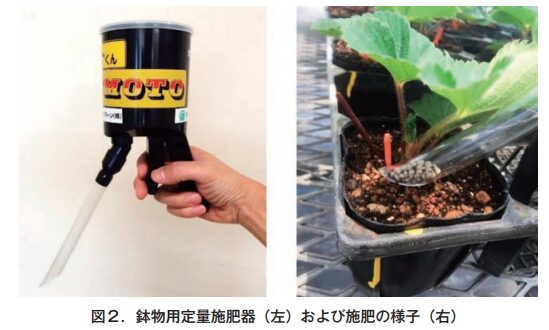
全量施肥区の肥料として,花芽分化の誘導期である8月下旬から9月下旬に慣行区と同程度の窒素溶出率となるよう,被覆肥料の溶出シミュレーションに基づき(図1),リニア型の被覆燐硝安加里であるエコロングトータル391-70タイプ(N:P₂O₅:K₂O=13:9:11%,ジェイカムアグリ(株))を選定した。全量施肥区の施肥には,鉢物用定量施肥器(ショットくん,(株)マツモト)を使用した(図2)。全量施肥区の施肥は2019年では6月24日,2020年では6月25日に行い,施肥量は2g/鉢(窒素量260mg/鉢)とした。
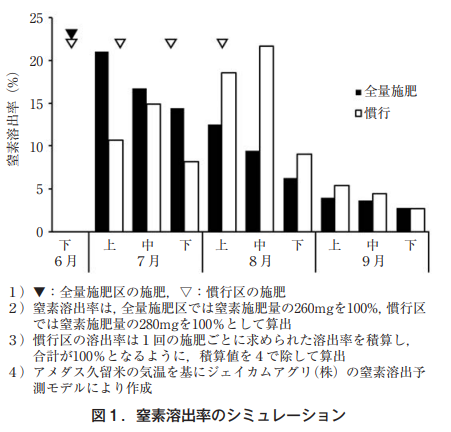
慣行区の肥料として,IB化成S1号(N:P₂O₅:K₂O=10:10:10%,ジェイカムアグリ(株))を用いた。慣行区の施肥は2019年では6月24日,7月8日,7月22日,8月5日,2020年では6月25日,7月8日,7月22日,8月5日に行い,1回当たりの施肥量を1粒とし,合計施肥量は約2.8g/鉢(窒素量280mg/鉢)とした。
(2) Seedling raising method
採苗は鉢受方式で行い,育苗培土はヤシガラピートやくん炭を含むいちご専用培土2号(N:P₂O₅:K₂O=100:400:50mg/L,清新産業(株))を用い,直径9cmの黒色ポリポットに約300mLの培土を充填した。苗は雨除け被覆を行った条件で管理した。両区とも育苗中に液肥の施用は行わなかった。育苗期のかん水は,天候に応じて1~3回/日行った。育苗期の摘葉は7月上旬から2週間毎に残葉数が3.0~3.5枚となるように行った。
(3) Cultivation method after seedling planting
イチゴの栽培には単棟ビニルハウス(間口6m,奥行き20m)を用いた。栽植様式は畝幅120cm,条間50cm,株間25cmとし,2条内なりの土耕栽培とした。定植は2019年では9月24日,2020年では9月23日に行った。
基肥は,有機物および被覆窒素を配合したあまおう専用肥料(N:P₂O₅:K₂O=8:6:3%,大日本産肥(株))を窒素量で10kg/10a施肥した。追肥は10月下旬にあまおう専用肥料とスーパーエコロング413-140(N:P₂O₅:K₂O=14:11:13%,ジェイカムアグリ(株))をそれぞれ窒素量で5kg/10a施肥した。
マルチ被覆は2019年では10月18日,2020年では10月26日に行った。天井ビニル被覆は,2カ年とも10月29日に行い,夜間最低温度が5℃以下にならないように温風暖房機で加温した。電照は暗期中断方式で,2019年では11月15日から2月28日,2020年では11月15日から2月18日に,草勢に応じて2~4.5時間点灯した。
3. results
(1) Nitrate nitrogen content in the medium
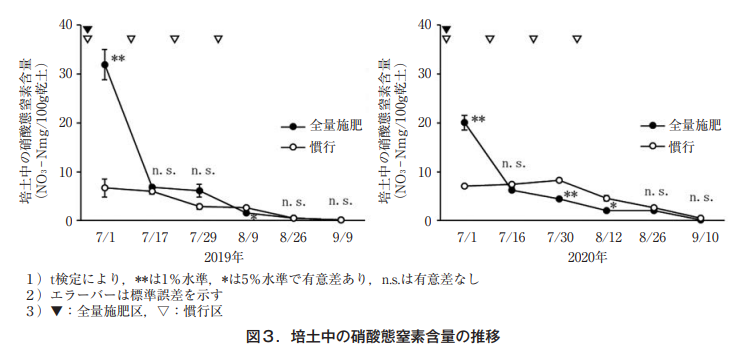
育苗期における培土中の硝酸態窒素含量の推移を図3に示した。2カ年とも培土中の硝酸態窒素含量は,全量施肥区では慣行区に比べて,7月上旬に13~25mg/100g乾土多いが,8月上中旬に1~3mg/100g乾土少なく,8月下旬以降には差が認められず,3mg/100g乾土以下で推移した。
(2) Nitrate ion concentration in petioles and flower bud differentiation
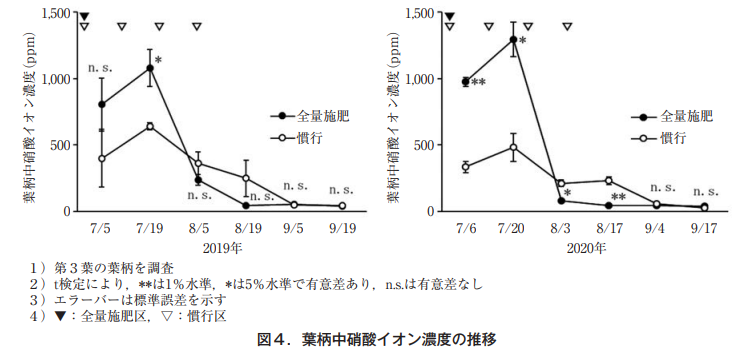
Figure 4 shows the trends of nitrate ion concentrations in petioles during the seedling growth period. Nitrate ion concentrations in petioles in the total fertilizer-applied area were higher than those in the conventional area, exceeding 1,000 ppm in mid-July, and were generally 40 to 50 ppm from mid-August onward, remaining at the same level or lower than those in the conventional area. The flower bud differentiation index in the total fertilizer-applied area did not differ from that in the conventional area in both years (data omitted).
(3) Growth during seedling stage
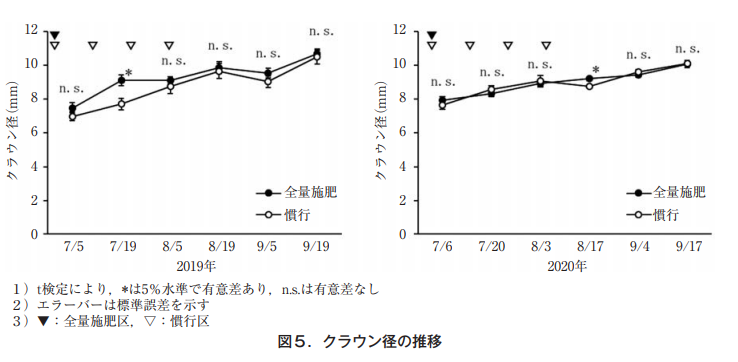
クラウン径の推移を図5に示した。全量施肥区のクラウン径は慣行区に比べて,2019年では7月19日に太かったが,その他の時期に差は認められなかった。2020年は8月17日に全量施肥区が慣行区に比べて太かったが,その他の時期には差が認められなかった。このように,クラウン径に差が生じた時期に2カ年で一定の傾向は認められず,定植期の9月下旬には両区とも10mm程度で差は認められなかった。また,第3葉の葉柄長および葉幅は,定植期の9月下旬には両区とも,それぞれ6~7cmおよび5cm程度で,試験区間に差は認められなかった(データ略)。
(4) Effect on fruit yield and flower cluster
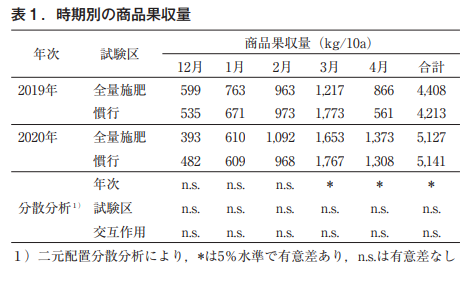
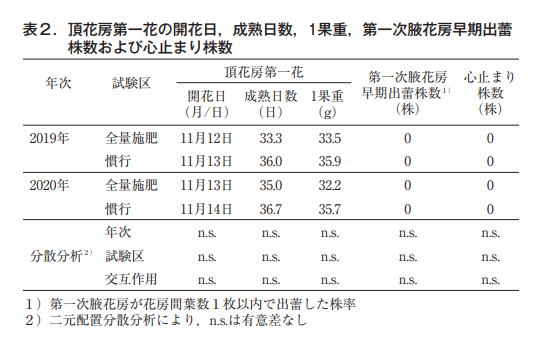
Product yields at different times of the year are shown in Table 1. There were no differences in the commercial fruit yields among the test sections at any time of the year. Flowering date, days to maturity, one-fruit weight, number of early budding plants of the first axillary flower, and number of heart stopping plants of the first flower of the apical bunch are shown in Table 2. No differences were observed between the two test sections. In both years, no early budding or dead center plants of the first axillary flower cluster were observed in both locations.
(5) Cost estimates for different fertilization methods during seedling growth
全量施肥区の資材費は,肥料費 5,100円に鉢物用定量施肥器の年間償却費 2,100円(商品価格15,000円を耐用年数7年として算出)を加えた7,200円であった。慣行区の資材費は肥料費の4,400円であっ(データ略)。全量施肥区の資材費は慣行区に比べて2,800円高かった。一方,10a当たりの施肥作業時間は,全量施肥区では4.7時間(施肥回数1回)となり,慣行区の18.7時間(施肥回数4回)に比べて14時間削減された(データ略)。この施肥作業時間から算出した労賃(1時間当たり自家労働評価額1,460円;福岡県農林水産部調べ)は,全量施肥区では6,900円,慣行区では27,300円で,全量施肥区は慣行区に比べて20,400円安かった。
The total cost of materials plus labor was estimated to be 14,100 yen for the total fertilizer application area and 31,700 yen for the conventional area, a reduction of 17,600 yen for the total fertilizer application area compared to the conventional area.
Consideration
イチゴは晩夏から初秋にかけて平均気温が25℃付近まで下がると,短くなった日長に反応して花芽分化するようになる(本田 1977)。しかし,育苗培土中の窒素含量が多いと,自然日長で短日条件となっても花芽分化が遅れる(泰松・木村 1981)。このため,適量の窒素を与えて充実した苗をつくる育苗前半と,窒素中断によって花芽分化を誘導させる育苗後半とで,異なる肥培管理を行う必要がある。
本試験において,育苗培土中の硝酸態窒素含量は,全量施肥区では慣行区に比べて7月上旬に13~25mg/100g乾土多いが,8月下旬以降に差は認められず3mg/100g乾土以下で推移した。この結果から,育苗前半の7月上旬には全量施肥区では慣行区に比べてより多くの窒素が苗に供給され,育苗後半の8月下旬以降は慣行区と同程度の窒素が供給されたと考えられた。育苗後半の肥培管理では,花芽分化を順調に誘導するために8月中旬から窒素供給を中断し,体内窒素濃度の目安となる葉柄中硝酸イオン濃度を100ppm以下にすることが重要である(森下 2014)。
On the other hand, it has been reported that flower bud differentiation and development are rather suppressed when extremely low nitrogen conditions are applied from around early September (Yoshida et al. 2002). In addition, when the nitrate ion concentration in petioles at the planting stage falls below 10 ppm, early budding of the first axillary flower cluster and heart-stopping plants are likely to occur (Takeuchi and Sasaki 2008). Therefore, it is considered necessary to maintain the nitrate ion concentration in petioles in the range of 10 to 100 ppm from mid-August to late September to avoid reducing the nitrogen concentration in the body too much in the latter half of seedling growth.
本試験において,全量施肥区の葉柄中硝酸イオン濃度は,2カ年とも7月下旬に1,000ppm以上であったが,8月中旬以降は慣行区と比べて同程度か低く,40~50ppm程度で推移した。また全量施肥区では,定植期に花芽分化の遅延は認められず,定植後に早期出蕾株や心止まり株は発生しなかった。これらの結果から,「あまおう」では,葉柄中硝酸イオン濃度が7月下旬に1,000~1,300ppmであっても,8月中旬以降に40~50ppm程度に管理すれば花芽分化は遅延せず,9月20~25日ごろに花芽分化を誘導できると考えられた。
However, the coated fertilizer used in the total fertilizer application is designed to accelerate nitrogen leaching under high temperature conditions (Gunjikake 2020); therefore, when temperatures in June to August are higher than normal, nitrogen leaching is accelerated in the total fertilizer application method, and there is concern that nitrogen may become insufficient in the latter half of seedling growth. In such cases, it is necessary to pay attention to prevent the nitrate ion concentration in petioles from decreasing too much in the latter half of seedling growth, for example, by using liquid fertilizer to add fertilizer.
定植時の苗の大きさや栄養状態は定植後の収量に影響するため,「あまおう」では定植期にクラウン径8.5~10mm程度で,葉柄が短く徒長していない苗の育成を目標にしている(福岡県園芸振興推進会議 2006)。本試験の全量施肥区の苗は,9月下旬の定植期に慣行区と同等の苗質となり,クラウン径は10~11mmであった。また,定植後の調査では,全量施肥区では慣行区と比較して,頂花房第一花の開花日や定植後の収量に差が認められなかった。
これらの結果から,被覆肥料を用いる全量施肥法で「あまおう」を育苗した場合,定植期の9月下旬には慣行と同等の苗質となり,頂花房第一花の開花日や定植後の収量は同等となることが明らかとなった。
We estimated the cost of different fertilizer application methods during the seedling stage, taking into account the cost of materials and labor. As a result, the total cost per 10a was estimated to be 17,600 yen lower than that of the conventional method, because the total cost per 10a was reduced by the labor-saving fertilizer application, although the cost of materials increased with the introduction of the fertilizer applicator in the total fertilizer application area. In other words, in the total fertilizer application method, the increase in material costs was more than offset by the decrease in labor costs due to labor-saving fertilizer application.
In conclusion, it is clear that the total application method of coated fertilizer using a metered-quantity fertilizer applicator for potted plants in raising strawberry "Amao" seedlings can produce seedling quality and yield comparable to those of conventional cultivation, and can save labor for fertilizer application.
References
●郡司掛則昭(2020)鉢もの花き栽培における緩効性肥料による省力施肥.農業と科学 726:9-11
●本田藤雄(1977)生理・生態からみたイチゴの栽培技術.誠文堂新光社.東京.p136-140
●福岡県園芸振興推進会議(2006)平成18年度版「あまおう栽培の手引き.3育苗管理.福岡県,p13-27
●福岡県農林水産部経営技術支援課(2020)主要野菜の栽培技術指針(第11版).p17-22
●森下昌三(2014)イチゴの基礎知識 生態と栽培技術.誠文堂新光社.東京.p157-162
●泰松恒男・木村雅行(1981)イチゴ宝交早生の促成栽培における苗質と開花,収穫パターンについて.奈良県農試研報12:30-42
●竹内 隆・佐々木麻衣(2008)イチゴ‘紅ほっぺ’の育苗方法が生育と収量に及ぼす影響.静岡農試研報1:1-10
●植松徳雄(1998)イチゴ栽培の理論と実際.誠文堂新光社.東京.p40 -44
●吉田裕一・森本由香里・大井美知男(2002)トレイ育苗したイチゴ品種の花芽分化に及ぼす気温と窒素栄養の影響.園学雑71別2:372
No Soil - No. 24 Soil is a Product of the Environment
-風化と生物の作用が岩石から土をつくる
前 ジェイカムアグリ株式会社
北海道支店 技術顧問
松中 照夫
About 600 million years ago, 4 billion years after the birth of the earth 4.6 billion years ago, something like soil (early soil) was formed, and about 300 million years ago, the soil we imagine was formed on the earth. In the last issue, I told you the story of the formation of soil. This time, I would like to talk about how soil is created by the environment.
1. change in perception of soil
Until the 19th century, soil was considered to be nothing more than a soft, weathered rocky surface layer of the earth's crust. Dokuchaev (1846-1903), a young Russian geologist who later became known as the founder of soil science, changed this view to one in which soil is created by the environment.
He believed that soil is formed by the interaction of various factors such as rocks, which are the raw materials of soil, climate, plants and animals, and topography, and that the formed soil changes with time. He also argued that soil, like animals and plants, is one of the components of nature and that soil is a product of the environment. Let us look at this idea in detail below.
2. two factors that create soil - weathering and biological action
わが国では,火山灰を原料とする土(黒ボク土)が広く分布している。しかし,世界的にみると黒ボク土は例外的な土で,一般的な土の原料は岩石である。この原料となる岩石を母岩という。その母岩から土ができるには,岩石が細かく砕かれる作用(風化)と,その砕かれた岩石に生物が働きかけて土をつくりあげていく作用の二つが必要である(図1)。
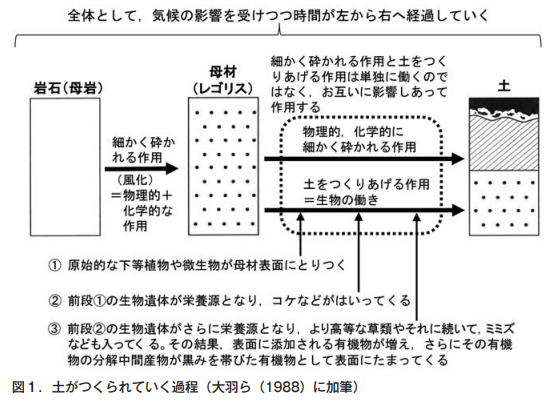
The first step in the formation of soil is for lichens and microorganisms, as described in last month's issue, to attach themselves to the surface of a material that has been broken into small pieces by weathering (this is called the parent material of soil). When they die after completing their lives, their remains are decomposed by other microorganisms. The decomposition products become plant nutrients. As these nutrients accumulate, an environment is created in which plants can live, and higher plants, such as mosses and grasses, invade. When mosses and grasses enter, their remains are decomposed by microorganisms and nutrients increase further. Then, soil animals (earthworms, etc.) can live there.
Soil animals live and die by feeding on the organic matter that has accumulated in the matrix as decomposition products of plant remains. As a result, the surface of the parent material becomes richer in nutrients. In this way, higher plants are able to live. As the higher plants die and are replaced by dead bodies, a black-colored layer of soil with a mixture of organic matter and the parent material gradually forms on the surface of the parent material.
The action that creates soil in this way is the result of the action of living organisms on the parent material. No matter how much a rock is weathered and crushed into small pieces, soil cannot be created without the presence and action of living organisms.
3. the function of soil-building organisms is affected by the environment
The workings of the organisms that make up the soil are closely linked to the environment. This is because the types of organisms and their activity are greatly influenced by the climate.
In cold regions at high latitudes, the amount of organic matter added to the soil is low because plant growth is poor. However, because of the cold weather, decomposition of organic matter by microorganisms does not progress, and organic matter accumulates, resulting in dark soil with a darker color, as indicated by the organic matter. On the other hand, in low-latitude tropical rainforest areas, the amount of organic matter added to the soil is much higher than in colder regions because of vigorous plant growth. However, because of the higher temperatures, the decomposition of organic matter by microorganisms is faster, and organic matter is less likely to accumulate in the soil. Therefore, the soil in this region does not darken, and a reddish-brown color is produced.
土ができ,変化するのは,与えられた環境条件の範囲の中であって,勝手気ままに土ができるのではない。だからこそドクチャーエフは,「土は環境の産物である」と表現し,「土は,何らかの機械的な,偶然的な,生命のない混合物ではなく,逆に,独立した一定の法則により決定され,支配される博物学的形成物(歴史的自然体)である」といい切っている。すなわち,一定の環境条件が与えられると,母材が同じなら同じ土ができあがる。しかし,母材が同じであっても,環境条件がちがうとできあがる土はちがってくる。まさに環境が土をつくるのだ。
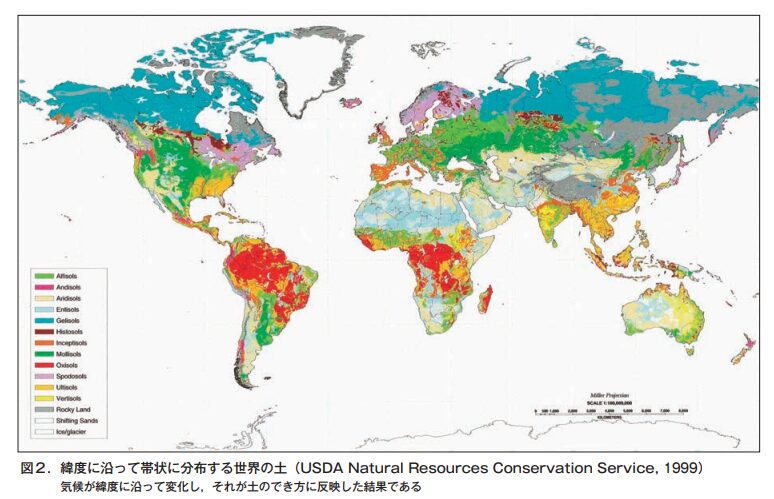
Looking at the world's soil again (Figure 2), it appears that soil is distributed in a band along the latitude of the earth.
This is because the climate varies greatly with latitude, and the soil is formed by the different actions of organisms in response to these changes.
From a macroscopic viewpoint, we can realize that "soil is a product of the environment," as Dokuchaev pointed out.
The moon is devoid of life. Therefore, the biological processes necessary to create soil do not work. Therefore, there are rocks on the moon, but no soil. Because the earth is at a perfect distance from the sun, the atmosphere and water can exist, and organisms were born. Thanks to the work of these organisms, soil was created and agriculture began.