

Site Search
Search within product
第746号 2022(R04).12発行
Click here for PDF version
§ Environmentally friendly spinach cultivation methods (Part 2)
Former Toyama Prefectural Agricultural Technology Center
松本 美枝子
§早期栽培水稲‘コシヒカリ’における被膜崩壊性改良型緩効性肥料の施肥効果
Kochi Agricultural Technology Center
Crops and Horticulture Division, Paddy Crops
研究員 武田 俊也
No § Soil - Part 17
植物が水と養分を吸収するしくみ
-Absorb necessary substances and eliminate unnecessary ones.
Jcam Agri Co.
北海道支店 技術顧問
松中 照夫
§2022 General Table of Previous Editions of this Journal
Environmentally Friendly Spinach Cultivation Method (Part 2)
Former Toyama Prefectural Agricultural Technology Center
松本 美枝子
3. good use of solar thermal effects
Introduction.
Irrigation is important in the hot season cultivation of soft vegetables, but insufficient irrigation delays growth, while too much irrigation can lead to disease outbreaks caused by Pythium, Rhizoctonia, and Fusarium. Chemical treatment is considered necessary to stabilize production during high temperatures (summer), and soil disinfection using solar heat is also effective. We investigated a more effective method of disinfection by solar heat treatment.
Processing and research methods
ハウス内に畦を立てた後,十分潅水し,外壁(膜)を密閉し,畦面もビニルで完全に密閉する。播種直前に,外気温,室温と同時に,地下5cm,10cm,15cm,20cmに温度センサーを埋め込み,自記温度計で温度を測定した。また播種30日後に,出芽した雑草の種類及び数を調査した。
Results and Discussion
夏播きホウレンソウでは,播種後15日頃まで(特に出芽揃い期)はリゾクトニアやピシウムに,15日以降はフザリウムに侵されやすく,収量が減少する。リゾクトニアは45℃で12時間,ピシウムは24時間,フザリウムは60時間処理すれば死滅するとされている。このことが太陽熱利用の有効性を示す根拠である。なお,ホウレンソウの根の表皮構造は,発芽から本葉3枚展葉期まで比較的軟らかいため土壌病原菌に罹病しやすいことも考慮する。
太陽熱消毒方法は,ハウスをビニルで密閉し,地表面もビニルで被覆するものである。日射量が5MJで,温度45℃を確保するためには, 地下5cmで外気温27℃以上が,地下10cmで外気温30℃以上が,地下15cmで外気温34℃以上が必要である。
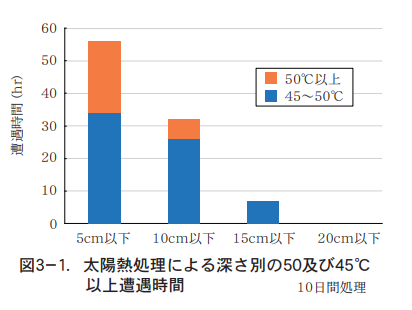
そこで,リゾクトニア及びピシウムの発生が問題となっている試験圃場Aにおいて太陽熱処理を行った。処理期間は10日で,45℃を経過したのは,地表面下5cmで56時間,10cmで32時間,15cmで7時間であった。
フザリウムが多発する試験圃場Bにおいて,耕起(12cm)区及び不耕起区を設け,表層に播種及び施肥した場合,不耕起では病害及び雑草の発生は著しく抑制されたが,耕起した場合,効果は消失した。また,試験圃場Bで30日間処理すると,45℃を経過した時間は,地表面下5cmでは130時間,10cmでは60時間,15cmでは15時間程度であった。この場合,初年度(前年度臭化メチル処理)は効果が認められたが,2年目は生育後半になりハウス周辺から萎凋が始まった。なお,同圃場でクロルピクリン消毒した区では,萎凋は全く認められなかった。
以上,前号(農業と科学11月号)で述べた結果と併せて要約すると,牛糞堆肥連用圃場では,有機物,土壌改良資材及び化成肥料を施用する必要はなく,LP30(0.9kg/10a)の局所施肥により窒素だけを供給すればよい(テープ封入肥料)。また,毎年行っている薬剤による土壌消毒は,2年に1度は太陽熱による消毒で代替えできる。
一方,乾燥鶏糞連用圃場では,有機物,土壌改良資材及び化成肥料の施用を止め,牛糞堆肥2t/10a/年により腐植を補給し,さらにLP30(2.7kg/10a)の局所施肥により窒素を補給する(テープ封入肥料)。また,土壌病害対策として,フザリウム菌密度の低い圃場では毎年,高い圃場では薬剤消毒と太陽熱消毒を交互に行うことによって生産が安定する。
This method increases the number of plantings because the application of organic matter and soil amendments can be reduced between cropping types. In addition, the fertilizer nitrogen utilization rate is improved, resulting in lower soil EC, among other benefits.
施設ホウレンソウの高温期栽培は,ピシウム及びリゾクトニア,フザリウム等による病害が発生しやすいので,太陽熱による土壌消毒が有効である。これらの処理効果は地表面から深さ5cmで効果が大きく,15cm程度が限界とされるため,耕起により効果を持続させることはできない。すなわち,各作付け前に肥料及び土壌改良資材と土を混和するため,17cm程度の土がロータリーでかき混ぜられ,下層の未消毒土壌や発芽可能な雑草種子が表面近くに持ち上げられると消毒効果が消失する。
Since Fusarium is killed by exposure to 45°C for 60 hours, the treatment period should be determined by checking the soil temperature. If the wilt is pronounced, the use of a chemical (chloropicrin) in combination with Fusarium fusarium should be considered.
夏場であれば1週間程度の処理であっても45℃で60時間(地下5cm)の処理効果が得られることもある。また,2作目開始前であっても,畦表面を軽く均し,十分に潅水した後にビニル被覆しハウスを密閉して2〜3日処理(短期間の太陽熱処理)することにより表面のリゾクトニアやピシウムが死滅するだけでなく,土壌中の昆虫殺卵効果も認められる。
4. rational cultivation method of spinach
これまでの試験の結果,有機物は肥料成分の供給源及び土壌物理性改善用資材として優れているが,作物が必要とする肥料成分バランスと有機物の肥料成分バランスに違いがあるため,土壌中に蓄積した肥料成分バランスにも乱れが生じる。そのため,2〜3年に一度は土壌分析を行い,前号の表1−3に示した基準値を参考に,不足成分は施用し,過剰成分は養分バランスの乱れがあった場合は施用を控えた方がよいと考えられた。
窒素は作物の吸収量が多く,降雨による流亡も多いので,毎作一定量施用する必要がある。その場合の窒素肥料として,ホウレンソウの窒素吸収特性に近い溶出を示す被覆尿素(LP30)を水溶性テープに封入し,種子の近辺に(深さ3cm程度)に埋め込むことにより,窒素利用率を慣行の3倍程度に高めることができた。しかし,ホウレンソウの施肥,耕起,畦立て作業は,重労働でも長時間労働でもないが,次の作付け迄,半月から1カ月が経過することも見受けられた。
On the other hand, the use of solar heat has been shown to be effective in controlling major diseases of spinach, including fungicide temperature and time, and has also been shown to be effective in weed control.
Here, we decided to examine more effective and labor-saving fertilization and soil disinfection methods.
Introduction of no-till cultivation
In recent years, no-tillage cultivation of various crops has been reported to investigate their growth and changes in soil physical properties. Kaneda et al. reported that no-till cultivation of rice in heavy clay soil (reclaimed land at Hachiro Lagoon) resulted in better drainage than tillage cultivation because the subsoil structure was more developed. In addition, in order to maintain the effect of soil disinfection in highland Chinese cabbage and lettuce cultivation in Nagano Prefecture, Japan, a second crop of seedlings was planted without tillage by mulching the entire surface, and the seedlings were grown in a stable manner.
The yield of the plant was about 1.5 times higher than the previous year.
The above mentioned facts show that no-till cultivation is possible without losing the disinfection effect of soil tillage by encapsulating fertilizer (LP30) and seeds in seed tapes that match the nitrogen absorption pattern of spinach, and that delays in fertilization, tillage, and foot-building can be avoided, and as a result, the foot-building surface due to soil shrinkage in the summer can be securely recognized and the effects of soil disinfection and weed control can be recognized and sustained. As a result, cracks on the surface of the ridge caused by soil shrinkage in summer can be eliminated, and the effects of soil disinfection and weed control can be recognized reliably and sustained.
[Example of rational spinach cultivation
① 施設ホウレンソウのスタートは夏場(温度の高い時期)とし,あらかじめ土壌分析を行う。仕事量に応じて,播種時期を検討する(段播き方法を考慮する)。
(2) Apply organic matter and fertilizers as necessary according to the results of soil analysis and tillage.
(iii) Establish a footing and irrigate well.
④ ハウスの外壁及び畦面を密閉し,15日程度太陽熱消毒を行う。地温は表層(5cm)が最も高く,殺菌効果も大きいが,深くなるほど効果は劣る(図3−1)。
⑤ 耕起せずにテープ状の種子及び肥料をシーダーマシンで地下3cm程度に埋設する。地表面に近いほど,太陽熱消毒の効果が大きいので,不耕起土壌にシーダーマシンで種子と肥料を埋設する方法は極めて有効である。シードテープ法のテープには水溶性素材(ホセトン)と微生物分解素材(メッシュロン)とがあり,前者は水に浸けるとすぐに溶けるが,後者は溶けない。したがって,メッシュロンテープに種子とLP30を封入した場合,水に浸漬し吸水させた後,30℃程度に加温することにより催芽処理が可能である。
(6) During the growing period, check soil moisture (irrigation), pests and weeds, and take actions as necessary.
⑦ 収穫は葉長20㎝程度から開始する。収穫の能率を高め生育を均一にするため5cm刻みに種子を播種(封入)する。
〜〜〜〜〜〜〜〜〜 one work completed
⑧ 二作目,三作目,四作目の播種前に雑草が出ていたら軽く除草し,再び⑤,⑥,⑦の順で作業を行う。
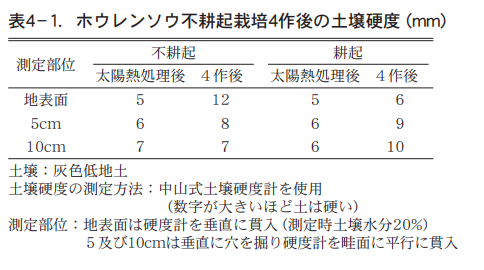
After one crop, three more crops were grown in no-tillage to investigate changes in soil hardness at the surface and below (in the root zone area).
その結果,1作後は両者ともに耕起後よりも硬くなり,その程度は地下10cmよりも顕著であった。しかし,2作後,3作後,4作後とさらに硬くなることはなく,表土よりも地下10cmのほうが柔らかい傾向にも変化は認められず,根及び地上部の生育が劣ることはなかった(表4−1)。また,春から栽培を開始した場合,表層の土がしまっていることから,次作(夏作)の畦表面に亀裂が生ずることはなかった。
Introduction of no-till cultivation
Since fertilizer is applied before sowing, the accumulation of fertilizer components in the soil tends to increase and the balance of components is easily disturbed if the number of plantings of spinach in a facility is too frequent. Therefore, the soil should be checked once every two to three years, and if there is a deficiency, the component should be replaced, but if there is an excess and the component balance is disturbed, it should not be replaced.
The appropriate time to start anniversary cultivation is mid-July to mid-August, when solar disinfection is more likely to be effective.
Actual cultivation repeats steps (4), (5), and (6).
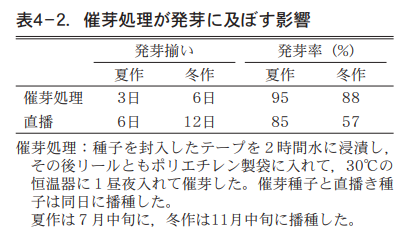
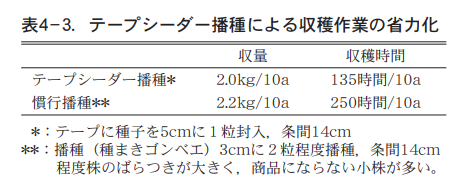
シードテープに封入された種子とLP30を土壌に埋設した後,十分な潅水を行い,その後は通常の管理を行って草丈20cm以上で収穫する。なお,収穫作業を効率よく行うには,栽植密度が適正で,発芽率及び株立率を限りなく100%に近くするため,シーダーマシンを使い,吸水及び催芽処理を行い,効率的に播種し,効率的に収穫するのがよい。ここでは,種子及びLP30をシードテープのメッシュロンテープ(すぐに水に溶けない)に封入し,吸水・催芽処理することを提案する。本方法は,低温や乾燥により出芽促進及び発芽揃いの向上や生育期間の短縮だけでなく,収穫作業の省力化にもつながる(表4−2,表4−3)。
If the surface soil is hard due to no-tillage and cannot be uniformly buried in the soil with the tape seeder, a plow specially designed for this machine can be installed to improve the accuracy of the operation.
以上のことから,ホウレンソウの窒素吸収に合った被覆尿素(LP30)と種子をシードテープに封入し,地下3cm程度に埋設することにより,有機物(特に牛糞堆肥)の肥料成分を効率よく利用することができ,窒素施肥量を著しく少なくすることができる。また,不耕起栽培により,太陽熱による土壌消毒及び雑草防除効果が十分に得られ,省力化及び作業時間の短縮が図られる。
The same effect as seed tape can be obtained by using a vacuum seeding machine.
References
●福井県,新潟県,富山県,石川県 地域重要新技術開発促進事業研究成果 生態系活用型農業における生産安定技術 福井県農業試験場 (1993)
●北海道立中央農業試験場 農芸化学部 土壌肥料科
短期太陽熱土壌消毒による露地ホウレンソウ立枯病・根腐病の軽減対策 土壌肥料科試験成績(1989)
●松本美枝子 施設ホウレンソウにおける窒素の合理的施肥方法 農業技術53(10)447−451(1998)
●宮元史登 生態系を活用した野菜の持続的安定生産技術の確立 太陽熱の効率的利用技術富山県農業技術センター 野菜試験成績書(1996)
●新潟県,富山県,石川県 地域重要新技術開発促進事業研究成果 北陸における野菜の持続的安定生産技術体系の確立 新潟農業総合研究所(1999)
●庄子貞夫監修 秋田県大潟村で実践する新しい水田農法 秋田県農業試験場大潟農場(2001)
●東京近郊野菜技術研究会編 軟弱野菜の新技術農耕と園芸 6月号別冊(1997)
Early Cultivated Rice 'Koshihikari' in
被膜崩壊性改良型緩効性肥料の施肥効果
Kochi Agricultural Technology Center
Crops and Horticulture Division, Paddy Crops
研究員 武田 俊也
Introduction
In paddy rice cultivation in Kochi Prefecture, slow-release fertilizers are widely used, in which fertilizer is coated with resin to control nitrogen leaching. However, this slow-release fertilizer has an environmental impact problem, because the residue of the film shells after leaching is likely to flow out of the paddy fields into rivers and the sea.
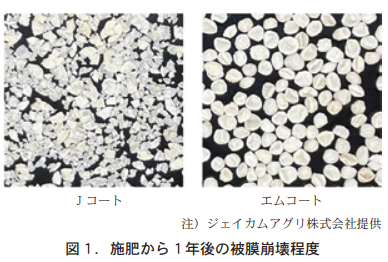
Recently, a new, easily collapsible film has been developed, and J-Coat, a slow-release fertilizer coated with this film, is expected to contribute to early collapse in the paddy field (Figure 1) and to prevent runoff from the paddy field by inhibiting surfacing during rice paddling. However, J-Coat tends to leach fertilizer nitrogen slightly faster than the conventional fertilizer, Emcoat 777, and there is concern that there may be a difference in fertilizer application effectiveness between these fertilizers.
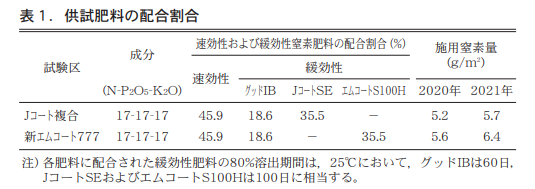
そこで,2020年と2021年に,新エムコート777を施用した場合と,このエムコートをJコートに替えた肥料(表1,以下,Jコート複合)を施用した場合の‘コシヒカリ’の生育,収量および品質を比較し,Jコート複合の施肥効果を検討した。
2. materials and methods
(1) Testing Method
試験は高知県農業技術センター(高知県南国市廿枝)の水田ほ場で行った。供試品種は‘コシヒカリ’とした。供試肥料はJコート複合と新エムコート777である(表1)。 施肥方法は側条施肥とし,実際の窒素施用量は,2020年ではJコート複合5.2g/㎡,新エムコート777 5.6g/㎡,2021年ではJコート複合5.7g/㎡,新エムコート777 6.4g/㎡であった(表1)。両年とも4月7日に栽植密度18.5株/㎡で機械移植した。
(2) Survey Method
2020年には5月25日から,2021年には5月13日から,いずれも最高分げつ期頃まで約7日おきに草丈,茎数,葉色(SPAD値)を調査した。なお,2020年は各区10株,2反復,2021年は各区20株,2反復とした。また,2ヶ年とも成熟期の稈長,穂長,穂数,葉色(SPAD値)ならびに精玄米重,玄米千粒重,整粒粒比(穀粒判別器RGQI10A),玄米タンパク質含有率(近赤外分析計 NIRFlex N−500) を各区20株,3反復で調査した。
Results and Discussion
(1) Year 2020
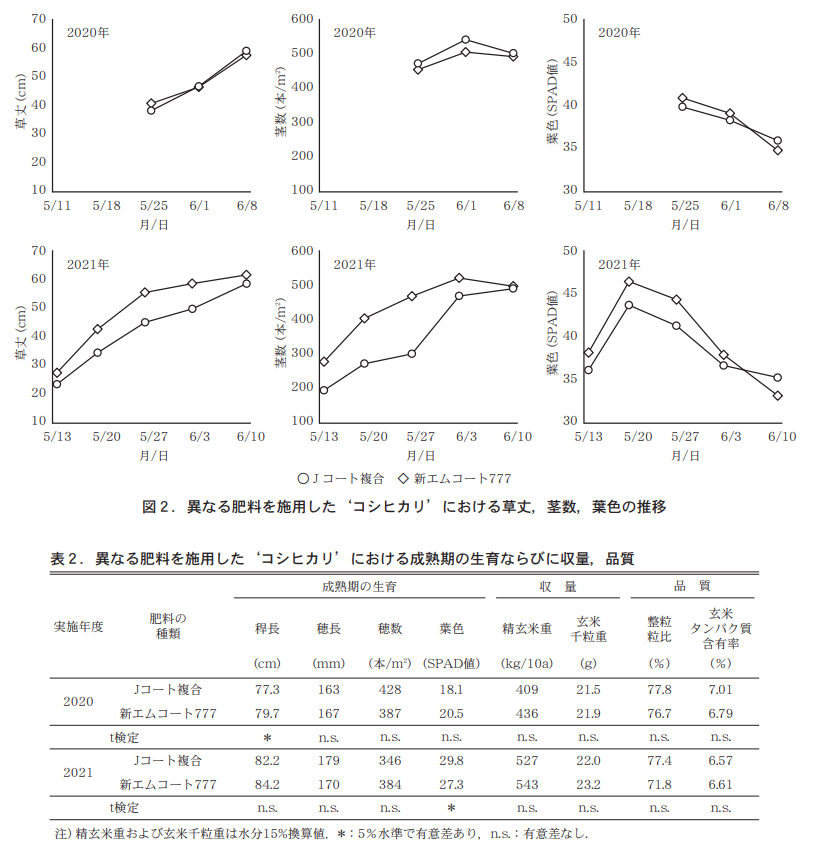
両区の草丈,茎数,葉色(SPAD値)は,移後から6月8日まで同程度で推移した(図2)。
成熟期において,新エムコート777区に比べ,Jコート複合区で稈長が短かったものの,穂長,穂数,葉色(SPAD値),精玄米重,玄米千粒重,整粒粒比,玄米タンパク質含有率には肥料の種類による有意な差は認められなかった(表2)。
2) Year 2021
新エムコート777区に比べ,Jコート複合区では,草丈は移植以降6月2日まで短く,茎数は5月26日まで少なく推移した(図2)。また,葉色(SPAD値)は移植後から6月2日までやや低く推移した(図2)。成熟期において,新エムコート777区に比べ,Jコート複合区では葉色(SPAD値)は高かったものの,稈長,穂長,穂数,精玄米重,玄米千粒重,整粒粒比,玄米タンパク質含有率には肥料の種類による有意な差は認められなかった(表2)。
These results indicate that in the early cultivation of 'Koshihikari', there were no differences in yield and quality between J-coat composite and new M-coat 777, although there were differences in plant height, number of stems, and leaf color (SPAD value) up to the maximum tillering stage and in culm length and leaf color (SPAD value) at maturity between the two cultivars. However, there were no differences in yield and quality. It is necessary to study the effect of J-Coat on fertilizer application in normal-season cultivation, which has different climatic conditions from early-season cultivation.
No Soil - Part 17
植物が水と養分を吸収するしくみ
-Absorb necessary substances and eliminate unnecessary ones.
Jcam Agri Co.
北海道支店 技術顧問
松中 照夫
Plants absorb water and nutrients through their roots. However, the mechanism is not as simple as taking in substances dissolved in soil water (soil solution) into the roots at the same time as the solution.
1. plant cells surrounded by cell membrane and cell wall
植物の細胞は,細胞膜で囲まれ,細胞膜は細胞壁で包まれている(図1)。
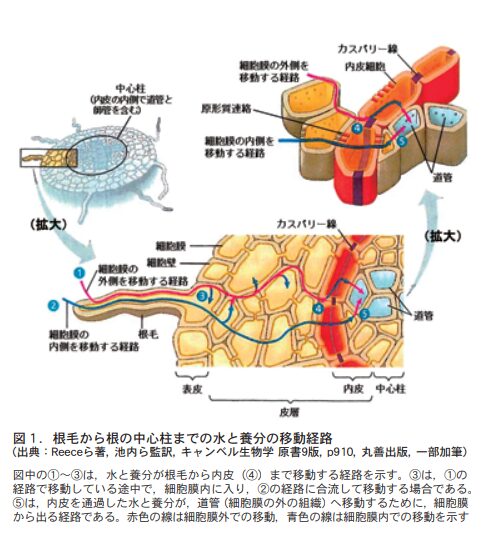
The cell wall is a colander-like mesh structure, through which water (in this case, pure H2O as a solvent for dissolving substances in the soil solution) as well as nutrient ions and many other substances dissolved in the soil solution can freely pass. ), as well as nutrient ions and many other substances dissolved in the soil solution. Substances that have passed through the cell wall ride the flow of water in the plant body created by leaf transpiration and reach the endodermis surrounding the central column of the root (Fig. 1, (4), where cells are connected one by one to form a ring). This is the migration path shown in Fig. 1 (i). Up to this point, the water and nutrient ions have not yet entered the inner cell membrane.
2. the last barrier to entry into the cell membrane - the caspary line
内皮の細胞壁は,カスパリー線という組織でリボンをかけたように帯状に囲まれている(図1)。図1の①の経路で,細胞壁を通過してきた水や養分イオンは,このカスパリー線に到着しても,ここでせき止められて中心柱へ移動できない。カスパリー線は,木材の主成分リグニンや脂質の一種スベリンが蓄積してできており,物質を自由に通過させないからである。
①の経路とは別に,水や養分イオンが,いきなり根毛の細胞膜を通過し,細胞の中を移動する経路もある(図1の②の経路)。この場合は,最初に通過しようとした細胞膜で膜の内側に入ることが許されるかどうかが判別される。そこで膜内に入ることが許された物質だけが,細胞膜を通過する。隣り合う細胞へは原形質連絡という細胞同士の溝を通過する。この経路では,最初に細胞膜の中に入っているので,内皮細胞も通過して,中心柱の道管の側まで移動できる。
The problem is how it is allowed to enter the plasma membrane when it attempts to pass through the endothelial cell caspary line in pathway (1) and when it first passes through the plasma membrane in pathway (2), respectively.
3. cell membrane function and water absorption
-Osmotic pressure and transport proteins (aquaporins)
細胞膜は,親水基と疎水基の二つの部分で構成されるリン脂質が,疎水基を隣り合わせるようにして二重層になってできている(図2)。図にあるように,膜を貫通するタンパク質があり,これらを含めて細胞膜が構成されている。この細胞膜を貫通するタンパク質は輸送タンパク質といわれ,細胞膜での物質輸送に大きな役割をはたす。
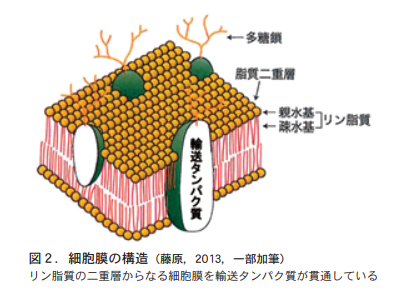
Since the plasma membrane holds a variety of intracellular substances, the concentration of substances is generally high inside the plasma membrane and low outside the membrane. If the cell membrane is a totally permeable membrane, such as the cell wall, which allows all substances to pass through, nutrient ions would normally be released from the inside of the cell, where the concentration is high, to the outside of the membrane, where the concentration is low, by diffusion through a concentration gradient. This makes the nutrient ions unavailable as nutrients. For this reason, the cell membrane is a semipermeable membrane that allows the solvent water to pass through, but not the solute nutrient ions or other substances. At this time, water enters and is absorbed by the highly concentrated inner side of the cell membrane to eliminate the difference in concentration between the inside and outside of the cell membrane. The pressure generated by this difference in concentration between the inside and outside of the semipermeable membrane is osmotic pressure.
ところが,浸透圧だけの水の移動速度は遅く,植物の水要求を十分に満たせない。それを補う水の輸送タンパク質がアクアポリン(水チャネルともいう)で,水の輸送速度は非常に速い。多くの植物細胞では,アクアポリンによって水の輸送速度が10倍以上高まる(平沢,2016)。植物が土壌溶液から水を吸収するのは,主にアクアポリンの働きである。
4. How nutrients cross the cell membrane - active transport by transport proteins
Transport proteins are also responsible for the entry of nutrient ions dissolved in the soil solution into the plasma membrane. Nutrient ions, which are solutes in the soil solution, cannot pass through the cell membrane, which is a semipermeable membrane. Moreover, since there is a concentration gradient between the inside and outside of the plasma membrane, nutrient ions must enter the plasma membrane against the concentration gradient in order to be absorbed. This is made possible by the function of transport proteins that penetrate the plasma membrane.
These transport proteins do not freely transport any substance, but have their own specific transport partners. As already mentioned, water is transported by aquaporin, a water-specific transport protein. Ammonium ions, the nutrient ions of nitrogen, have a transport protein (ammonium ion transporter) that is responsible for their passage through the membrane. Plants are able to selectively take up only the nutrient ions they need from a soil solution containing various substances (selective absorption) because each transport protein has the property of transporting its own counterpart. At this time, there are also transport proteins that generate energy to transport nutrient ions from the outside to the inside of the membrane against the concentration gradient (active transport).
Thus, plants skillfully selectively absorb only water and nutrient ions from substances dissolved in the soil solution around their roots, eliminating unwanted substances.
5. the final step in nutrient absorption is transfer to the ducts
Absorbed water and nutrient ions do not remain in the root cells. The absorbed water and nutrient ions are transferred to the various parts of the plant body, such as the stem and leaves. This is done through ducts. Since ducts are pipes for transport, they are the outer tissues of the plasma membrane and consist mainly of cell walls.
このため,内皮細胞内に入った水や養分イオンは,再び,細胞膜外へ出て道管に移動する必要がある(図1の⑤の移動)。この役割を果たす輸送タンパク質は,細胞膜内に入るために利用した輸送タンパク質ではなく,別の輸送タンパク質であることが多い。
Thus, water and nutrient ions that reach the ducts move to the plant organs where they are needed, where they are used as nutrients and converted into substances that nourish the plant.
General Index of Previous Editions of this Journal in 2022
<1月号>
§ Responsibility of fertilizer manufacturers to contribute to agriculture
ジェイカムアグリ株式会社 常務執行役員 勝呂 俊行
§ Sakai Farm built by our predecessors (No.3)
〜120年の歴史−成績書から振り返る
品種・肥料等の変遷〜
JA福井県 坂井農場
前農場長 長谷川 彰
No § Soil - No. 8
Conditions for Good Soil Chemical Properties - Part 3
適度に含まれる作物の養分
ジェイカムアグリ株式会社 北海道支店
技術顧問 松中 照夫
<2月・3月合併号>
§Experience high-yield technology using a combination of side-row fertilizer application and seedling box placement.
ジェイカムアグリ株式会社 東北支店
技術顧問 上野 正夫
No § Soil - No. 9
Conditions for Good Soil Chemical Properties - Part 4
土が養分を保持するしくみ
ジェイカムアグリ株式会社 北海道支店
技術顧問 松中 照夫
<4月号>
§スマート農業連動土づくり・次世代型基肥一発可変施肥体系による主食用米の多収技術の開発
株式会社ファーム・フロンティア 取締役会長
山形大学農学部 客員教授 藤井 弘志
No § Soil - No. 10
Summary of Good Soil Conditions
−どんな土でも必ずよくなる−
ジェイカムアグリ株式会社 北海道支店
技術顧問 松中 照夫
<5月号>
§茶園の施肥効率向上と省力のための条施肥技術の確立
静岡県農林技術研究所
茶業研究センター 茶環境適応技術科
研究員 小野 嵩知
§二条大麦における肥効調節型肥料を用いた全量基肥播種溝施肥法
大分県農林水産研究指導センター
農業研究部 水田農業グループ 清田 梨華
No § Soil - No.11
Compost emerged as a nutrient transfer material.
−養分の補給方法を考える−
ジェイカムアグリ株式会社 北海道支店
技術顧問 松中 照夫
<6月号>
§ Nutrient water absorption and its transfer between day and night in tomatoes
元 岡山大学大学院 自然科学研究科 桝田 正治
No § Soil - No.12
Manure Effectiveness and Soil Conditions
−土の黒さが決め手−
ジェイカムアグリ株式会社 北海道支店
技術顧問 松中 照夫
<7月号>
§肥効調節型肥料を利用したシクラメンの省力栽培技術
長野県野菜花き試験場 花き部 森野 林太郎
No § Soil - No.13
Types of Organic Substance Materials and Their Effects
−C/N比が要点−
ジェイカムアグリ株式会社 北海道支店
技術顧問 松中 照夫
<8月・9月合併号>
§露地夏秋どりねぎにおける被覆燐硝安とリン酸質肥料のチェーンポット内施肥技術
地方独立行政法人 北海道立総合研究機構
農業研究本部 道南農業試験場
研究部 生産技術グループ
主任主査(栽培環境) 大橋 優二
§上益城地域における農協営農活動の変遷と私の出合
農事組合法人 かしま広域農場 工藤 健一
No § Soil - No. 14
Era of change in nutrient source from compost to chemical fertilizer
−その歴史的経緯−
ジェイカムアグリ株式会社 北海道支店
技術顧問 松中 照夫
<10月号>
§被覆肥料に由来するマイクロプラスチックの生態リスクと排出量
農研機構農業環境研究部門 上級研究員 永井 孝志
§中華めん用小麦「ラー麦」において高い子実タンパク質含有率を確保できる省力施肥法
福岡県飯塚農林事務所 飯塚普及指導センター 石丸 知道
No § Soil - No. 15
Wheat growth in a field where only chemical fertilizers are used
−堆肥だけの畑と比べる−
ジェイカムアグリ株式会社 北海道支店
技術顧問 松中 照夫
<11月号>
§ Environmentally friendly spinach cultivation methods (Part 1)
元 富山県農業技術センター 松本 美枝子
§オタネニンジン栽培の省力化・生産安定化に向けた技術開発
農研機構 東北農業研究センター
上級研究員 久保 堅司
No § Soil - Part 16
Comparing the Effects of Compost and Chemical Fertilizers
−共通点とちがいは何か−
ジェイカムアグリ株式会社 北海道支店
技術顧問 松中 照夫
<12月号>
§ Environmentally friendly spinach cultivation methods (Part 2)
元 富山県農業技術センター 松本 美枝子
§早期栽培水稲‘コシヒカリ’における被膜崩壊性改良型緩効性肥料の施肥効果
高知県農業技術センター 作物園芸課
水田作物担当 研究員 武田 俊也
No § Soil - Part 17
How plants absorb water and nutrients
−必要な物質を吸収し,不要な物質は排除する−
ジェイカムアグリ株式会社 北海道支店
技術顧問 松中 照夫
§2022 General Table of Previous Editions of this Journal