

Site Search
Search within product
第734号 2021(R03).10発行
Click here for PDF version
§トマト水疱症発生の品種間差異は地上部重と地下部重の割合が関与する
Fukushima University, Faculty of Agriculture, Department of Food and Agricultural Sciences
深山 陽子
§土のはなし−第5回
よい土の条件 物理的性質−その4
適度に水を保持し排水もよい土とは
Jcam Agri Co.
北海道支店 技術顧問
松中 照夫
Varietal differences in the occurrence of tomato blistering disease are
地上部重と地下部重の割合が関与する
Fukushima University, Faculty of Agriculture, Department of Food and Agricultural Sciences
深山 陽子
Introduction
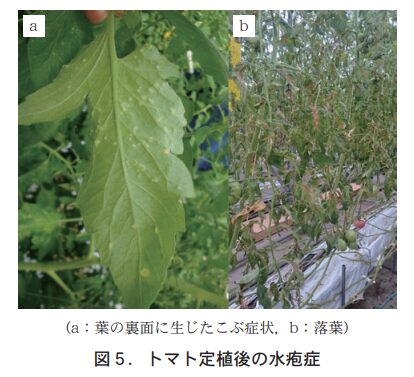
トマト水疱症は,葉こぶ症とも呼ばれている生理障害である。葉の裏面にこぶが現れ(図1ab),症状がひどいものは葉が変形(図1c)・褐変し,さらには落葉(図1d)してしまう。水疱症は葉の表層が変化することでこのような症状になるといわれており(Suzuki et al.,2020),近年,特に苗生産現場で問題になっている(浄閑,2015,三須ら,2018)。
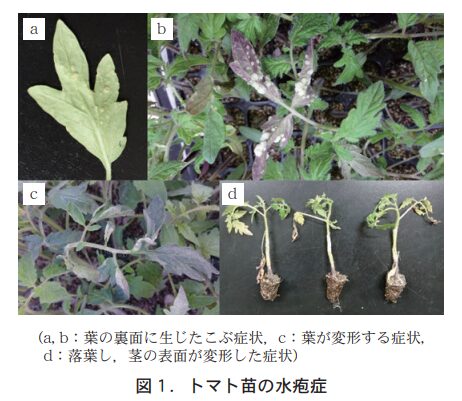
水疱症の発生原因は明確にはなっていない。紫外線強度が低いときや高湿度が継続するときに発生するという報告(Lang,S. P.,Tibbitts,T. W. 1983,Eguchi et al.,2016など)がある。しかし,生産現場では,紫外線強度が高く,高湿度が長時間継続しない条件でも発生が認められている。例えば,かん水不足等により乾燥条件が続いた後,急激に湿潤条件に変化したときに多発した事例がある。このことから,水疱症の発生には,植物体の吸水量と蒸散量の変動が関与していると考えられる。また,トマトの品種により水疱症の発生程度が異なることが明らかになっている(円谷ら,2017,小澤ら,2018)。以上のことから,植物体の吸水を行う根と蒸散を行う地上部の割合が発生程度の品種間差に影響していると考えられる。
Here we would like to present some of the author's research on tomato blistering.
2. EUT type
供試品種として,神奈川県の主要品種である‘ハウス桃太郎’,‘CFハウス桃太郎’,‘CF桃太郎はるか’,‘桃太郎ピース’,‘桃太郎ホープ’,‘サンロード’,‘麗容’,‘麗夏’,‘麗旬’,‘TYみそら86’,‘湘南ポモロン・レッド’,‘湘南ポモロン・ゴールド’の12品種を用いた。これらの品種を市販培土を充填した128穴セルトレイに播種して育成した苗を試験に供試した。
3. interspecific differences in blistering and above-ground dry matter weight/underground dry matter weight
Differences in the occurrence of blistering were examined by placing 14-day-old seedlings in the closed seedling production system "Seedling Terrace" in an artificial weather chamber at a temperature of 30°C and a relative humidity of 901 TP3T, with continuous bottom feeding. No blistering was observed in the seedlings before the start of treatment.
その結果,処理3日目では‘ハウス桃太郎’,‘桃太郎ホープ’,‘サンロード’,‘麗容’,‘湘南ポモロン・レッド’,‘湘南ポモロン・ゴールド’で水疱症の発生は認められなかったが,‘桃太郎ピース’では水疱症発生株率は100%となった。処理6日目では,‘サンロード’,‘麗容’,‘湘南ポモロン・ゴールド’で発生は認められなかった。一方,‘CF桃太郎はるか’,‘麗夏’,‘麗旬’,‘TYみそら86’では100%に達した。処理9日目では,‘麗容’以外は100%の発生となった(表1,図2)。
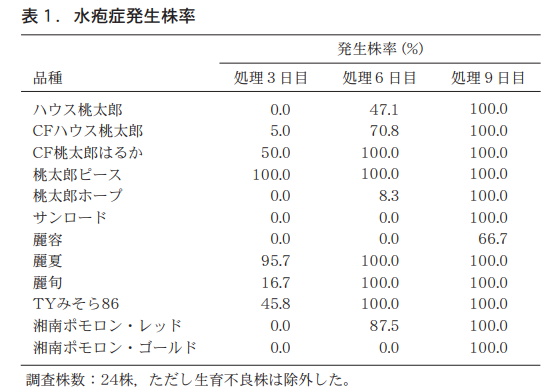
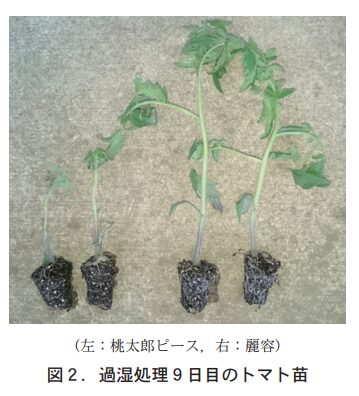
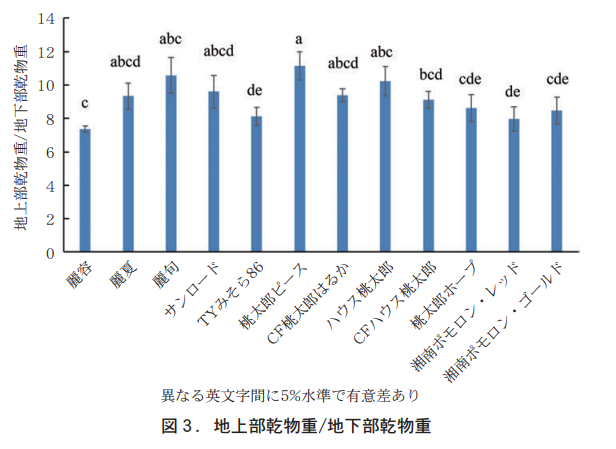
The aboveground dry matter weight/underground dry matter weight was calculated by weighing seedlings grown for 16 days on the "seedling terrace" as described above after drying the aboveground and underground portions at 60°C. The aboveground and underground portions were then weighed.
その結果,地上部乾物重/地下部乾物重は,‘麗容’で最も小さく,次いで‘湘南ポモロン・レッド’,‘TYみそら86’の順で小さい値を示した。一方,‘桃太郎ピース’で最も大きく,次いで‘麗旬’,‘ハウス桃太郎’の順で大きいという結果になった(図3)。
In other words, the smaller the ratio of roots to above-ground parts, the more likely it was that blistering would occur.
4. interspecific differences in water potential variability
水ポテンシャル測定には,「苗テラス」内で128穴セルトレイを用いて栽培された購入苗(ベルグアース(株))を用いた。水ポテンシャルの測定品種は,前述の実験で水疱症の発生程度が多かった‘桃太郎ピース’,中程度であった‘CFハウス桃太郎’,少なかった‘麗容’の3品種を用いた。気温30℃相対湿度50%,給液をしない乾燥した条件に設定した人工気象器内に入れ,24時間経過後に相対湿度90%,連続底面給液を行なう湿潤条件に変更し,トマト苗の水ポテンシャルの値の変化を調べた。
その結果,土壌水分率は処理開始時に78〜79%,24時間後に37〜44%,連続底面給液を開始してから2時間後(処理開始から26時間後)に79〜80%となった。水ポテンシャルは,‘桃太郎ピース’,‘CFハウス桃太郎’,‘麗容’の順に乾燥条件時に低下した。そして,乾燥条件から湿潤条件に変更したときに水ポテンシャルは急激に上昇し,26時間後には3品種の値に有意差がなくなった(図4)。つまり,地上部重/地下部重が大きい品種ほど乾燥時に水ポテンシャルが下がりやすく,湿潤時に急激に上昇する幅が大きいことが明らかになった。
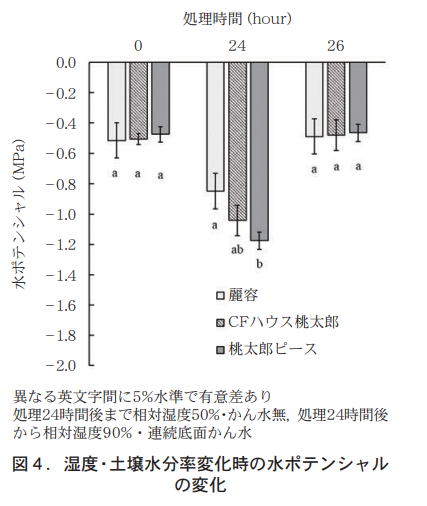
It was inferred that the development process of blistering was caused by an imbalance between the rate of water absorption from the roots and the rate of transpiration from the leaves, resulting in damage to the leaf surface layer due to swelling pressure.
When growing seedlings in cell trays, bottom-feeding is often used. In bottom-feeding, soil moisture content increases rapidly during watering. Furthermore, in closed seedling production facilities, the relative humidity also increases rapidly during watering. This suggests that the risk of blistering may be greater in cultivars with a low subsoil weight relative to the above-ground weight.
5. Conclusion
今回は,水疱症の発生原因について閉鎖型苗生産システムで生育した苗を用いた実験から水環境の急激な変化が水疱症発生の一因と考察した。しかしながら,水疱症は定植後でも発生する(図5)。このときはセルトレイでの育苗時のように底面給液ではないため,水環境変化は他の要因で起こっていると考えられる。また,定植後の地上部重/地下部重の割合と水疱症発生程度の関係については調べられていない。今後はこれらについても明らかにしていく予定である。
thanks
We would like to thank Berg Earth Corporation and Hiroyuki Kikuchi for providing the experimental seedlings. This research was supported by JSPS Grant-in-Aid for Scientific Research JP19K06013.
No Soil - No. 5
よい土の条件 物理的性質−その4
適度に水を保持し排水もよい土とは
Jcam Agri Co.
北海道支店 技術顧問
松中 照夫
The second of the four conditions for good soil, which concerns the physical properties of the soil, is that the soil should "retain a moderate amount of moisture and have moderate drainage. In the previous article, I described how to determine whether the soil drains well or not from the cross-section of the soil. This time, we will consider how soil retains water, the fact that some water in the soil can be used by crops and some cannot, and what kind of soil retains water adequately and drains well.
1. capillary tension is the key to water retention and drainage
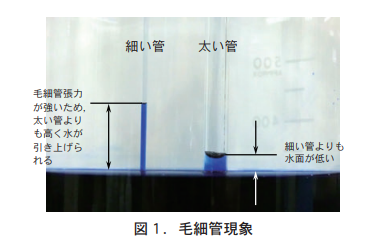
図1を見てほしい。太さのちがう2種類のガラス管を青インクで染めた水(以下,インクと略)に立ててある。どちらのガラス管でも,水面が少し上がっている。これを毛細管現象といい,水を引き上げる力が毛細管張力である。細いガラス管のほうがインクを高く引き上げているのは,太いガラス管より毛細管張力が強いからである。
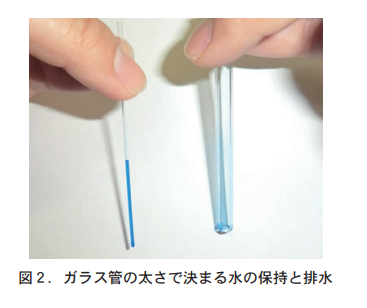
このガラス管をインクの表面より上に持ち上げると,細いガラス管のインクは管に残り,太いガラス管のインクは床に落ちてしまった(図2)。細いガラス管の毛細管張力は重力より強く,そのため水はガラス管に保持されて(保水)いる。しかし,太いガラス管の毛細管張力は重力が下方に引っ張る力より弱く,その結果,インクがガラス管から脱落(排水)したのだ。
Let us consider this in terms of the gaps in the soil. The space between particles in soil is composed of small, thin gaps and large, thick gaps. Sandy soil with coarse grains (coarse-grained soil) has fewer small gaps and more large gaps, so the capillary tension in the gaps is weak and water tends to drain out. This results in poor water retention, which can lead to drought damage to crops. On the other hand, fine-grained and cohesive soil (fine-grained soil) has many small gaps and few large gaps, so the capillary tension in the gaps is strong. Therefore, water is retained in the narrow gaps, resulting in poor drainage.
2. water that can and cannot be used by crops
Imagine that there has been a very heavy rainfall and that all the crevices in the soil have been filled with water. There is no space for air to enter the soil, and there are only soil particles and water. The amount of water in the soil at this time is called the "maximum water capacity. However, about 24 hours after the rain stops, the water that was held in the thick crevices by a force weaker than gravity is pulled down by gravity and drains away. Air enters the gap where the water has been drained away. The amount of water in the soil at this time is called the "field water capacity. Of course, the drained water cannot be absorbed and used by the crop.
If there is no rain for a while after this condition, the soil dries out. As the dryness progresses, the crop wilts, even though there is no water in the soil at all. At this time, it is often experienced that the wilting is restored by watering. However, if the dryness continues without water, the crop withers and dies. However, even in such a case, the water in the soil has not completely disappeared. The amount of water in the soil at this time is called the "permanent wilt point" (wilt means to wilt). The water in the soil at this time is held in very fine crevices and clay (soil particles finer than 0.002 mm in diameter) with a force greater than the water absorption capacity of the crop roots. Therefore, even though the soil has not completely run out of water, the crop cannot absorb the water and withers and dies.
Ultimately, the amount of moisture that is available to the crop in the soil is the amount of moisture at the permanent wilting point minus the amount of moisture at the field capacity, which is the state after drainage is completed. This moisture available to the crop is called effective moisture. The water remaining in the soil at the permanent wilting point is called invalid moisture because it is not available for crops.
3. soil type and effective moisture content
土の粒の大きさと有効水分量の多少は,非常に密接な関係にある(図3)。粒の粗い(粗粒質)土は,太い大きなすき間が多く排水が良好なため,圃場容水量の時の水分量そのものが少ない(図3)。土の粒が細かくなるにつれて,細いすき間が増えていくので土に保持される水分量が増え,圃場容水量の水分量も増加する。しかし,土の粒がある程度まで細かくなると,排水に関係する太いすき間に変化がなくなるので,土の粒がそれ以上細かくなっても圃場容水量は大きく変化せず頭打ちになる(図3)。
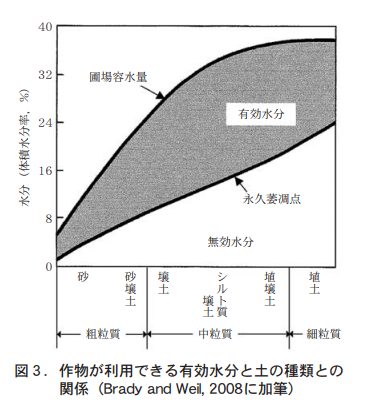
一方,作物がしおれて枯れるほどになった時の土の水分量,すなわち永久萎凋点の水分量は,土の粒が細かくなればなるほど直線的に増えていく(図3)。これは,土の粒が細かくなるほど粘土分や非常に細かいすき間が多くなって,そこに強力に保持される水分量が多くなるためである。したがって,圃場容水量と永久萎凋点の差である有効水分量は,中粒質くらいの土で最大になる(図3)。
4. soil with reasonably good drainage and water retention and how to determine this
Medium-grained soil is neither extremely coarse-grained nor extremely fine-grained. Medium-grained soil has both large gaps for drainage and small but not too fine gaps for water retention. This moderate proportion of crevices produces a soil that drains well and retains a large amount of effective water content.
To determine if the soil is medium-grained, knead the moist soil with your thumb and forefinger and stretch it into a thread. The soil can be considered medium-grained if it can be stretched to the thickness and length of a matchstick, but not beyond that. If the soil is not matchstick-like, but rather difficult to form threads, it is considered coarse-grained soil.
5. the size of soil particles cannot be easily changed
We know that medium-grained soils are reasonably good for drainage and water retention. However, the size of the soil particles is determined by the degree of weathering of the rocks from which the soil is made, which requires time enough to tell the geologic age of the soil. Turning coarse- or fine-grained soil into medium-grained soil is not something that can be done overnight. Creating gaps in the soil for water retention and drainage requires a generational effort to continue applying organic matter such as compost.