

Site Search
Search within product
第716号 2019(R1).12発行
Click here for PDF version
§「紅秀峰」の大玉生産のための灌水・施肥技術
Yamagata Prefectural Agricultural Research Center
Horticultural Experiment Station, Horticultural Environment Dept.
主任専門研究員 安藤 隆之
§ Agricultural Activities and Greenhouse Gas Emissions Reduction
東北大学 名誉教授
齋藤 雅典
§ 2019 General Index of this Journal's Previous Editions
Irrigation and Fertilization Techniques for Producing Large Red Shuho Cherry
Yamagata Prefectural Agricultural Research Center
Horticultural Experiment Station, Horticultural Environment Dept.
主任専門研究員 安藤 隆之
Introduction
Yamagata Prefecture is one of the leading fruit tree producing prefectures in Japan, ranking third in the nation in terms of fruit tree production in fiscal year 2009. Among these, oto is the "face" of Yamagata Prefecture, boasting a production value of 36.8 billion yen and accounting for 761 TP3T of the national production.
As we actively export agricultural products in the future, most of the oriental peppers distributed overseas are 3L size (31 mm or larger in diameter), whereas Japanese fruits are 2L size even if they are large. Although they are highly evaluated for their good eating quality and fruit coloring, they are inferior in terms of size, making them weak in terms of competitiveness.
In order to increase the competitiveness of Yamagata-grown oats in overseas markets, we have been developing technology to produce large, high-quality oats, mainly 3L size, by using the prefectural variety "Benishuho". These results were obtained through the "Development of Production and Processing Technologies for Super-Large Ohtou for Enhancing International Competitiveness and Expanding Exports", an innovative technology development and urgent deployment project (regional strategic project) conducted by the National Institute of Agrobiological Sciences (NIAS), Japan.
2. test outline
(1) Establishment of soil moisture management indexes for production of large red grapes.
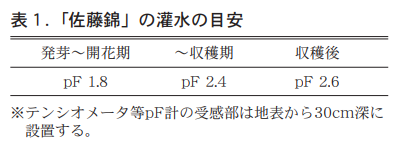
Although there is a standard irrigation technique for "Sato Nishiki" using pF value as an indicator (Table 1), there is no standard for "Benihide", and irrigation has been carried out based on experience and intuition. In fact, when irrigation was carried out according to the irrigation guideline for "Sato Nishiki," the grapes often showed symptoms of water stress such as leaf curling and wilting as the harvest period approached, suggesting that more irrigation was necessary for "Beni Shuho" than for "Sato Nishiki.
For this reason, a test area was set up in which soil moisture was managed at a higher level than the "standard for Sato Nishiki." Trees grown in 60-liter pots were tested, and soil moisture management indices were created.
(2) Improvement of nitrogen fertilization method for "Red Shuho
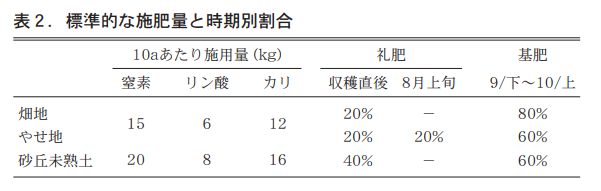
In Yamagata Prefecture, the standard annual nitrogen fertilizer rate is 15 kg-N/10a, which is generally applied as a post-harvest fertilizer and a basal fertilizer from the lower part of September to the upper part of October (Table 2). However, because Beni Shuho is a fertile grape variety, its vigor tends to be a little weaker than that of Sato Nishiki, and its fruits tend to be less fertile. As a countermeasure, we recommend increasing the ratio of post-harvest fertilizer to 50%, which has been shown to maintain vigor and produce good fruit. In addition, when the full annual amount of fertilizer was applied to "Sato Nishiki" immediately after harvest, the growth and fruit quality were equal to or better than those of "Sato Nishiki", and the effect of increased yield was obtained.
3. test method
(1) Soil moisture management for production of large "Red Shuho" grapes (pot cultivation)
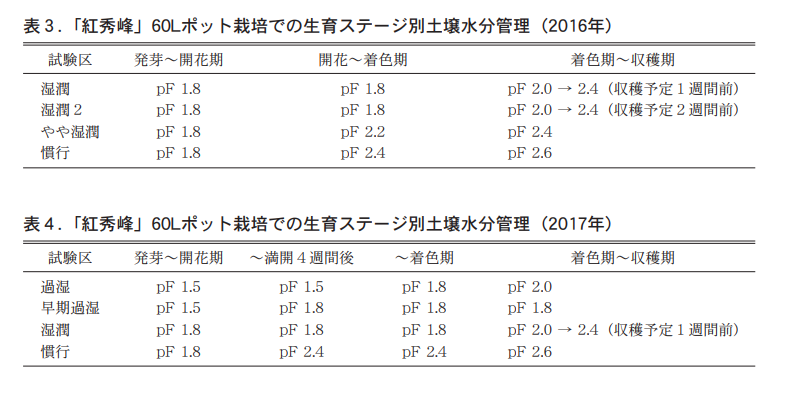
Red Shuho" (5th year, as of 2016) cultivars grown in 60L pots were tested to investigate fruit quality when irrigation was managed at a higher soil moisture level than that of "Sato Nishiki" (Table 3), using the standard irrigation rate of "Sato Nishiki" as the practice in 2016, and at different growth stages. The irrigation was applied when the pF value reached a predetermined level. Fruit set was managed by picking 3 buds/bunch of short-fruited branches before budding and 2 fruits/bunch of short-fruited branches around 20 days after full bloom.
In 2017, a new plot was added in which soil moisture was further managed for enrichment (Table 4) , and fruit quality was investigated. Note that in 2017, budding was conducted on 2 buds/flower bunches of short-fruited branches before budding, and harvesting was conducted on 2 full-fruited/flower bunches of short-fruited branches around 20 days after full bloom.
(2) Soil moisture management of "Red Shuho" created (field test)
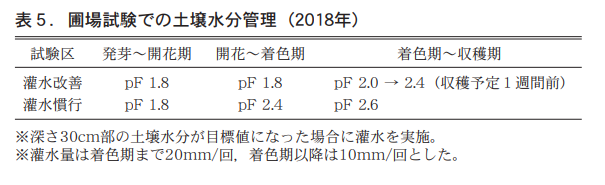
In order to verify the test results with pot-grown trees, we conducted a verification test using 21-year-old "Benishuho" / Aoba cherry trees that have been planted in the field since 2017, with the test plot where soil moisture management was conducted based on the irrigation guidelines of "Sato Nishiki" as the conventional irrigated plot and the improved irrigated plot as the moisture management with the best fruit quality (growth) in the pot test (Table 5). The verification test was conducted using the conventional irrigated area as the test area and the improved irrigated area as the area with the best fruit quality (growth) in the pot test (Table 5). In order to eliminate the influence of rainfall, the test was conducted under rain cover from the flowering period until harvest. For fruit set management, 3 buds/bunch of short-fruited branches were harvested before budding, and 2 fruits/bunch of short-fruited branches were harvested around 20 days after full bloom.
(3) Improve nitrogen fertilization methods
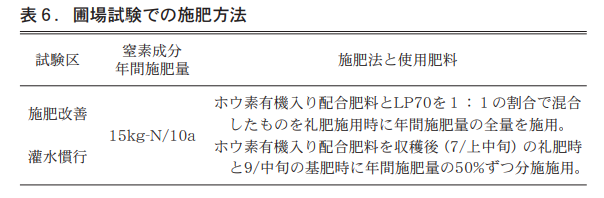
2016年から2年間,場内圃場(細粒褐色低地土)において,20年生「紅秀峰」 /アオバザクラ台(2016年時点)を供試した。年間窒素施肥量を15kg−N/10aとし,収穫後の礼肥割合を50%,9月中旬の基肥割合を50%に分施した区を慣行施肥区とし,収穫後全量施肥した区(以下,施肥改善区と呼ぶ)の生育や果実品質と比較することによって窒素施肥法改善の影響について検討した(表6) 。結実管理等については,灌水試験と同様である。
4. test results
(1) Soil moisture management for production of large "Red Shuho" grapes (pot trial)
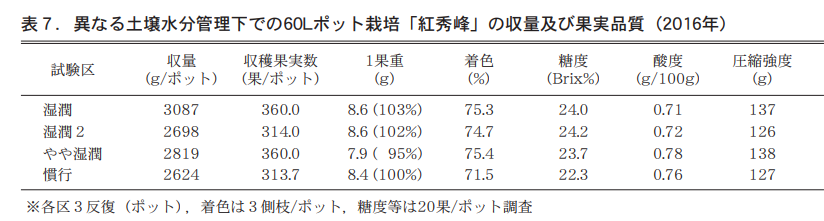
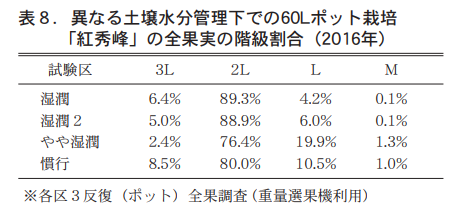
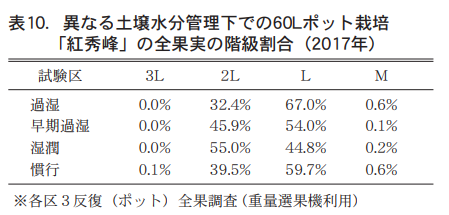
In particular, the wettest area with the highest soil moisture among the test areas in 2016 had the highest percentage of fruits larger than 2 L, and the sugar content was also higher than that of the conventional area (Table 7). There were no significant differences in fruit characteristics (coloration and compressive strength) other than single fruit weight among all the test areas (Table 8), suggesting that it is more important to manage soil moisture until harvest time for "Red Shuho" than for "Sato Nishiki".
2017年は,2016年に最も良好な結果が得られた湿潤区,さらに土壌水分をより多めに管理する区を設けたが,前年同様に,湿潤区で2L以上の果実割合が最も高かった(表9) 。
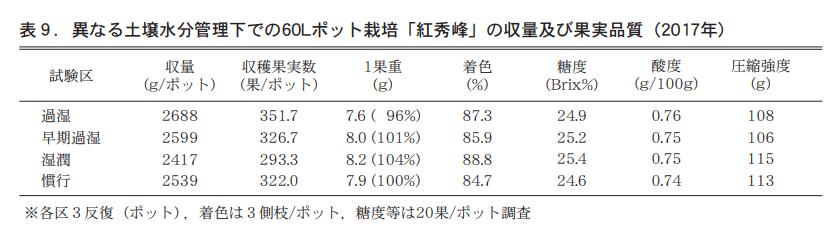
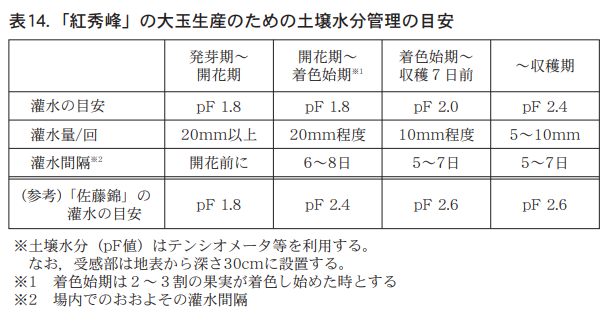
なお,満開4週間後まで土壌水分を多く管理しすぎると,逆に果実肥大が劣る傾向であり,土壌水分が過剰になったことで根の活性が劣ったことが原因であると推察された。2016年同様,果実の大きさや一果重以外の果実形質はほぼ同様であった(表10) 。なお,2018年にも追試験を行ったが,2017年と同様の結果であった(データ省略) 。これら2カ年の結果から,「紅秀峰」の大玉生産には,発芽〜着色期まではpF1.8,着色期〜収穫1週間前まではpF2.0,その後はpF2.4とする土壌水分管理が適すると考えられた。
(2) Verification of soil moisture management indices in the field (irrigation treatment test) and nitrogen fertilization method
Improvement test (fertilizer treatment test)
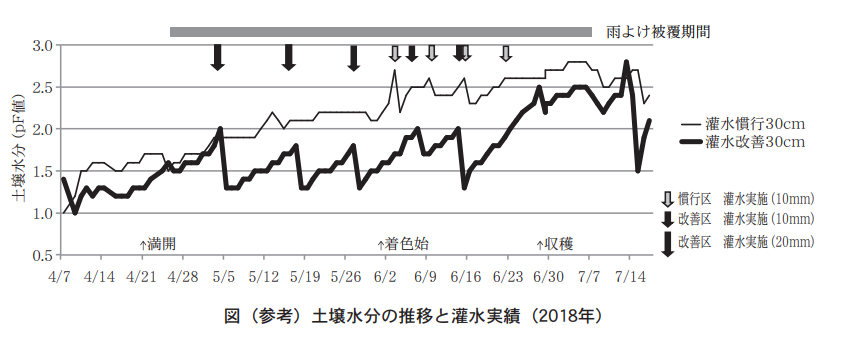
A combination of improved irrigation and fertilizer treatments were applied to 22-year-old 'Red Shuho'/'Aoba-zakura' trees (2018) in a plot in the horticultural experiment station. The results showed that the number of flower buds per bouquet-like short-fruited branch was higher in the irrigated area than in the conventional area, indicating the effect of irrigation (Table 11). Fruiting rate was higher in the improved area where all fertilizer was applied after harvest, and the number of fruiting shoots per bouquet of short-fruited branches was higher in the improved area.
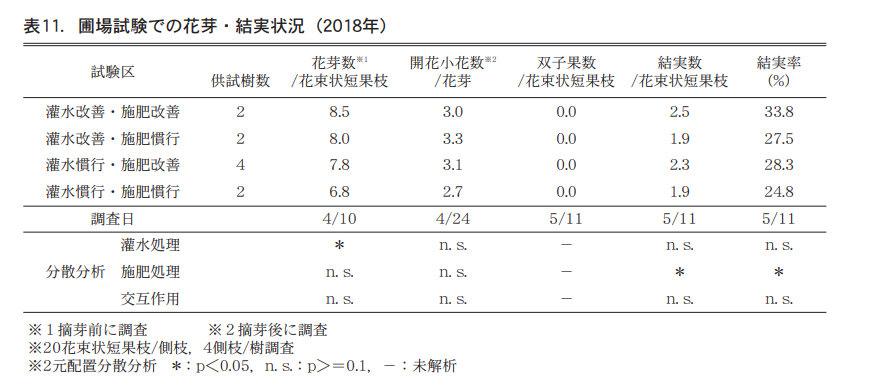
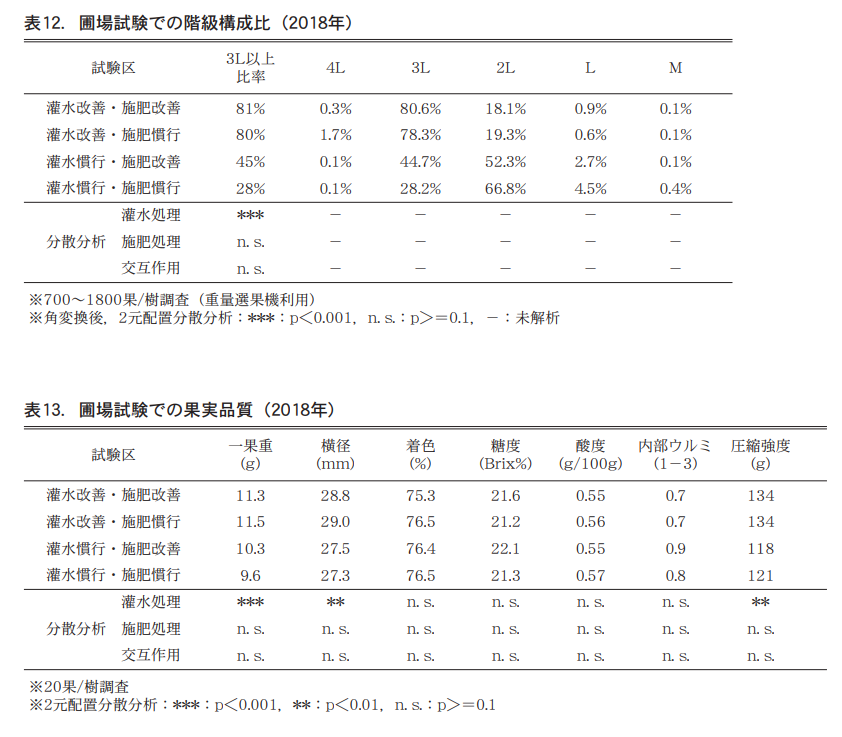
The difference in fruit diameter between the irrigated and non-irrigated areas became larger after the coloring period, and the fruit tended to continue to grow until the latter half of the season when a certain level of soil moisture was maintained until harvest (data omitted). The actual percentage of fruit greater than 3 L per tree was higher in the improved irrigated area, at 801 TP3T or more, and 301 TP3T or more higher than in the conventional irrigated area (Table 12). In terms of fruit traits other than fruit size, the compressive strength of fruit in the irrigated area was higher, but the other traits were the same (Table 13). The results were also similar in the field plots where the same moisture management was conducted (data omitted). On the other hand, there was no effect of improved fertilizer application on fruit size and compressive strength.
The growth results were obtained up to 2 years after fertilization, and the effects of the treatments on shoot length and leaf size were similar to those of the conventional treatments in both the irrigation and fertilization tests (data omitted).
Summary
Although there was no effect of improved fertilizer application on the production of large grapes of "Red Shuho," the effect of improved irrigation was very high. Therefore, it is important to irrigate "Beni Shuho" with slightly more soil moisture than the standard irrigation of "Sato Nishiki" until harvest, and to manage irrigation according to the indices in Table 14 based on pF values. The total post-harvest fertilization of "Red Shuho" improved the fruiting rate and the tree growth was equivalent to that of conventional fertilization (3 T of 501 TP each applied as a fertilizer and a base fertilizer), suggesting that this method is effective in reducing fertilizer use.
Agricultural Activities and Greenhouse Gas Emissions Reduction
東北大学 名誉教授
齋藤 雅典
1. planetary boundary
It has been exactly 10 years since Rockström et al. introduced the concept of Planetary Boundaries (PB) in Nature in 2009, which describes the environmental capacity for sustainable human development within the finite Earth system. PB is the environmental capacity for sustainable human development in the finite earth system. In other words, it indicates that there is a risk of "irreversible and rapid environmental change" after human activities exceed the threshold of PB.
すでに1960年代に「宇宙船地球号」という言葉で人類は地球という閉鎖システムの中で化石エネルギーを使いつづけ,汚染をまきちらしている問題点が指摘された。さらに,ローマクラブが「成長の限界」で地球資源の限界を指摘し,「人口増加や環境汚染などの現在の傾向が続けば,100年以内に地球上の成長は限界に達する」と警鐘を鳴らしたのが1972年であった。その後,地球温暖化の問題が顕在化し,IPCCが設立されたのが1988年。地球の資源の有限性と閉鎖システムである地球の環境汚染,さらに人間活動の地球気象システムへの影響まで,過去半世紀以上にわたって,地球環境問題と人類の持続的な開発の調和の問題が論議され研究が進められてきた。数々の提言は種々の政策にも反映されてきているものの地球環境問題は深刻さの程度を増している。
The PB paper cited at the beginning of this paper analyzed the current status of nine major processes related to the global environment, and found that climate change, lack of biodiversity, and biogeochemical processes (nitrogen and phosphorus) had already exceeded the PB, or the threshold that would cause irreversible changes in the global environment (Figure 1). Calculations based on various models suggest that if the PB is below the threshold, compensatory actions in the Earth system will prevent irreversible and abrupt changes from occurring.
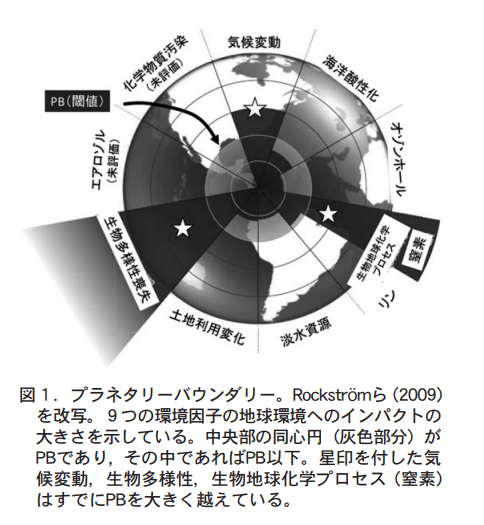
In this paper, I would like to discuss "climate change, especially greenhouse gases", which were pointed out to have already crossed the threshold in the PB 10 years ago, and the problem has become even more serious during the past decade, and their relation to agricultural activities from the perspective of the life cycle of food production and consumption.
2. life cycle assessment (LCA)
Environmental problems are extremely diverse, ranging from the local to the global level, and trade-offs often occur where technologies introduced to reduce some environmental impacts increase other impacts. Life cycle assessment (LCA) methods have been developed to evaluate the total environmental impacts of products and services throughout their life cycles, and are now widely used as a general tool for environmental impact assessment in various industries.
Life cycle assessment (LCA) is a method of analyzing and evaluating the environmental impact of a product based on a comprehensive survey of the types and amounts of energy, materials, and waste generated throughout the product's life cycle, from raw materials to manufacturing, use (consumption), and disposal. LCA has been developed for industrial products, but there are high expectations for the LCA method as an evaluation tool for environmentally friendly agriculture, and since then, research on LCA for food systems, including not only production sites but also distribution and processing of agricultural products, has been expanding both in Japan and overseas.
3. greenhouse gases
温室効果を示す主要なガスとしてCO2,CH4,N2O,各種フロン類などがある。特に,化石燃料の燃焼に由来するCO2は,地球温暖化を引き起こす主たる原因としてその排出削減が進められている。一方,CO2は,森林の伐採など土地利用変化によって土壌有機物や森林バイオマスが分解することによっても放出され,全球的にみるとその量は膨大なものとなる。CH4,N2Oは,主に嫌気的な有機物分解あるいは無機態窒素の酸化還元などの生物地球化学的プロセスによって放出され,水田農業,反芻家畜ルーメン,窒素肥料の形態変化など農業活動との関連が深い。IPCCの第4次報告書では地球全体の温室効果ガス排出量のうち約3割が農林業活動に由来するとされている。
In 2014, FAO warned that greenhouse gas emissions from agriculture, forestry, and fisheries have almost doubled in the past 50 years and that if no action is taken now, emissions will increase by another 301 TP3T by 2050. In other words, in order to minimize climate change, there is no time to spare for greenhouse gas reduction in the agricultural sector.
4. greenhouse gas emissions in the food system
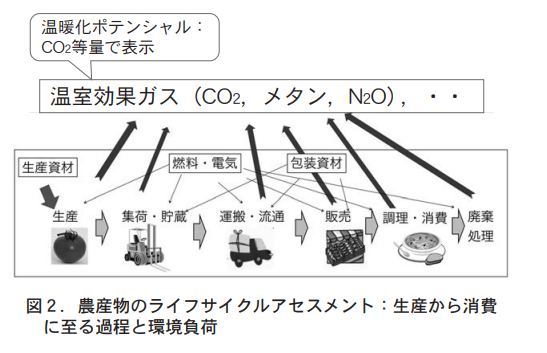
Agricultural products are produced on the farm, stored or processed, delivered to consumers, consumed, and the residues are disposed of. By examining the environmental impact of food products throughout their life cycle, it is possible to determine the processes that emit greenhouse gases during food production (Figure 2).
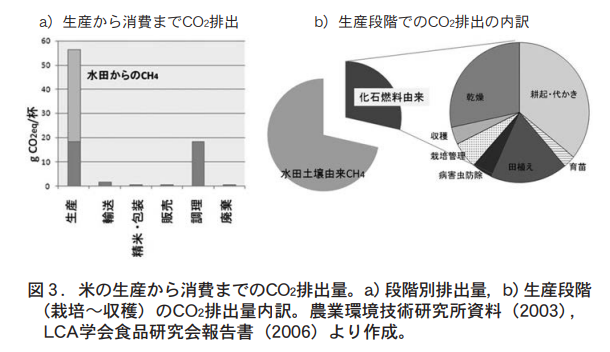
一例として,米の例を示すが,ご飯一杯のためにどのくらいCO2が排出されるかを示したものである(図3) 。なお,CH4やN2Oについては,その排出量に温暖化係数(CH4は21,N2Oは310)をかけてCO2等量として標準化して計算している。化石燃料由来のCO2は栽培と調理で比重が高く,それよりも水田からのCH4排出が温室効果ガスとしては大きい割合を示している。調理でのCO2は炊飯器に使用する電気であり,栽培場面では,肥料・農薬,農業機械の燃料などである。栽培場面の内訳を示した図によると,耕起・代かき,田植え,収穫・乾燥という作業のための化石燃料と電気の占める比重が大きく,肥料・農薬の製造に関わる部分は栽培管理の中にまとめられており,それほど比重は高くない。
他の作物について,生産・流通のCO2排出量の比較を図4に示した。施設栽培では暖房に燃料を使用するのでCO2排出量は大きく,海外からの輸入作物については輸送に伴うCO2排出量の割合が相対的に大きくなる。この図に示していないが,国内産のコムギでは栽培が集約的であり,収穫後の乾燥(コムギ)などに多大のエネルギーを消費しているために,海外産作物に比べてCO2排出量が低いとは言い難い状況にある。英国で全粒粉パンのコムギ栽培からパン製造までを調べた例では,温室効果ガスの半分以上が栽培・収穫段階で排出されており,その中では窒素肥料(硝酸アンモニウム20kgN/10a相当,英国では硝安が広く使われている)の製造に由来するCO2排出量が全体の4割以上となっている(図5) 。一般に, 大規模栽培では温室効果ガス排出量に占める肥料の割合は高い。
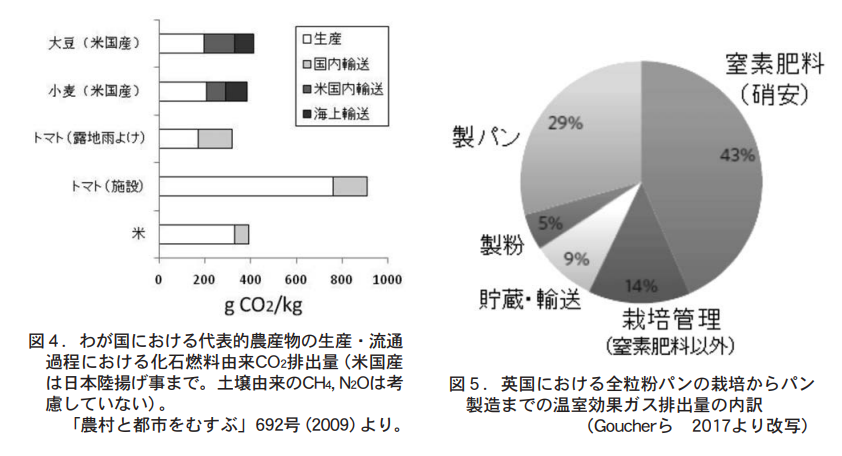
わが国の稲作の場合は,水田からのCH4放出を削減する取り組み(中干し期間延長など)が,効果的な温室効果排出削減策となるし,施設野菜栽培などでは,加温・冷却のためのエネルギー消費を節減することが温室効果ガス排出削減につながる。一方,英国のコムギのような例では,肥料利用効率の向上,すなわち施肥量削減が,すぐに温室効果ガス排出削減につながる。
5. Carbon footprint
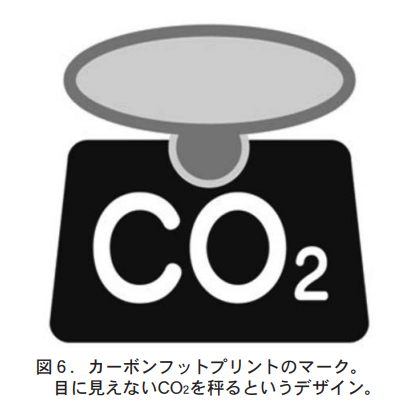
個々の食品のCO2排出量をCO2量として包装等に示す「カーボンフットプリント」は,温暖化へのインパクトを「見える」ようにする有効な指標として,国内外で検討が進められてきた。フットプリントとは足跡の意味であり,製品ができるまでにどれだけCO2が排出されているかを示すものである。経済産業省等のプロジェクトを経て,「カーボンフットプリント」の第三者認証制度が整備され,認定された商品についてはCFPマークを付して,商品のライフサイクルを通したCO2排出量が明示されている(図6) 。米,ハム,加工食品など40以上の農産物・加工食品などがすでにCFPマーク認証を得ている。
https://www.cfp-japan.jp/about/
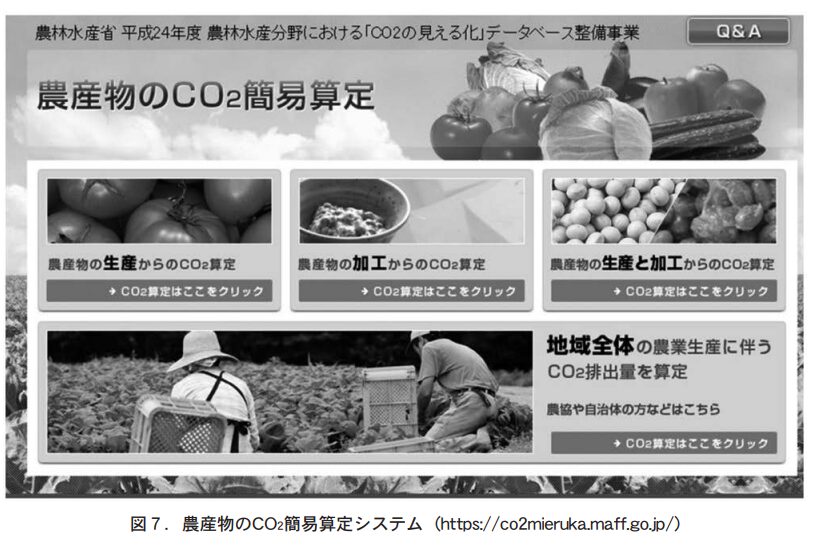
一方,農業生産現場では,生産から流通・消費・廃棄までのライフサイクルの評価よりも,まずは生産段階でのCO2排出量を評価したいという生産者・事業者も多い。そうした要望に応えるために,農水省は,「農林水産分野における「CO2の見える化」ポータルサイト」を設け,生産者自身の営農記録から比較的簡単に農産物のCO2排出量を計算できるようになっている(図7) 。
https://agri-co2mieruka.jp/ このサイトでは各地域の慣行農法によるデータも比較として見ることができる。カーボンフットプリント制度などの「CO2の見える化」の事業が進められるようになって10年近くが経つが,必ずしも普及しているとは言い難い。
いろいろな理由が考えられるが,消費者の理解が進んでいないことに加え,ある程度理解をしている消費者であってもカーボンフットプリントによって消費行動が変化するという訳ではないのかも知れない。また,施設栽培における省エネや大規模栽培における施肥量削減は,経営的にも効果が高いので生産者も積極的に取り組みやすいが,一般の農業生産者や食品加工業者等の場合,温室効果削減への取り組みが販売面などビジネスとしてメリットにつながっていないことが大きいと考えられる。これから,こうした制度をいかに実効性のあるCO2排出につなげていくかが問われている。
Summary
地球温暖化に伴い,栽培の現場では高温による登熟不良や品質低下など深刻な問題が生じており,さまざまな対策技術の開発が進められている。一方,農業生産そのものも温室効果ガスを排出し,温暖化に対して責任のあることも忘れる訳にはいかない。フードシステム全体としてのCO2排出をみてみると,生産(栽培〜収穫)段階の負荷の割合が大きいので,そのための対策(肥料・農薬・燃料の効率的利用による使用量削減など)が重要なことは言をまたない。
On the other hand, biogeochemical processes (nitrogen and phosphorus) mentioned in the PB refer to the biogeochemical cycling of major nutrients, nitrogen and phosphorus, and are inseparably related to agriculture, especially fertilizer use. Last year, a paper was published in Nature (Springmann et al., Nature 562: 520-524, 2018) that examined how the food system as a whole can reduce its environmental impact, including greenhouse gases, to below PB. The environmental impacts were estimated under several scenarios, including technological measures such as improving fertilizer efficiency, reducing food loss, and shifting from meat to vegetarian diets, all of which would have difficulty reducing environmental impacts below the PB.
これらの対策を平行して相乗的な効果を期待しなければ目標達成は難しいという。この論文は地球レベルでの論議であるが,わが国の農業とフードシステムについても,同様に,複眼的視野をもってさまざまな対策を平行して行っていく必要がある。
2019 General Index of Previous Issues of this Journal
<1月号>
§ Stable production with low cost
ジェイカムアグリ株式会社
生産管理本部長 望月 弘道
Development of a Total Basal Fertilizer Cultivation Technique for Semi-Promoted Tomato Plots with Accumulated §Phosphoric Acid
愛知県農業総合試験場
園芸研究部 野菜研究室
佐藤 広幸
§Examination of the practicality of J-Coat, a rice one-shot fertilizer coated with a new type of film
静岡農林技術研究所
水田農業生産技術科
松永 真
白鳥 孝太郎
(現 静岡県庁畜産振興課 畜産技術班)
<2月・3月合併号>
§トマトの紐栽培
-肥効調節型肥料の紐上置き肥-
桝田 正治
(元 岡山大学 自然科学研究科)
§ Chemical fertilizers: from the advent of chemical fertilizers to the present and the future
-化学肥料が果たしてきた役割-
ジェイカムアグリ株式会社 北海道支店
技術顧問 松中 照夫
<4月号>
§The trend and function of nitrates in the body
ジェイカムアグリ株式会社
技術顧問 柴田 勝
§カリ施肥による玄米中放射性セシウムの吸収抑制対策と避難指示区域における農業復興に向けた取り組み
福島県農業総合センター
浜地域農業再生研究センター
齋藤 隆
<5月号>
Growth yield and degree of film collapse of rice plants using §-coated urea fertilizer (J-Coat)
元 福島県農業総合センター
会津地域研究所
専門員 川島 寛
§MEISTER Fertilizer Efficacy Test on Paddy Rice in Jilin Province, China (Report 1)
秋田県立大学
名誉教授 佐藤 敦
<6月号>
§ Rice MEISTER Fertilizer Efficacy Test in Jilin Province, China (Report 2)
秋田県立大学
名誉教授 佐藤 敦
§ Phosphoric acid reduction index in leafy vegetables (komatsuna and spinach)
岐阜県農業技術センター
土壌化学部
専門研究員 和田 巽
<7月号>
§積雪地域のナシ栽培における緩効性肥料入りBB肥料を用いた基肥・礼肥同時施肥技術の確立
京都府農林水産技術センター
農林センター丹後農業研究所
山口 俊春
§Improvement of Seed Protein Quality by "Wheat Fertilizer Daimyo," a Fertilizer with Controlled Fertilizer Effects on Wheat
熊本県農業研究センター
生産環境研究所
研究員 門田 健太郎
<8月・9月合併号>
§冠水の時期と時間ならびに湛水後の液肥かん注処理がレタスの生育,収量に及ぼす影響
兵庫県立農林水産技術総合センター
淡路農業技術センター 農業部
主任研究員 中野 伸一
§ゴルフ場で起きているサッチの問題とCDU入り肥料の芝生サッチ分解効果試験
一般財団法人関西グリーン研究所
所長 森 将人
<10月号>
§Science of seeing the invisible - Application to the field of agriculture
福島大学 農学群 食農学類
教授 平 修
§An approach to citrus one-shot fertilization system in Shizuoka Prefecture
JA静岡経済連 みかん園芸部 柑橘果樹課
<11月号>
§ Fertilization management of park trees by local residents
齊藤秀幸1・菅原心也1・沓沢ミエ子2・由利真人3・橋本大樹4・辻 信一5
(1宮城大学・2つばめの杜公園管理会・3山元町役場・4山元復興ステーション・5神戸まちづくり研究所)
§ Integrated control of above-ground and below-ground management to support smart agriculture in horticulture facilities
農業・食品産業技術総合研究機構
野菜花き研究部門
岩崎 泰永
<12月号>
§ Irrigation and fertilizer application techniques for the production of large "Beni Shuho" grapes
山形県農業総合研究センター
園芸試験場 園芸環境部
主任専門研究員 安藤 隆之
§ Agricultural Activities and Greenhouse Gas Emissions Reduction
東北大学
名誉教授 齋藤 雅典
§ 2019 General Index of this Journal's Previous Editions