

Site Search
Search within product
第766号 2024(R6).12発行
Click here for PDF version
§讃岐うどん用小麦「さぬきの夢2009」における肥効調節型肥料の全量基肥施用について
Kagawa Prefectural Agricultural Experiment Station, Crop and Specialty Crop Research Division
谷川 昭彦
§マイクロロングトータルによる加工・業務用タマネギの育苗作業の省力化の検証
Ibaraki Prefecture West Agriculture and Forestry Office
Bando Regional Agricultural Extension Center
林 可奈子
(現 茨城県病害虫防除所)
§土のはなし-第37回
農地は作物を栽培する土地である
-農地で生物の多様性をどう考える-
前 ジェイカムアグリ株式会社
北海道支店 技術顧問
松中 照夫
§2024年本誌既刊総目次
Sanuki Udon Flour "Sanuki no Yume 2009
肥効調節型肥料の全量基肥施用について
Kagawa Prefectural Agricultural Experiment Station, Crop and Specialty Crop Research Division
谷川 昭彦
Introduction
Kagawa Prefecture is the smallest prefecture in Japan, but it is famous as the largest udon prefecture in Japan. According to the 2022 household survey by the Ministry of Internal Affairs and Communications, Takamatsu City ranks first in Japan in the annual per-household expenditure on Japanese soba and udon (eating out) at 13,968 yen, more than double the national average of 5,911 yen. This is about 2.6 times the national average of 1.99, ranking first in Japan.
このように,うどんの消費量は日本一だが,うどんの原材料となる小麦のほとんどはオーストラリア産小麦「ASW」が使われている。こうした中,県民,製粉・製麺業界から「香川県産小麦で讃岐うどんを!」との声が高まり,県オリジナルの讃岐うどん用品種として初めて育成されたのが「さぬきの夢2000」である。
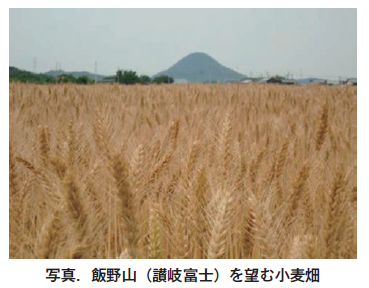
Since then, development of the variety has continued, and it has now been replaced by the second generation "Sanuki no Yume 2009. Thanks to the efforts of farmers and related parties to expand the cultivation of "Sanuki no Yume 2009," the area under cultivation is gradually increasing year by year. However, in order to further expand the area, it is necessary to save labor in cultivation management. In this paper, we report on a study of total basal application of fertilizer to reduce fertilizer use in wheat cultivation management.
Methods and results
(1) Testing Method
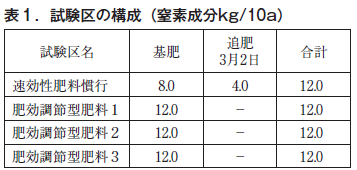
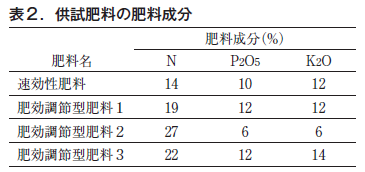
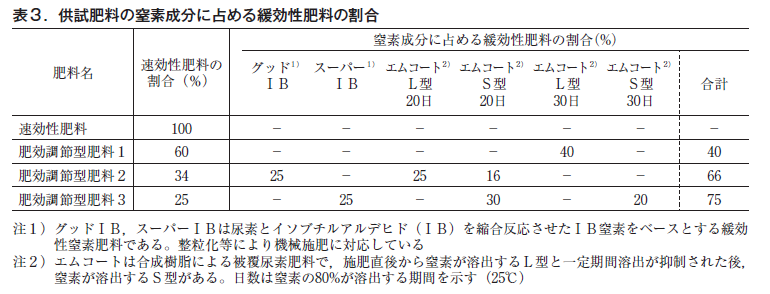
試験は2017年播きで,香川県農業試験場(香川県綾川町)の圃場で行った。品種は「さぬきの夢2009」を用いた。播種期は11月2日(早播),11月13日(適期播),12月4日(遅播)の3時期で行った。播種方法はドリル播きで播種量8kg/10aとした。試験区は,速効性肥料慣行区,肥効調節型肥料1区,肥効調節型肥料2区,肥効調節型肥料3区の計4区とし,小麦の生育,収量,品質を比較した(表1)。なお,供試肥料の各肥料成分および緩効性肥料の割合はそれぞれ表2および表3に示すとおりである。
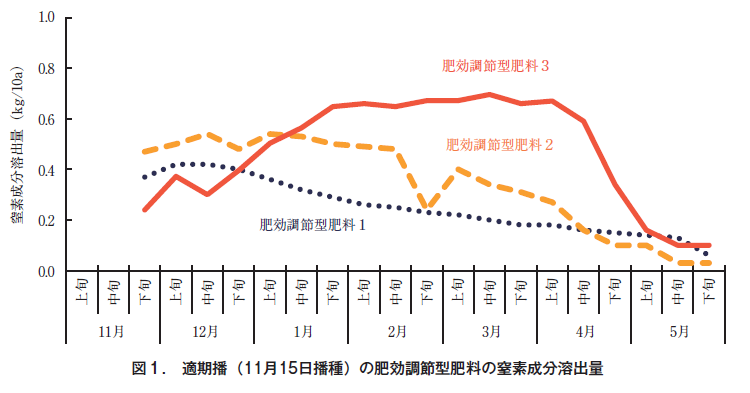
(2) Dissolution characteristics of fertilizer with regulated fertilizer effect (Figure 1)
The leaching pattern of nitrogen from fertilizer 1-3 was simulated using the Takinomiya AMeDAS normal (30 years from 1981 to 2010). The base fertilizer application date was set for November 15.
The results showed that fertilizer leaching of fertilizer 1 reached a maximum in mid-December, followed by a gradual decline. Fertilizer 2 remained high until mid-February, then dropped sharply in late February, followed by a gradual decline. Fertilizer 3 was low until mid-December, increased from late December, and remained high from late January to mid-April.
(3) Test results
There was no significant difference in culm length and ear length between the two fertilizer treatments at each sowing period, when the conventional fast-acting fertilizer treatment was used as the standard. The number of ears was the same or slightly higher in all but the three fertilizer-regulated treatments sown at the right time of the year. The weight of fine wheat in the fertilizer-regulated zone was slightly lower than that in the late-seeded zone, except in the three fertilizer-regulated zones. There was no significant difference in thousand-grain weight and appearance quality among the fertilizer treatments, but the early sowing resulted in lower thousand-grain weight and slightly poorer appearance quality. In addition, protein content tended to be lower in the early-seeded fertilizer treatments (Tables 4 and 5).
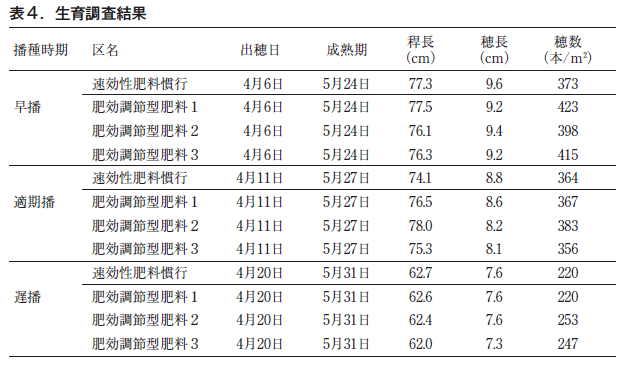
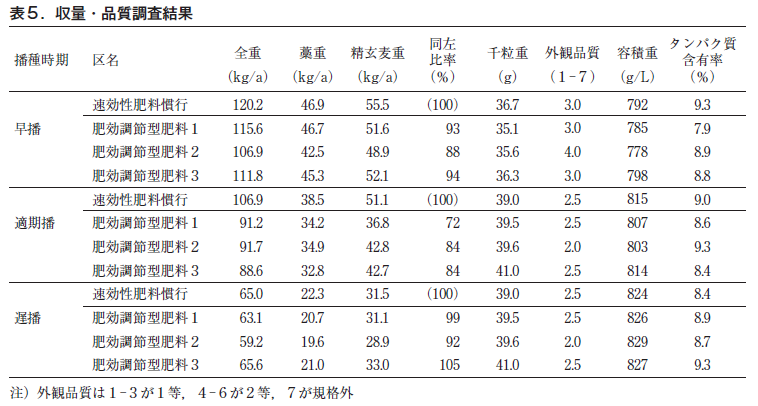
Based on these results, the total basal fertilizer application of the regulated fertilizer was slightly inferior to the fast-acting fertilizer system in terms of yield, but among the three fertilizer treatments, the three regulated fertilizer treatments maintained their efficacy until the latter half of growth and were considered to be better overall.
Summary
A trial of total basal fertilizer application using fertilizer-regulated fertilizer in Sanuki Udon wheat "Sanuki no Yume 2009" was introduced.
The results of this test showed that fertilizer 3 was good, but the extremely high percentage of slow-release fertilizer (75% of the total nitrogen content) made the price of fertilizer too high to make it practical.
Based on the test results and cost-effectiveness in terms of yield and quality, a controlled-release fertilizer consisting of 45% fast-acting fertilizer and 55% slow-acting fertilizer (25% Good IB and 30% Emcote S20H) was finally adopted in 2020 as "Sanuki no Yume Ippatsu" in the growing calendar.
「さぬきの夢一発」は,規模の大きな経営体を中心に普及し,作付面積の拡大に一定の貢献をした。現在,香川県農業試験場では「さぬきの夢2009」に続く後継品種「さぬきの夢2023」の栽培試験を行っており,その中では「さぬきの夢2023」向けの緩効性肥料を利用した施肥法についても検討している。
References
●総務省(2022):家計調査
●総務省(2021):経済センサス活動調査
●ジェイカムアグリ:緩効性窒素肥料・グッドIB・スーパーIB
https://www.jcam-agri.co.jp/product/ibdu.html
●谷川昭彦,宮原和典,大熊将夫,池内 洋(2020):生育後半に肥料を効かせて小麦「さぬきの夢2009」の収量アップ 豊穣,58:8~10
By Micro Long Total
加工・業務用タマネギの育苗作業の省力化の検証
Ibaraki Prefecture West Agriculture and Forestry Office
Bando Regional Agricultural Extension Center
林 可奈子
(現 茨城県病害虫防除所)
Introduction.
JA茨城むつみ玉葱研究会は,古河市,坂東市,五霞町,境町の生産者9名が所属しており,平成29年から加工・業務用タマネギの契約栽培に取り組んでいます。現在はタマネギを1ha規模で作付けし,経営の一部門と位置付ける経営体も育成される等,野菜経営の補完品目,あるいは普通作経営の複合品目として,取り組みが広がっています。
In the fall sown onion cultivation that our research group is engaged in, onions are sown in early September, planted from mid-November to early December, and harvested from late May to early July. For planting and harvesting, an efficient and labor-saving work system is being established through the shared use of fully automatic transplanters, harvesters, pickers, and other equipment.
一方,約2か月間にわたる育苗管理は,機械等の技術導入は難しく,規模拡大に伴い増加する作業量の軽減が課題となっています。特に管理作業の一つである追肥作業は,ジョウロまたは背負い式動噴による液肥施用を,播種2週間後から定植まで,週に1回の頻度(計5~6回)で行われています。10aあたり約60トレイ分(448穴トレイ)のタマネギ苗を管理するため,1ha規模で作付けする生産者は追肥1回の作業に半日~1日近く要するため大きな負担となっていました。
Therefore, we tested whether the use of a slow-release fertilizer, "Microlong Total 70 Type," as a fertilizer material during the seedling stage would (1) reduce the time required for a single application of fertilizer and (2) reduce the number of applications of fertilizer during the period of seedling growth.
Verification of labor-saving fertilizer application
The verification was conducted in two onion research households growing onions in the 2004 (sown in early September 2021) and 2005 (sown in early September 2022) crop years. The amount of fertilizer applied per application was set at 10 g/tray or 25 g/tray, and the application was made two weeks after sowing, based on examples in other prefectures.
(1) Case 1: Producer A (2022, 5-year production)
研究会の中でも大規模でタマネギを生産する生産者Aは,令和4年産の作付面積190aのうち,5a分の苗にあたる約30トレイで,マイクロロングトータルによる追肥を試験導入しました。処理は手まきまたはサンパースタート(以下サンパー,ヤマト農磁株式会社:図1)を用いて行いました。
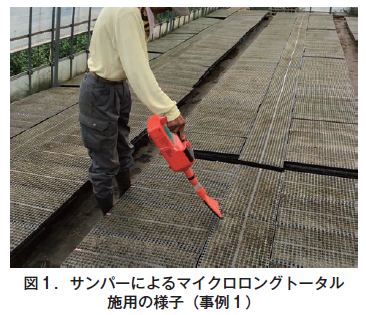
The working time for total microlong application was 1 to 2:30 min/tray by hand and less than 10 sec/tray with thumper in the 25 g test plot, and about 1 min/tray by hand and less than 10 sec/tray with thumper in the 10 g test plot (Table 1).
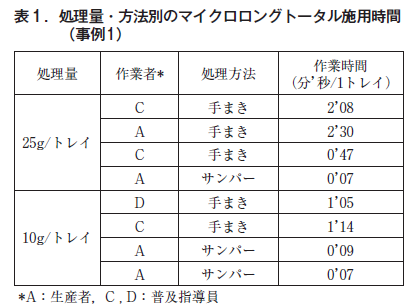
In the case of the treatment using Samper, which required particularly short working time, it was estimated that the fertilizer application time for 10a of seedlings was 6 to 7 minutes. The usual fertilizer application by grower A (four times with a jar) required 68 minutes of work for 10a of seedlings, and it was estimated that the use of Micro Long Total could reduce the amount of time required to about one-tenth of that by using Micro Long Total.
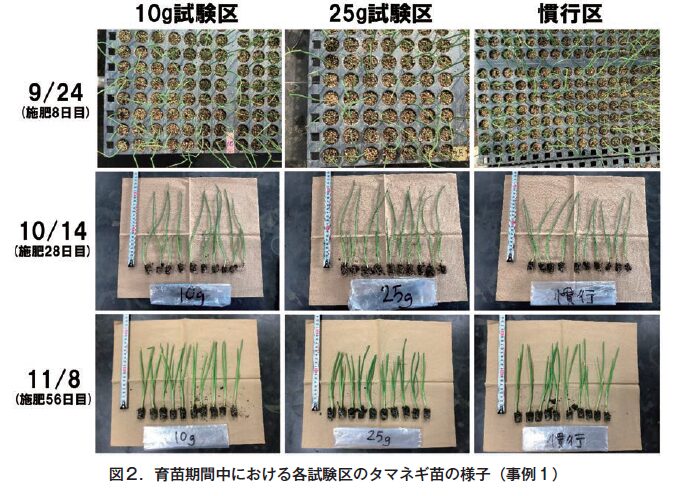
A seedling quality survey (10 seedlings x 3 replications) was conducted in mid-November, just before planting, and the seedlings in the test area treated with MicroLong Total showed growth comparable to that of seedlings treated with conventional fertilizer (Figure 2). Growth after planting was also generally good, and the final yield was comparable to that of the conventional method (data omitted).
令和5年産では,作付全面積にあたる200a分の苗(約1,200トレイ)で,サンパーを用いてマイクロロングトータルによる追肥を行いました。令和4年産と同様に,令和5年産も育苗期の追肥は本資材1回のみでしたが,例年通り生育良好な苗を育成することができました。また,慣行の追肥で1日近く要していた1回の作業を半日程度に抑えられるなど,作業時間を大きく短縮できました(生産者所感)。
Farmer A, who conducted the demonstration, felt that the reduction in the frequency of fertilizer application was particularly significant, and decided to continue using Micro Long Total fertilizer from 2024 onward. He also expressed his desire to further expand his onion acreage because of the labor savings in fertilizer application.
(2) Case 2: Producer B (2023)
タマネギを60a作付する生産者Bは,10a分の苗(約60トレイ)で,マイクロロングトータルによる追肥を試験導入しました。生産者Aの事例を参考にし,処理はサンパーを用いて行いました。
The total time required to apply MicroLong Total to 10a of seedlings was 16 minutes in the 25g test plot and 17 minutes in the 10g test plot. The use of MicroLong Total reduced the time needed to apply fertilizer by about one-third from the 25 minutes required for the usual liquid fertilizer application by Grower B (five times in total, using a back-powered sprayer).
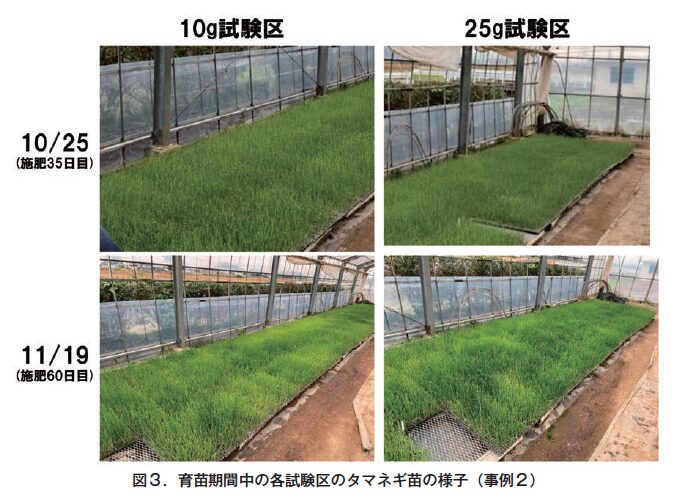
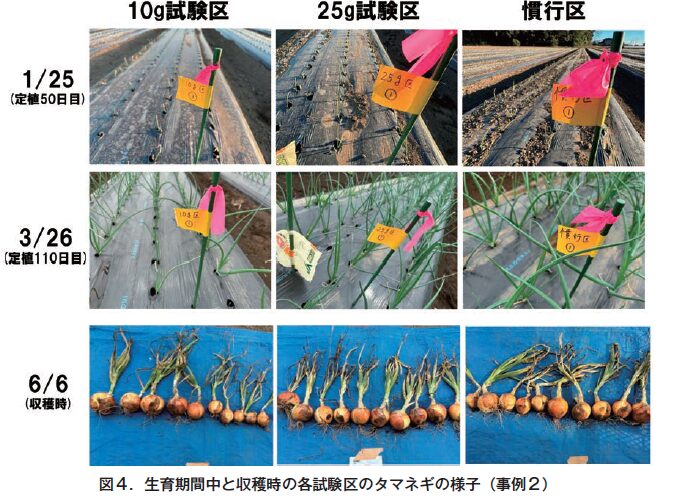
しかしながら,本資材1回のみの施用で良好な苗を確保できた生産者Aと異なり,生産者Bの苗は11月下旬に葉の黄変がみられ(図3),その後12月上旬の定植までに2回,液肥による追肥を行うこととなりました。生産者Aよりも育苗期間が約2週間長かったこと,令和4年9月から12月上旬は平年よりも高温であったこと等が原因で,肥料切れが発生したと考えられました。なお,追加の追肥を行ったことで,定植後の生育は概ね順調で(図4),最終的な収量も慣行と同程度となりました。
Although an additional application was required, grower B gave a positive opinion about the reduction in the number of fertilizer applications and the shortening of work time per application. Based on this case, it was considered necessary to consider increasing the amount of fertilizer or combining fertilizer application in the latter half of the seedling growth period, even when using slow-release fertilizers, when the seedling growth period is longer than two months or under environmental conditions that may cause the fertilizer effect to wear off earlier than usual, such as high temperatures during the growing period.
Conclusion
Verification by two growers in our area showed that the use of Micro Long Total could save labor for fertilizer application during the onion seedling period. When we introduced the case study to onion research members at a field workshop, some members showed interest, while others said that they would prefer to use liquid fertilizer for fertilization because it can be used in combination with irrigation work.
In addition, as shown in Case 2, the fertilizer efficacy period of MicroLong Total may vary depending on the weather conditions during the seedling growth period, and the results may differ from those in our production area depending on the region, crop type, and other factors. When actually introducing micro long total fertilizer, we would like to ask our customers to consider the necessity of conducting a trial on a small scale first.
No Soil - No. 37
農地は作物を栽培する土地である
-農地で生物の多様性をどう考える-
前 ジェイカムアグリ株式会社
北海道支店 技術顧問
松中 照夫
So far, I have described the reality that man's excessive economic activities have not only brought the world's soil to the verge of degradation, but have also led to environmental destruction. Starting this month, I would like to change the topic to organic agriculture and compare it with conventional agriculture that has been commonly practiced. This month's theme is how to understand farmland and how to consider biodiversity in that farmland.
1. farmland is not a pristine natural ecosystem
About 10,000 years ago, people began what we now call agriculture. This beginning of agriculture and food production on farmland was also the beginning of environmental destruction in the sense that people added their hands to the pristine natural ecosystems that had been given to them.
Since the beginning of agriculture, farmland has been managed by people in order to maximize the productivity of crops grown there by creating an optimal growing environment for the crops. For example, in rice paddies in conventional agriculture, the priority is given to the growth of rice plants, and people manage the paddies to prevent the invasion of various plants and animals other than rice plants. Therefore, biodiversity is kept low (Figure 1).
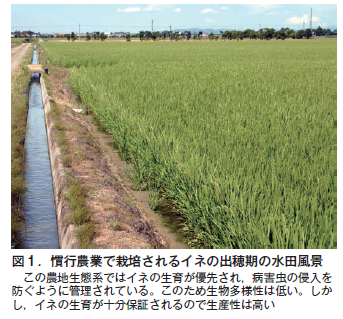
This effort, on the other hand, is rather counterintuitive from the standpoint of protecting biodiversity. This is why agriculture is considered one of the most serious threats to biodiversity in the world (Newbold et al., 2015). In contrast, organic agriculture, unlike conventional agriculture, finds significance in protecting biodiversity even in the anthropogenic ecosystem of farmland.
2. organic farming aims to improve the quality of life and livelihood
わが国で有機農業といえば,単に化学肥料や農薬を使用せずに農産物を生産する農業とか,有機JAS規格を満たす農業と思われがちである。しかし,有機農業とはそのような外形で表現できるものではない。奥深い目標が有機農業にはある。世界の有機農業活動を国際的に束ねる組織である国際有機農業運動連盟(1972年フランスで発足,略称IFOAM:アイフォーム)は,2008年の総会で有機農業の定義と有機農業が目指すことを,以下のように宣言している。
「有機農業は,土壌・自然生態系・人々の健康を持続させる農業生産システムである。それは,地域の自然生態系の営み,生物多様性と循環に根差すものであり,これに悪影響を及ぼす投入物の使用を避けて行われる。有機農業は,伝統と革新と科学を結び付け,自然環境と共生してその恵みを分かち合い,そして,関係するすべての生物と人間の間に公正な関係を築くと共に生命(いのち)・生活(くらし)の質を高める。」(日本語訳はIFOAMによる)
Thus, organic farming is not only about producing healthy food, but also about the local environment, the living creatures including people who live there, and the way people should conduct agriculture. This is why organic farming is also strongly concerned with local environmental preservation and animal welfare (animal welfare). It never thinks that it is enough if it is good enough only for oneself.
3. it is difficult to balance crop production with protecting biodiversity on farmland
The problem is that it is difficult to balance maintaining rich biodiversity on farmland with increasing the desired crop production on that farmland.
According to the results of a large-scale survey of paddy fields in Japan (Katayama et al., 2019; Katayama et al., 2020), biodiversity was superior in paddy fields under organic agriculture than in conventional agriculture (Figure 2). However, in the same study, when rice yield was compared between the two, the yield of rice was 30% lower in the paddies of organic agriculture than in conventional agriculture (Figure 3).
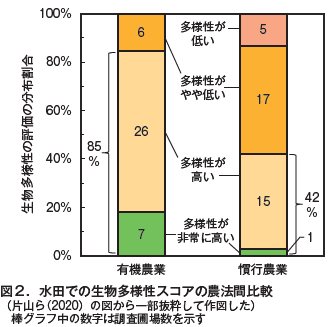
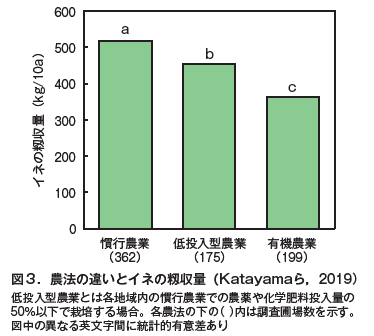
The higher yields in rice paddies in conventional agriculture than in organic agriculture are the result of the farmland's objective to protect the growth of rice plants in preference to other plants and animals, and to increase yields. Organic paddy farming recognizes the significance of protecting biodiversity by allowing the plants and animals that congregate in the paddy fields to coexist, even at the expense of rice yield.
Similar comparisons have been made in studies examining global reports for various crops, where crop yields in organic agriculture were about 75-80% of the same crops grown in conventional agriculture (De Ponti et al., 2012; Seufert et al., 2012).
However, this incompatibility between biodiversity and crop productivity in agricultural land is not limited to organic farming. For example, an interesting result was noted in a study of pastureland in the UK, where the type and amount of nutrients applied as chemical fertilizers, as well as treatments with and without acidification, continued for more than 160 years (Crawley et al., 2005).
When nitrogen application was increased using a chemical fertilizer (sodium nitrate), which is less likely to cause acidification of pasture soil over time in this study, a species of grass that responded well to fertilizer nutrients became dominant among the many grass species, reducing diversity. However, hay yield increased. Conversely, when nitrogen application was reduced, there were no dominant grass species in the pasture, and many grass species grew and diversity increased. However, hay yield decreased.
In the end, it can be understood that biodiversity on farmland is not a characteristic of organic agriculture alone, but reflects differences in thinking about whether priority should be given to the growth of cultivated crops on farmland or whether coexistence with other plants and animals should also be tolerated.
4. the meaning of the coexistence of organic and conventional agriculture
With the world population projected to reach 9.7 billion by 2050, food production through agriculture will become increasingly important to protect human life. Conventional agriculture attempts to increase production (yield) per unit land area by creating an environment that is beneficial to the growth of crops grown on that land. These efforts are essential to ensure a stable supply of food for people from the earth's limited land resources.
On the other hand, organic agriculture is necessary for those who want to support and share the goals and ethics of organic agriculture, and for those who cannot eat produce produced by conventional agriculture with peace of mind due to concerns about chemical substances. However, it is necessary to recognize once again that it is difficult to balance crop production with the preservation of biodiversity, which organic agriculture values, in the ecosystem of farmland.
2024年本誌既刊総目次
<1月号>
§ジェイカムアグリがなすべき事
ジェイカムアグリ株式会社
営業統括本部長 河村 光太郎
§コーティング肥料マイスター細粒の芝地における肥料効果試験
一般財団法人関西グリーン研究所
所長 森 将人
§土のはなし-第28回
農業と環境問題-その3
農地由来の窒素による大気汚染-アンモニア揮散
前 ジェイカムアグリ株式会社 北海道支店 技術顧問
松中 照夫
<2月・3月合併号>
§高温に負けない施肥法としての「苗箱まかせ」
株式会社ファーム・フロンティア
取締役会長 藤井 弘志
§土のはなし-第29回
農業と環境問題-その4
農地由来の窒素による大気汚染-一酸化二窒素排出
前 ジェイカムアグリ株式会社 北海道支店 技術顧問
松中 照夫
<4月号>
§園芸作物の光応答反応と農業技術(1)
-キクとイチゴにおける電照の現状-
元 岡山大学大学院自然科学研究科
桝田 正治
§土のはなし-第30回
農業と環境問題-その5
農業由来の温室効果ガスと地球温暖化
前 ジェイカムアグリ株式会社 北海道支店 技術顧問
松中 照夫
<5月号>
§園芸作物の光応答反応と農業技術(2)
-Theoretical background of light irradiation on flowers and vegetables and control of flower growth.
元 岡山大学大学院自然科学研究科
桝田 正治
§愛知県における農作物鳥獣被害防止対策の取組
愛知県農業水産局農政部農業振興課
野生イノシシ対策室
辻井 修
§土のはなし-第31回
危機に瀕する世界の土-その1
古代文明の崩壊と土の劣化
前 ジェイカムアグリ株式会社 北海道支店 技術顧問
松中 照夫
<6月号>
§育苗箱全量施肥法における稲わら還元の影響について
福島県農業総合センター
半澤 勝拓
安田 優衣
§土のはなし-第32回
危機に瀕する世界の土-その2
不適切な人間活動が土を劣化させる
前 ジェイカムアグリ株式会社 北海道支店 技術顧問
松中 照夫
<7月号>
§苗箱まかせの施肥作業時に役立つ早見表と施肥量調整のポイント
熊本県農業研究センター 生産環境研究所
土壌環境研究室
柿内 俊輔
§福井県における土壌環境の変遷と今後の対策
ジェイカムアグリ株式会社 西日本支店
技術コンサルタント 長谷川 彰
§土のはなし-第33回
危機に瀕する世界の土-その3
塩類集積による土の劣化とそのリスク
前 ジェイカムアグリ株式会社 北海道支店 技術顧問
松中 照夫
<8月・9月合併号>
§日本ナシ「幸水」に対する根域施肥と表面局所施肥を組み合わせた50%減肥技術
長野県南信農業試験場 栽培部
技師 塩原 孝
§テレビ番組〈満天☆青空レストラン〉にみる付加価値を意識した作物生産について
-果菜類・豆類編-
宮城大学 食産業学群
齊藤 秀幸
§土のはなし-第34回
危機に瀕する世界の土-その4
侵食による土の劣化
前 ジェイカムアグリ株式会社 北海道支店 技術顧問
松中 照夫
<10月号>
§テレビ番組〈満天☆青空レストラン〉にみる付加価値を意識した作物生産について
-葉茎菜類・根菜類・果樹編-
宮城大学 食産業学群
齊藤 秀幸
§土のはなし-第35回
危機に瀕する世界の土-その5
酸性雨による土の劣化
前 ジェイカムアグリ株式会社 北海道支店 技術顧問
松中 照夫
<11月号>
§タケノコ栽培の「働き方改革」
-緩効性肥料による施肥作業の省力化-
福岡県農林業総合試験場 資源活用研究センター
森 康浩
茶木 彩佳
(現 福岡県筑後農林事務所)谷崎 ゆふ
(現 福岡県農林業総合試験場 筑後分場)井手 治
§土のはなし-第36回
先進国経済が途上国の土や資源を収奪する
-その現実と環境破壊の事例から学ぶこと
前 ジェイカムアグリ株式会社 北海道支店 技術顧問
松中 照夫
<12月号>
§讃岐うどん用小麦「さぬきの夢2009」における肥効調節型肥料の全量基肥施用について
香川県農業試験場 作物・特作研究課
谷川 昭彦
§マイクロロングトータルによる加工・業務用タマネギの育苗作業の省力化の検証
茨城県県西農林事務所
坂東地域農業改良普及センター
林 可奈子
(現 茨城県病害虫防除所)
§土のはなし-第37回
農地は作物を栽培する土地である
-農地で生物の多様性をどう考える-
前 ジェイカムアグリ株式会社 北海道支店 技術顧問
松中 照夫
§2024年本誌既刊総目次