

Site Search
Search within product
第767号 2025(R7).01発行
Click here for PDF version
§日本と世界の農業の発展に向けて
Jcam Agri Co.
代表取締役会長 藤野 恭弘
§排水不良復旧農地における肥効調節型肥料の植え溝施肥によるネギ生育改善効果
Crop Environment Department, Furukawa Agricultural Experiment Station, Miyagi Prefecture
瀧 典明
§北海道の露地ねぎにおけるハイパーCDUの低肥沃度土壌への活用
地方独立行政法人 北海道立総合研究機構
Planning and Coordination Department, Agricultural Research Division
Stationed at Hokkaido Nuclear Environmental Center
佐々木 亮
§土のはなし-第38回
有機農業の養分源・堆肥生産の課題
-堆肥生産には労力と土地が不可欠-
前 ジェイカムアグリ株式会社
北海道支店 技術顧問
松中 照夫
For the Development of Agriculture in Japan and the World
Jcam Agri Co.
代表取締役会長 藤野 恭弘

Happy New Year!
At the beginning of the year 2025, I would like to extend my greetings to all the readers of "Agriculture and Science".
Yes.
As of June 19 last year, I assumed the position of Chairman and Representative Director of JCAM Agri Co. I would like to further enhance my recognition of the management policy since its establishment, "to contribute to agriculture and related fields in Japan and around the world through fertilizers," and I will make every effort to live up to your trust and expectations.
Last year, many parts of Japan were hit by disasters such as the Noto Peninsula Earthquake and the torrential rains and strong winds caused by Typhoon No. 10. We express our deepest sympathies to those who have been affected by these disasters, and we pray for the earliest possible recovery.
From a global perspective, the price of fertilizer raw materials has remained high due to continued instability caused by political instability, such as the escalating conflicts in Ukraine and the Middle East. Import prices of urea, phosphorus ammonia, potassium chloride, etc., the main raw materials, have doubled since 2020, partly due to the weak yen. As a fertilizer supplier, we will continue our efforts to supply "better products at lower prices" and contribute to the stable supply of food both domestically and internationally through our specialty products such as coated fertilizers and slow-release fertilizers.
In Japan, a decrease in the area under cultivation due to the aging of agricultural producers and a decrease in the agricultural population are recognized as major social issues. Under these circumstances, the "Revised Basic Act on Food, Agriculture and Rural Areas" was enacted last year as a national policy. The revised law aims to "shift to an industry in harmony with the environment" and "maintain and develop agricultural production under a declining population.
Based on specific measures, we will work to strengthen food security and structural transformation of agriculture. As a company that has supported agricultural production in terms of fertilizers, we have high expectations for the future development of the policy.
There is no doubt that fostering agricultural leaders is an urgent issue, and we recognize that the promotion of smart agriculture and the shift to an industry in harmony with the environment, in particular, are extremely important factors for the future development of Japanese agriculture. As a fertilizer manufacturer, we will continue to promote research and development in cooperation with related parties to find out what kind of products and performance will be required in this trend toward smart agriculture.
From the viewpoint of fostering industry in harmony with the environment, corporate activities focusing on global environmental considerations have been attracting attention in recent years. We, too, have been strengthening our efforts to reduce the environmental impact of the problem of outflows of coated shells from the field. We have developed a new J-Coat with plastic content reduced to about 3%, and plan to promote the replacement of existing products throughout Japan. We have already developed and introduced to the market IBDU and CDU, which are synthetic slow-release nitrogen fertilizers without plastic coating. As for the development of environmentally friendly coated fertilizers, we are also focusing on the development of biodegradable resin-coated fertilizers and non-plastic coated fertilizers. We are determined to contribute to the future of agriculture by accelerating the development of products to reduce the environmental burden, which is expected to become increasingly important in the future.
Finally, I would like to conclude my New Year's greetings by asking for your continued patronage of this issue of "Agriculture and Science" and wishing you a happy and prosperous new year.
Fertilizer Regulation in Restored Farmland with Poor Drainage
植え溝施肥によるネギ生育改善効果
Crop Environment Department, Furukawa Agricultural Experiment Station, Miyagi Prefecture
瀧 典明
Introduction
宮城県内三陸沿岸の畑地は,東日本大震災の津波とその後のガレキ処理により従前のほ場表層がほぼ消失した。もともと小規模の畑地が点在している地域であったが,営農の担い手が見込める地域では,農地復旧工事の中で畑寄せによるほ場の大区画化が行われるとともに,厚さ約30cmの山土の客土による畑地造成が行われた。
当地域では震災直前から重点品目の一つにネギ(長ネギ)が位置づけられていたため,復旧農地でも機械施設整備と併せて作付けが振興された。しかし,客土中に土壌有機物が少ないため低地力である上,土壌の締まりによる透水性の悪化傾向が見られ,排水不良によりネギ生育が安定しないことが問題となっていた。
On the other hand, in the cultivation of leeks, a one-shot base fertilizer containing a fertilizer with controlled fertilizer efficacy is sometimes used to save labor for fertilizer application, but these fertilizers are expected to have stable fertilizer efficacy even under poor conditions such as low fertilizer retention or excess soil moisture, and are therefore considered effective for stabilizing production in restored farmlands.
Therefore, this study examined a fertilization system that utilizes fertilizer with regulated fertilizer application in restored farmland with poor drainage.
2. Testing Method
(1) Outline of the test site
The field was located in a restored field in District T, Minamisanriku-cho, Miyagi Prefecture, Japan. The 30-cm surface layer of the field was a clayey clay layer, and the soil classification was "gravelly normal immature lowland soil (fine-grained brown forest soil fill development phase)." Leek planting in District T began in 2015, but because of wet damage, a 3% slope was constructed across the field as a surface drainage measure before cultivation began in 2017. As part of the construction work, 4 t/10a of cattle manure was applied as a soil preparation measure, but the soil organic matter content per 100 g of dry soil before the start of the 2017 test was 1.2 g and 0.2 mg of soluble nitrogen, far below the improvement targets (organic matter content of 3 g or more and soluble nitrogen of 5 mg or more) in the basic guidelines for soil fertility enhancement. The soil fertility was extremely low.
(2) Fertilization design
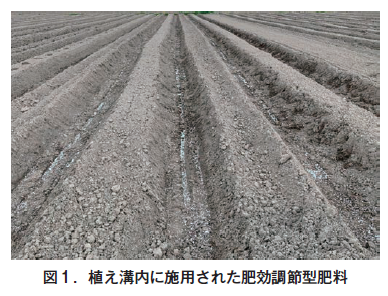
試験を開始した2017年は,基肥を全面全層施肥,追肥を土寄せ前に4回施用する対照区に対し,肥効調節型肥料を全量基肥として植え溝施肥する区を設けた(表1,図1)。肥料は,堆肥からのリン,カリウム供給を前提として低PKのエコロング250-100日タイプ(20-5-10)を用い,これに定植直後の肥効を補うためハイパーCDU細粒5の苗箱施用(西畑,2011)を組み合わせた。肥効調節型肥料を植え溝施肥する場合,慣行施肥量に対し2割削減可能とされることから(今野ら,1998),施肥量は対照区比83%とした。また,比較として肥効調節型肥料を全面全層施用する区を設けた。
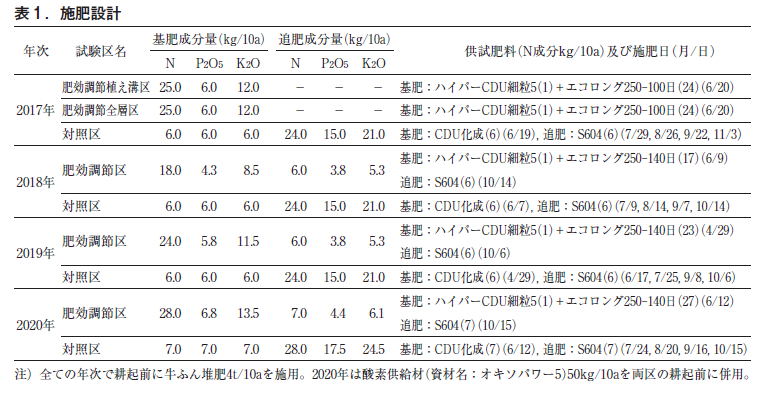
一方,2018年以降は肥効調節区の基肥は植え溝施用のみとし,2017年の結果を受けて溶出日数140日タイプに変更したほか,対照区の4回目の追肥と同量の追肥を1回行う体系とした。2019年は,肥効調節区の合計施肥量を対照区と同量にした。2020年は両試験区の合計施肥量をさらに5kg/10a増やし,加えて酸素供給材を併用した。
(3) Outline of cultivated species
The leek variety "Summer Fan Power" was used in all years, with 3-seedings of chainpot LP303 in 2017, 2019, and 2020, and 2-seedings of the same CP303 only in 2018, and the row spacing at planting was 90 cm. Planting and yield survey dates were June 20 and December 7, 2017, June 8 and December 7, 2018, April 29 and December 23, 2019, and June 12 and December 1, 2020, respectively. Pest and weed control were farmer practices. In all four years, the trials were conducted in separate fields in District T. The previous crop in all fields was leeks.
(4) Fertilizer nitrogen leaching process
In order to understand the leaching process of the fertilizer under field conditions, mesh bags containing 3 g of ECOLONG 250 were buried in the soil in the field. The bags were collected over time during the growing period of leeks and the amount of residual nitrogen was measured, and the percentage of nitrogen that decreased was used as the leaching rate.
Test Results and Discussion
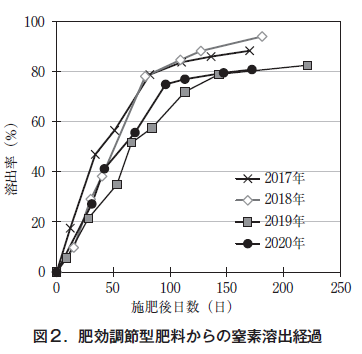
The nitrogen leaching from the test fertilizers measured by the field burial method showed that in 2017, when the 100-day type was used, the leaching rate exceeded 80% on October 8, 110 days after fertilizer application, and thereafter almost no fertilizer effect was observed for 2 months until harvest (Figure 2). Therefore, from 2018 onward, the 140-day type was used and the system was changed to one additional application of fertilizer. As a result, in 2018, when May-July tended to be hot, leaching was almost the same as in 2017, but in 2019 and 2020, leaching tended to persist until later in the season than in 2017.
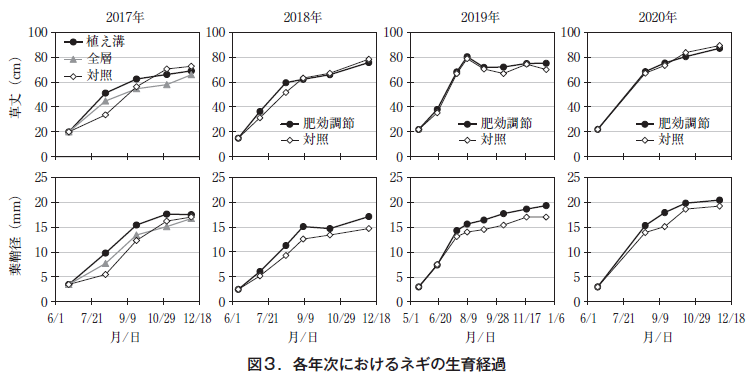
ネギの生育経過を見ると,2017年は,草丈,葉鞘径ともに肥効調節植え溝区が対照区を上回る値で推移し,収穫時には対照区の草丈が最も高くなったが,葉鞘径は肥効調節植え溝区が上回った(図3)。一方,肥効調節全層区は常に植え溝区を下回る値で推移し,収穫時は草丈,葉鞘径ともに3区で最も低い値となった。
In terms of growth and yield at harvest, the fertilizer regulated planting furrow area tended to outperform the control area in terms of stover weight and yield, but the differences were not statistically significant (Table 2).
On the other hand, the yield in the full-layer fertilizer-regulated zone was significantly lower than that in the other two zones. Kobayashi (1994) found that full-layer and row applications of fertilizer with regulated fertilizer produced similar yields in leeks grown with full basal fertilizer, but local application was considered more appropriate under poor drainage and low soil fertility conditions.
In 2018, the fertilizer design was changed to compensate for fertilizer efficacy in the second half of growth, resulting in higher grass height at harvest than the previous year (Figure 3) and higher yield trend than the control, but no significant differences were observed and the target yield of 3 t/10a was not reached (Table 2).
In 2019, when the amount of fertilizer applied in the fertilizer-controlled area was the same as in the control area and the planting time was accelerated, grass height in early August was the highest in four years, but growth was stagnant thereafter due to overgrowth of weeds caused by excessive soil compaction due to excessive moisture in the field during the rainy season (Figure 3). Even under such conditions, the leaf sheath diameter remained higher in the fertilizer-regulated area, and the stem and leaf weights and yield at harvest were also significantly higher in the fertilizer-regulated area (Table 2).
In 2020, the amount of fertilizer applied was increased to secure the target yield, and oxygen suppliers were used in combination, resulting in a yield of 3 t/10a in both the fertilizer-controlled and control areas, with a trend toward higher yields in the fertilizer-controlled area, although this was not statistically significant (Table 2).
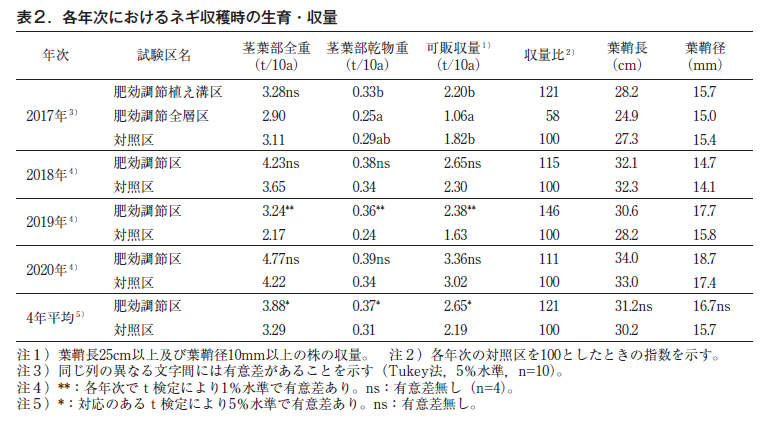
4年間の各項目の平均値(2017年は植え溝区の値)について対応のあるt検定をした結果,茎葉重,収量ともに肥効調節区が有意に高い値となった。なお,ネギ収穫時の茎葉のリン,カリウム濃度は両区で差がなく(データ略),肥効調節区のPK施肥量が少ないことの影響は見られなかった。
Summary
In leek cultivation on restored farmland with poor drainage and low soil fertility, a planting trench fertilization system using a regulated-release fertilizer as the base fertilizer resulted in a 20% higher yield than the conventional fertilization system (base fertilizer + four additional fertilizer applications), suggesting that this fertilization method is more effective than conventional methods. This may be due to the fact that in poorly drained fields, root growth is easily restricted by excessive humidity, but the gradual supply of nitrogen from the fertilizer with regulated fertilizer at the base of the leek plant may have accelerated recovery from the humidity damage.
works cited
1) Kobayashi, Y. 1994; Total basal fertilization of leeks with slow-release nitrogen fertilizers. Tochigi Prefectural Agricultural Experiment Station Research Results 13: 37-38.
2) Konno Y., Kuroda J., Kumagai K., Togashi M., Ueno M. 1998. Fertilizer efficiency in local application of total basal fertilizer to leeks. Tohoku Agricultural Research 51: 231-232.
3) Nishihata, H. 2011; Seedling Box Fertilizer Technology for Improving Early Growth of Leeks in Total Basal Fertilizer Cultivation. Agriculture and Science 632: 1-3.
In open-air leeks in Hokkaido
ハイパーCDUの低肥沃度土壌への活用
地方独立行政法人 北海道立総合研究機構
Planning and Coordination Department, Agricultural Research Division
Stationed at Hokkaido Nuclear Environmental Center
佐々木 亮
Introduction
Because open-air leeks prefer well aerated soils, they are often grown in sandy soils with good drainage. However, the reality is that leeks grown on sandy soil are often heavily fertilized. In addition, despite the high fertilizer content, a relatively high proportion of M- and S-standard green onions are shipped, and some growers have difficulty in securing the weight of a single green onion.
Therefore, we focus on pre-planting seedling box fertilization using Hyper CDU and present our study on fertilization of open field spring-sown leeks in soils with low nitrogen fertility and cation exchange capacity (CEC), such as sandy soils.
2. Testing Method
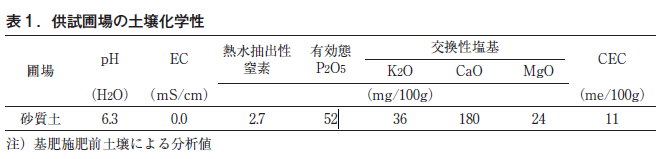
試験を行った圃場は北海道原子力環境センターの場内圃場で,熱水抽出性窒素が3mg/100g未満,CECが12me/100g未満の窒素肥沃度および陽イオン交換容量が低い砂質土である(表1)。露地ねぎの栽培は,栽植密度を条間1m×株間5cm×2粒/株の40粒/㎡とし,苗筒に日本甜菜製糖株式会社製チェーンポットCP303(264 株/冊)を利用した。苗箱施肥は特記がある区を除き,ハイパーCDU細粒2を利用し88g/冊を表面施用し,定植後換算で2kgN/10aとした。
Hyper CDU Fine Granules 2 is a slow-release nitrogen fertilizer with a nitrogen content of 30% and a fertilization period of 20 to 30 days for CDU (acetaldehyde condensed urea). CDU is a cyclized compound of two molecules of urea and two molecules of acetaldehyde, a fertilizer component mainly degraded (mineralized) by microbial degradation.
Test 1 was conducted in two cropping seasons in 2021-2022 with four levels of seedling box fertilizer application timing: no fertilizer, one day before planting, one week before planting, and two weeks before planting.
Test 2 was a comparison of Hyper CDU fine granules 2 and Hyper CDU fine granules 5 (fertilization period of 30-60 days) as a seedling box fertilization material comparison test. Seedling box fertilizer was applied one day before planting.
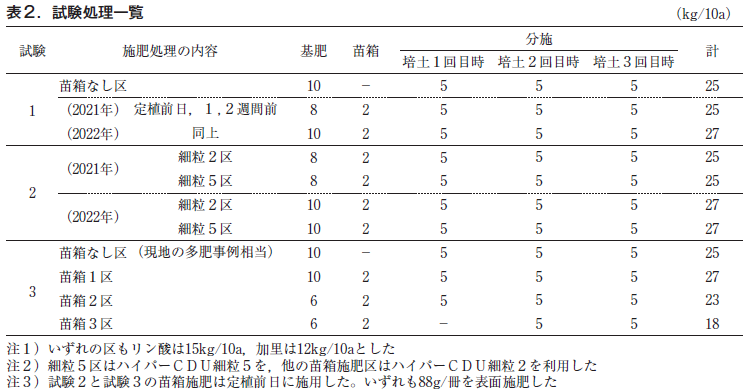
Trial 3 was a nitrogen fertilization trial, in which the treatments in Table 2 were applied in two cropping seasons in 2022-2023.
Results and Discussion
(1) Study of seedling box fertilizer application timing (Test 1)
We investigated whether seedling box application of fertilizer to open field leeks would cause problems such as fertilizer burn on seedlings, and when the best time to apply fertilizer would be. Under the conditions using Hyper CDU fine granule 2, which has a relatively fast leaching rate, seedling characteristics did not differ from those of seedlings without a seedling box and no fertilizer burn was observed when the box fertilizer was applied from two weeks before planting to the day before planting (Table 3). In addition, the applied fertilizer remained adhered to the surface of the seedling box and did not dissipate even after planting, and was applied at the base of the plant after planting. Growth and yield after planting tended to be higher in the area where fertilizer was applied to the seedling boxes than in the area where fertilizer was applied without the boxes (Table 4). There was no difference in the timing of fertilizer application.
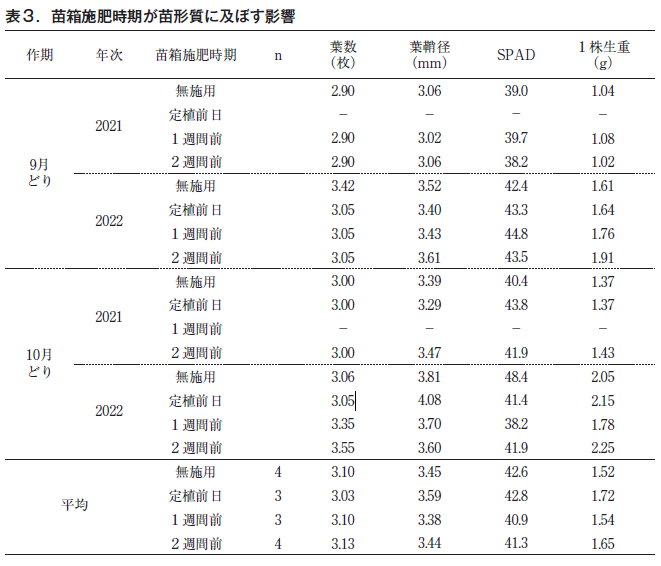
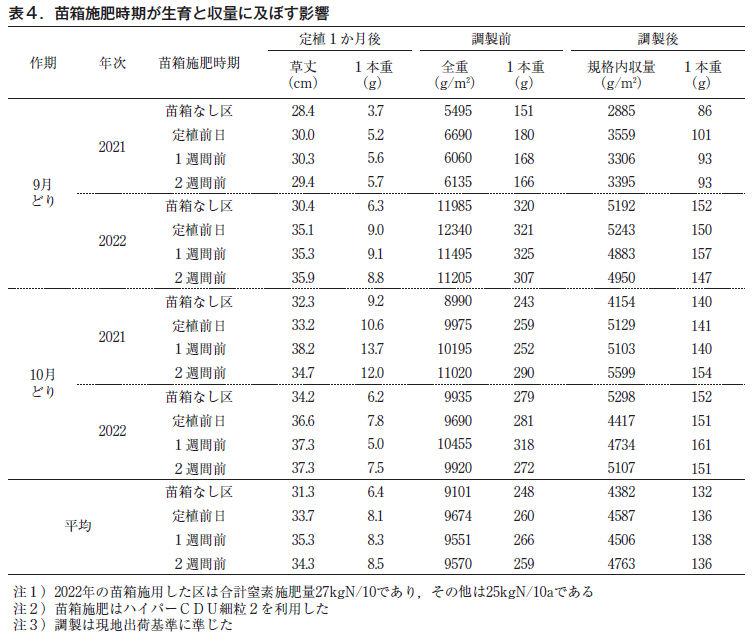
As shown above, seedling box fertilization using Hyper CDU fine granules 2 did not cause any problems with seedling quality and had the same effect on growth and yield after planting if the application time was within the range from two weeks before to one day before planting.
(2) Selection of seedling box fertilizer materials (Test 2)
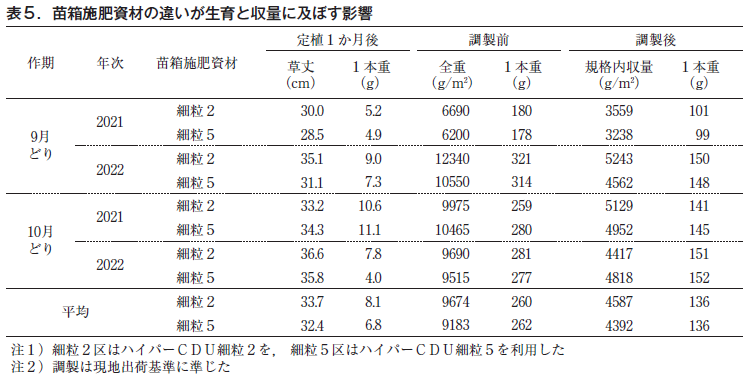
The effects of Hyper CDU fine grain 2 and Hyper CDU fine grain 5, which differ in nitrogen fertilization period, on seedling box fertilization of leeks in the open field were compared. Although there was no significant difference in plant height and one plant weight one month after planting, the fine CDU 2 tended to outperform the fine CDU 5 (Table 5). No problems were observed in the subsequent growth, and there was no discernible difference in the in-specification yield and weight per plant after preparation between the materials.
From the viewpoint of promoting early growth, Hyper CDU fine granule 2 was considered suitable as a seedling box fertilizer material because of its rapid elution.
(3) Examination of nitrogen fertilizer amount (Test 3)
Nitrogen fertilizer application rates were examined for a combination of seedling box fertilization, basal fertilization, and partial fertilization. First, SPAD values at 1 month after planting were higher in the group with box fertilization than in the group without box fertilization (Table 6). The higher the amount of nitrogen fertilizer applied, the higher the SPAD value. In this case, the SPAD value was higher in the "with 1" group than in the "without 2" group, where the amount of nitrogen fertilizer applied was higher. The same relationship was observed in the "Yes 2" and "No 3" areas. The application of seedling box fertilizer was considered to have a greater effect on the initial growth of the seedlings than the increase in the amount of base and partial fertilizers.
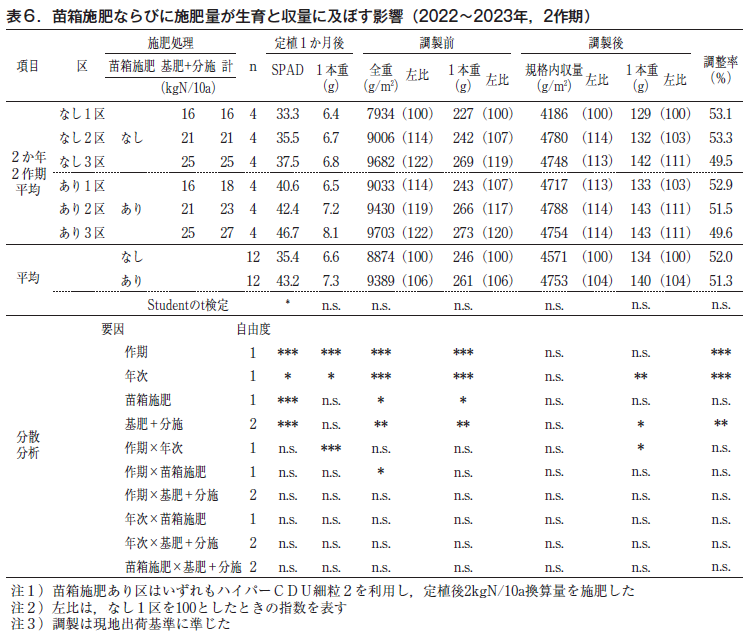
In terms of total weight before preparation and single seedling weight, the group with seedling box fertilization was heavier than the group without seedling box fertilization, and the higher the nitrogen fertilization level, the heavier the seedlings tended to be.
The post-preparation within-specification yields tended to be heavier in the group with seedling box fertilization than in the group without seedling box fertilization, but the nitrogen fertilization level was at a plateau with no discernible effect, except in the "no fertilization 1" area. Thus, the effect of nitrogen fertilizer level on pre-conditioning total weight and in-specification yield tended to be slightly different. In addition, the high nitrogen fertilizer application tended to cause more deformed plants (dwarfed plants) in the high nitrogen fertilizer application area.
To examine the appropriate amount of nitrogen fertilizer, we first focused on the "None 1" area. Its growth rate was remarkably small, and it appeared to be deficient in nitrogen nutrients. The amount of nitrogen fertilizer applied was set according to the standard amount in Hokkaido (18 kg N/10a of nitrogen fertilizer for soils with low nitrogen fertility in the Hokkaido Fertilizer Guide). However, it is necessary to study the amount of nitrogen fertilizer applied to soils with low nitrogen fertility and cation exchange capacity, such as sandy soil, as in the test conditions.
According to the results of the interview survey, the amount of nitrogen fertilizer applied to leeks in the open field is often higher than 25 kg N/10a. Although the yield and weight per plant of "Pear 3", which corresponds to this high fertilizer application, were higher than those of "Pear 1", the preparation rate was lower, and there were concerns about a decrease in production efficiency and an increase in labor for preparation and residue treatment.
そこで,調製率の改善と,規格内収量ならびに1本重の確保の両立が可能かどうかを検討した。表3に示した結果を区ごとに見ると,「あり2区」は窒素施肥量が上回る「なし3区」とほぼ同等の規格内収量と1本重で,定植1ヵ月後の生育と調製率は上回る傾向であった。「あり1区」も窒素施肥量が上回る「なし2区」とほぼ同等の規格内収量と1本重であった。
These results suggest that the combined application method with seedling box fertilization has the characteristics of better initial growth and higher fertilization efficiency than the conventional method of applying only base fertilizer and partial fertilization, thus ensuring good initial growth and in-specification yield even with reduced nitrogen fertilization, and increasing the preparation rate through reduced nitrogen fertilization.
(4) Study of workability and cost of seedling box fertilization
苗箱施肥は育苗床に設置したままのチェーンポット苗に対し,ハイパーCDU細粒2を定植前日までに施用する。施肥作業は育苗箱粒剤散布器や動噴など既存の機材が使用でき,専用の農機具を必要としない。施肥量は,264株/冊の苗筒を栽植密度20株/㎡で定植する場合,苗箱に88g/冊を施用すると,定植後に2kgN/10a換算となる。表面施用されたハイパーCDU細粒2は苗箱表面で固着し,そのまま定植されて株元施肥となる。この施肥量において,苗箱施肥によって生じる資材費は1840円/10aである。ただし,この資材費の増額は,減肥ならびに基肥が苗箱施肥分を調製して減ずる分の資材費減額によって相殺されることが見込める。このように,苗箱施肥は費用面の負担が軽微であると考えられた。
Summary
For open field spring-sown leeks in sandy soils with low nitrogen fertility and cation exchange capacity, a combination of pre-planting seedling box fertilization with a slow-release fertilizer (Hyper CDU) and a conventional fertilizer system of basal and partial application with chemical fertilizers was effective in ensuring early growth and yield while reducing fertilizer use.
No Soil - No. 38
有機農業の養分源・堆肥生産の課題
-堆肥生産には労力と土地が不可欠-
前 ジェイカムアグリ株式会社
北海道支店 技術顧問
松中 照夫
農地で作物を栽培すると農地の土にあった養分は作物に吸収され,その作物が収穫される時に農地から持ち出される。この収奪された養分を農地に補給しなければ,土の肥沃度は低下する。化学肥料が世の中に登場した19世紀より遙か前の時代,堆肥は農地から収奪された養分の補給に用いる養分移転資材として考え出された(詳細は本連載の第11回(2022年5月号)参照)。
In this article, we will consider the challenges of labor and land to produce and actively use compost as a nutrient transfer material, which is especially necessary in organic farming.
1. paddy rice cultivation does not require large amounts of compost due to the high natural supply of nutrients.
The widespread and general use of chemical fertilizers in the world is a relatively new story, having begun after World War II. Before that, compost was the main source of nutrients. However, the dependence on compost as a source of nutrients is small in rice cultivation and large in field cultivation. Let us first look at the rice crop to see why.
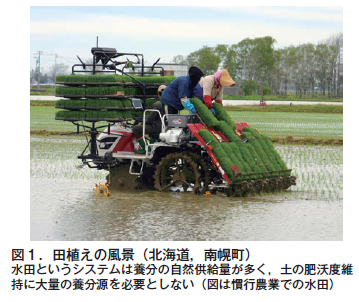
水稲が栽培される水田は湛水状態に置かれる。この時,用水に溶け込んでいた窒素やカリウムなどの養分は,用水とともに水田へ自然に供給される。同時に湛水条件の水田は,酸素不足の還元状態になる。もともと土の中で植物が吸収しにくい形態だったリンや鉄は,還元状態になると吸収されやすい形態へ変化して有効化する。水田というシステムは,このような自然からの養分供給量が多い。このため養分を積極的に与えなくても,土の肥沃度は大きく低下しない。
したがって,水稲作は土の肥沃度維持のために大量の養分源を必要としない。養分源としての堆肥への依存度が低いのはこのためである。水稲作で有機農業が成立しやすいのは,このような事情が一因だろう。
Therefore, the raw materials for producing compost as a source of nutrients were wild grasses and weeds growing outside of farmland, as well as leaves, branches, undergrowth, paddy field weeds, and straw, all of which could be collected through diligent human labor. In Japan, the use of livestock manure for compost production was not common, and livestock were mainly used as service animals.
2. crop rotation is a prerequisite for field cultivation, and composting using livestock is a source of nutrients.
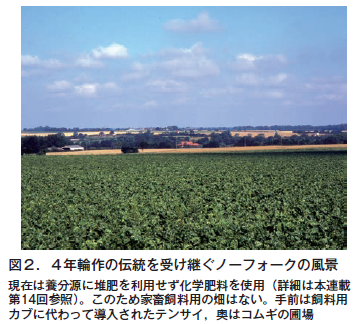
Field crops cannot be grown in rows like rice paddies, and crop rotation is a prerequisite for field cultivation. Furthermore, fields do not have a natural supply system of plant nutrients as rice paddies do. Therefore, if the fields are not supplied with nutrients, crop yields will drop dramatically. Therefore, before the advent of chemical fertilizers, farmers relied heavily on compost as a source of nutrients. The idea of actively using livestock in field crop areas, especially in Europe, was then conceived. The final result was the four-year crop rotation of the Norfolk method, which was perfected in England in the 19th century.
In Norfolk farming, forage crops (fodder turnips and red clover) are grown to feed livestock, which absorb nutrients from the soil, and then the feed is fed to livestock, which collect the nutrients in the form of manure. Livestock are kept in barns, so the recovery rate of manure is high. Finally, the manure is used as a raw material to produce compost, which is then fed to the fields for human food production (wheat and barley are grown), thus establishing a nutrient cycle system within the farm. This super-intensive farming method, which maximizes the use of manure as a source of nutrients, has been so revolutionary that it has doubled the production of wheat (for details, see Part 11 of this series).
3. the origin of the Norfolk farming method is the Flemish saying
ノーフォーク農法発祥の地の対岸,ヨーロッパ本土のフランドル地方(現在のオランダ南部からベルギー西部,フランス北部地域)には古くから「飼料なければ家畜なし,家畜なければ肥料なし,肥料なければ収穫なし」との格言がある。ヨーロッパの輪作で,養分源としての堆肥が果たす役割の大きいことをこの格言は物語っている。これはまさにノーフォーク農法の原点である。
There is another important point to be made in this adage. That is, the production of compost as fertilizer requires feed for livestock. As the saying goes, compost cannot be produced as a source of nutrients without producing crops that feed livestock (forage crops), not human food. That is why Norfolk Farming allocated half of the land area on the farm to fodder crop production, and added fodder turnips and red clover to the crop rotation. This increase in forage production increased the number of livestock that could be kept, which in turn greatly increased the amount of manure produced. Thus, it became possible to increase the production of manure as a source of nutrients. The increased production of manure increased the amount of inputs to the farmland, and the amount of nutrients given to the farmers increased. The result was an almost doubling of wheat yields, as already mentioned.
To support this, however, it was necessary to allocate half of the farmland for nutrient source production, i.e., cultivation of forage crops for livestock feed. This was a major land use challenge for the Norfolk farming method, which uses nutrient cycling to maintain soil fertility and sustain high crop production. The land area for human food production is only half of the farmland.
4. land for producing livestock feed is required for compost production using livestock.
How to secure the source of nutrients is an important issue when producing crops on a certain area as organic farming in field crops. It is important to remember that even in field crops, if we try to maintain soil fertility through nutrient cycling using livestock, as in Norfolk farming, labor for livestock rearing and land for livestock feed production are required in the cycle system. The amount of feed produced on the land determines the number of livestock that can be kept on the farm. The number of animals determines the amount of manure produced, which in turn determines the amount of manure produced. As the Flemish saying goes, "Without feed there is no livestock, and without livestock there is no manure.
5. what to do about the increased labor burden of compost production
家畜を利用しない畑作であっても,有機農業が目指す養分循環型の作物生産では,養分源の堆肥は循環系外で生産されたものを持ち込むのではなく,自給すべき資材である。緑肥の利用や作物の収穫残渣を利用した堆肥生産で養分源を確保する必要がある。しかも使い勝手の良い完熟堆肥とするには,堆肥の切り返しなどの管理労力を必要とする。有機農業に取り組む農家が,その面積を縮小する最大の理由は労力がかかることだという(農水省,2022)。除草の他に堆肥生産で増える労働負担をどうするかも大きな課題だ。
農林水産省が2021年5月に立ち上げた「みどりの食料システム戦略」は,2050年までに有機農業を全耕地面積の25%,100万haに拡大することを目指すという。しかしこの面積へ養分補給するのに必要な有機質肥料生産のことを,熟慮されているのだろうか。はなはだ疑問である。