

Site Search
Search within product
第715号 2019(R1).11発行
Click here for PDF version
§ Fertilization management of park trees by local residents
齊藤 秀幸1・菅原 心也1・沓沢 ミエ子2・由利 真人3・橋本 大樹4・辻 信一5
(1宮城大学・2つばめの杜公園管理会・3山元町役場・4山元復興ステーション・5神戸まちづくり研究所)
§ Integrated control of above-ground and below-ground management to support smart agriculture in horticulture facilities
National Agriculture and Food Research Organization
Vegetable and Flower Research Division
岩崎 泰永
Fertilization management of park trees by local residents
齊藤 秀幸1・菅原 心也1・沓沢 ミエ子2・由利 真人3・橋本 大樹4・辻 信一5
(1宮城大学・2つばめの杜公園管理会・3山元町役場・4山元復興ステーション・5神戸まちづくり研究所)
Introduction
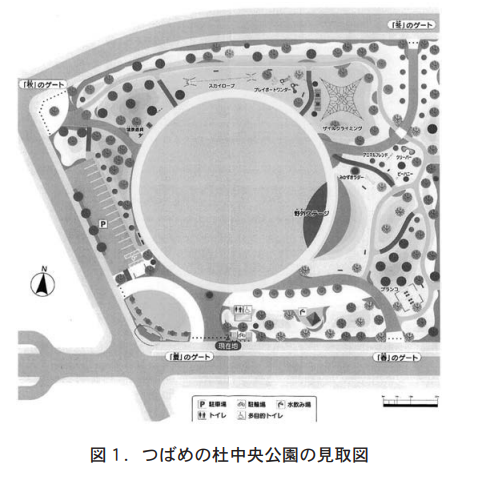
In late March 2016, five years after the Great East Japan Earthquake, Tsubame no Mori Central Park (Yamamoto Town, Watari County, Miyagi Prefecture) was opened. The park is a lush green park with a lot of playground equipment, and each entrance and exit is planted in consideration of spring, summer, fall, and winter (Figure 1). In March 2017, the following year, the "Tsubame no Mori Park Management Association" (hereafter, "Park Management Association") was established by volunteer residents mainly from the Tsubame no Mori area (about 20 members), with the aim of improving the park through collaboration between residents and the government. While inspecting playground equipment and picking up trash as part of their activities, some residents voiced their concern that the trees in the park lacked vigor.
2. survey of trees (vigor) in the park
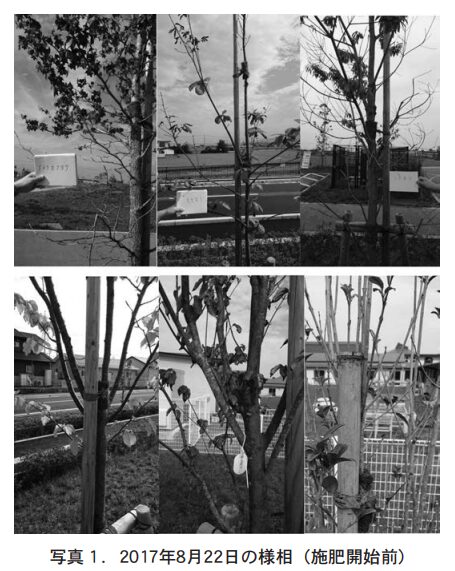
A preliminary survey was conducted on August 22, 2017, and a full visual vigor survey of all 156 trees in the park was conducted on August 27, 2017. The results of the preliminary survey indicated that none of the trees were considered to be fully grown, and all were considered to be weakened to varying degrees (Photo 1).
Some of them were already partially or completely dead. It seemed that some of the branches were allowed to die in order to concentrate the surviving parts (the parts with leaves) in a certain area within the same tree for the sake of survival. This was thought to be a device to prevent the dispersion of nutrients. Therefore, in the August 27th survey, we classified the vigor of the trees into three levels.
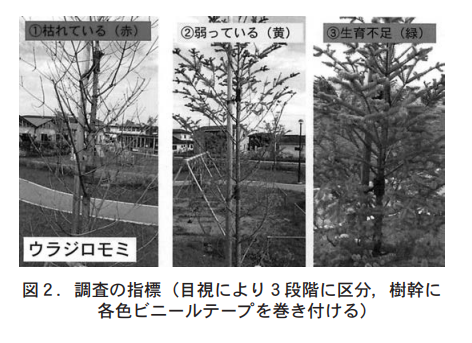
That is, as shown in Figure 2.
(1) dead (not a single leaf, twig breaks without squeezing), (2) dead (not a single leaf, twig breaks without squeezing), (3) dead (not a single leaf, twig breaks without squeezing), (4) dead (no leaves)
Weak (barely any leaves left, about to wither)
(iii) Insufficient growth (leaves but poor color, branches not spreading)
The three levels were indicated by wrapping red, yellow, and green tape around the trunk, respectively.
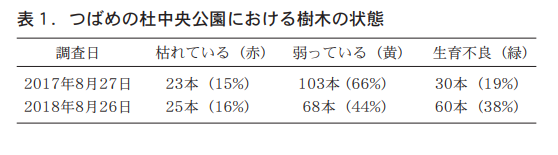
As a result, the
1) dead; 23 trees (15%),.
(2) Weak; 103 (661 TP3T),.
(iii) Poor growth; 30 (19%)
Table 1).
3. fertilizer management in 2017
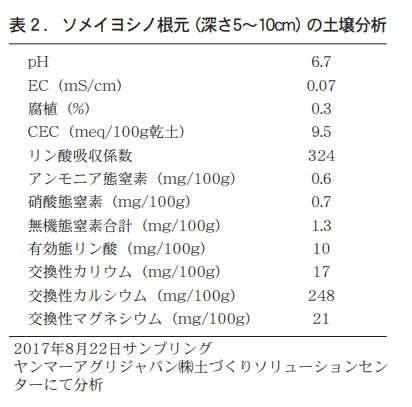
As a result of the survey, it was feared that if no action was taken, the vigor of the tree would weaken further, which would affect overwintering, and so it was decided to urgently manage the fertilizer. The topsoil (5 to 10 cm deep) was found to be deficient in each fertilizer component, but excessive in calcium (Table 2). This may be due to the effect of soil improvement after the earthquake.
Liquid fertilizer (61 TP3T nitrogen, 101 TP3T phosphate, 51 TP3T potash, and trace amounts of bitter soil, manganese, and boron) at 500 times was applied six times on September 5, 16, 19, 26, October 3, and 10. The spraying was done in collaboration with members of the park management association and town staff. Normally, a dilution of 250 times is the standard for garden trees, but considering the fact that fertilizer absorption was declining, a thinner dilution was used and the number of applications was increased.
4. 2018 fertilizer management
Last year, first aid was provided by the Park Management Association, but in 2018 fertilization was managed by the town based on soil analysis results (Table 2). The fertilizers used in the fertilization included a drench fertilizer (Green Pile by Jaycam Agri Co.) and slow-release fertilizers (nitrogen 10%, phosphoric acid 10%, potash 10%, and bitter soil 1%). Fertilizer was applied in early May.
5. results of fertilizer management over the year (August 27, 2017 - August 26, 2018)
In the August 27, 2017 survey, (1) dead; 23 (15%), (2) weak; 103 (66%), (3) poor growth; 30 (19%), but one year later on August 26, 2018, (1) dead; 25 (16%), (2) weak; 68 ( 44%), and 3) poor growth; 60 trees (38%) (Table 1). The number of plants in (1) increased by only 11 TP3T, while the number of plants in (3) increased by about 201 TP3T. In short, many of the "weak" stage in (2) were promoted to (3) "poor growth".
6. fertilizer management in 2019
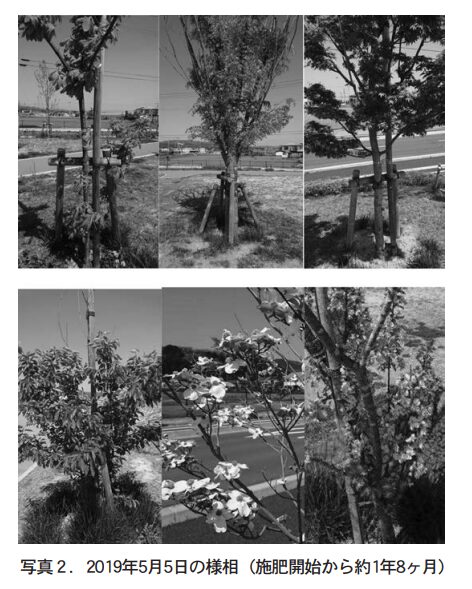
The condition of the tree on May 5, 2019 was as shown in Photo 2. The green color has become darker, and the vigor of the tree seems to have recovered. Fertilizer management by the town is continuing this year; granular organic 1001 TP3T fertilizer (61 TP3T nitrogen, 61 TP3T phosphate, and 41 TP3T potash) was applied on or about January 20.
7.まとめ
Many trees are planted in parks, but in most cases, the soil environment is not conducive for them. In many cases, it is difficult to say that proper fertilizer management is being carried out. However, in this park, the enthusiastic efforts of local residents and the support of the town have been effective, and the trees are recovering their vigor.
Supporting Smart Agriculture in Facility Horticulture
地上部管理と地下部管理の統合的制御
National Agriculture and Food Research Organization
Vegetable and Flower Research Division
岩崎 泰永
Introduction
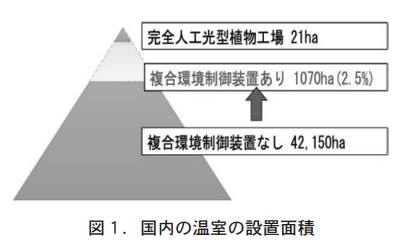
施設野菜の生産現場ではCO2濃度,気温,湿度,気流などを作物の生育に好適な範囲に維持する環境制御技術に対する関心が急速に高まっており,多くの機関や民間企業で環境制御についての研究や技術開発,製品開発が行われるようになっている。しかし,国内の施設栽培面積のうち複合環境制御装置を備えた施設はわずか2.5%にとどまっている(図1) 。筆者ら農研機構野菜花き研究部門つくば拠点では環境制御技術の理論や具体的な手法を明らかにすることによって,環境制御技術を生産現場に広く浸透させ,生産性の向上や,生産者の収益向上,競争力強化を進めることが第一の目的である。
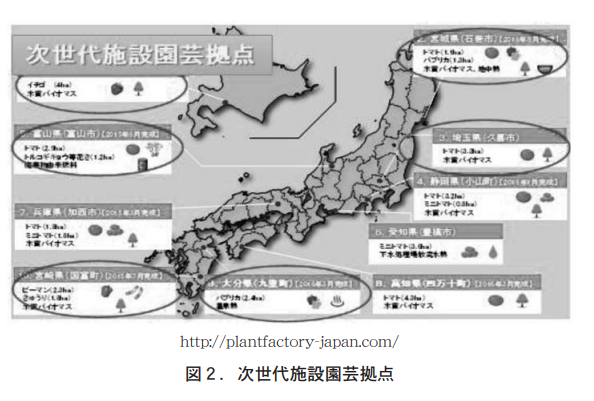
The Ministry of Agriculture, Forestry and Fisheries (MAFF) has established 10 hectare-scale demonstration facilities throughout Japan as part of its "Project to Accelerate the Introduction of Next-generation Horticulture" (Figure 2) to demonstrate and establish a Japanese model of horticulture that utilizes employment to expand the scale of production and makes effective use of local energy.
On the other hand, research on nutrient solution cultivation was active in the 1990s, and a wide variety of research was conducted on the development of nutrient solution cultivation systems such as rockwool and NFT, medium, culture medium formulation, circulation of culture medium, and sterilization of culture medium. However, at present, there are very few examples of research and development of new products. In essence, environmental management as aboveground management and culture medium management as belowground management mutually influence each other, so if environmental conditions change, culture medium management should be changed accordingly. In the next-generation horticultural facilities, with the exception of a few, liquid culture has been introduced, and there is room for improving yield and quality by comprehensively optimizing environmental management and culture medium management together.
In this section, we will consider environmental control and the development of hydroponics technologies that may be necessary in the future from this perspective.
2. utilization of ICT and AI
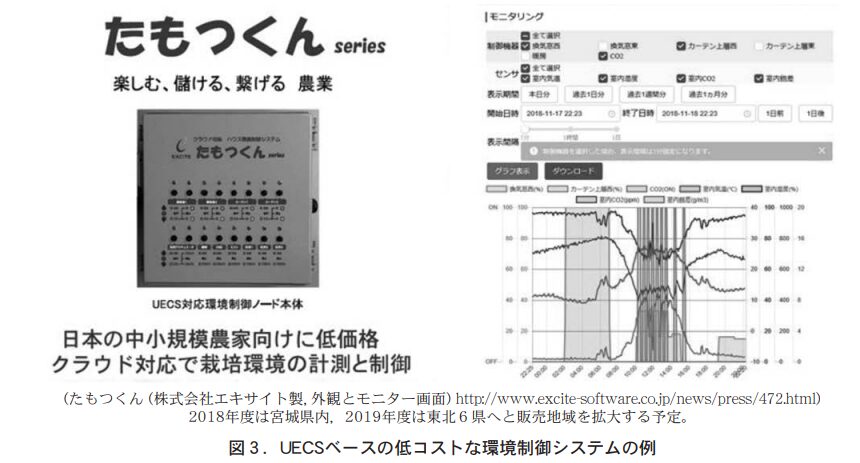
The National Institute of Agro-Environmental Sciences (NIAS) has been developing an environmental control system using the Ubiquitous Environmental Control System (UECS, http://www.uecs.jp). UECS is an open standard for environmental control systems for horticulture, and a major feature of UECS is that sensors and control devices using the UECS standard can exchange data even if they are from different manufacturers. The main feature of UECS is that data can be exchanged among sensors and control devices that adopt the UECS standard, even if they are made by different manufacturers. The National Institute of Agro-Environmental Sciences (NIED) is developing a UECS-based environmental control system in cooperation with private companies (Figure 3).
クラウド対応の環境モニタリングシステムが安価に市販されるようになり,気温,湿度,CO2濃度など栽培環境の情報の収集は極めて容易となった。一方,これらのデータの活用方法については,決まった方法がなく,多くの生産現場で試行錯誤が続いている。宮城県農業・園芸総合研究所は環境情報と生育情報をウィークリーレポートとしてまとめ,環境制御の設定に反映する手法を提案した(図4) 。
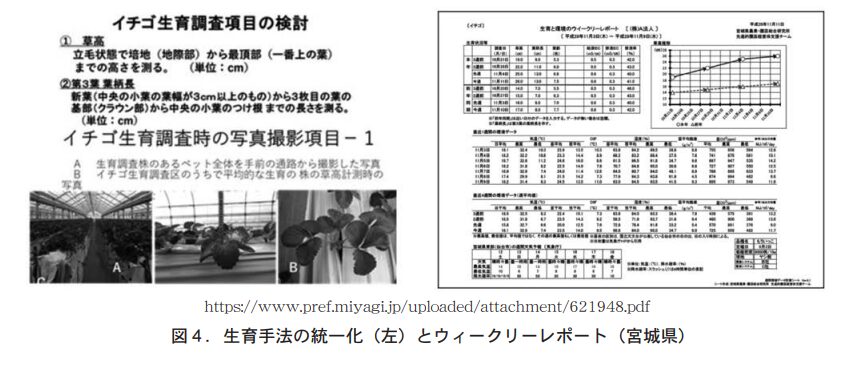
この手法は宮城県下の多くの生産現場で活用されており,最近では複数の生産者がグループを形成し,グループ内で情報を共有し,ノウハウの蓄積に役立てている。環境データが容易に収集蓄積できるようになった一方で,生育データの収集は,現在も人手による生育調査が中心となっており,生育データの収集は生産現場では大きな負担となっている(図5) 。
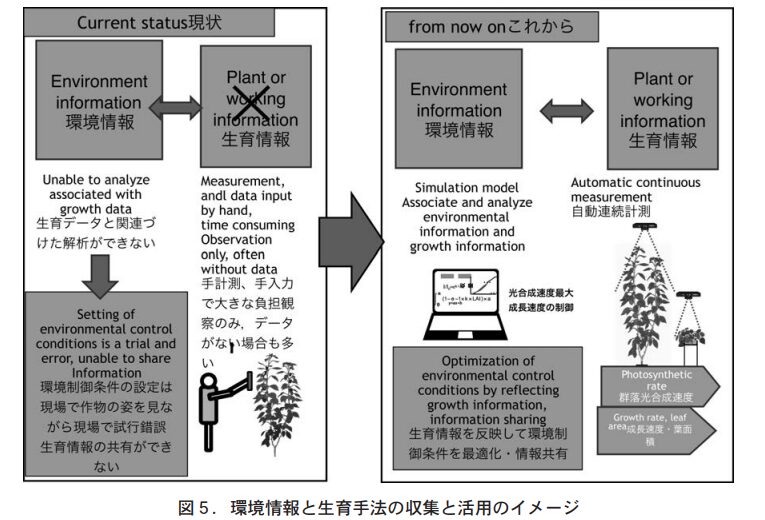
現実には単なる観察だけで数値データがない場合も多い。さらに,苦労して,環境データと生育データをセットで収集できたとしても,両者の関係を解析するきまった手法は確立されていないという問題もある。両者の関係を読み解くには「勘と経験」だけが頼りとなりがちである。筆者らは,3次元形状センサ(キネクト)を利用して,作物群落の葉面積と草丈を非接触で連続的に収集するシステムを開発している(図6) 。
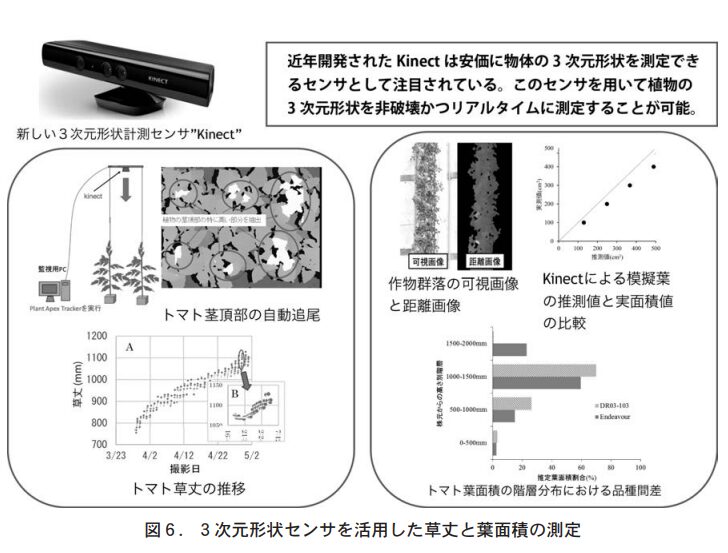
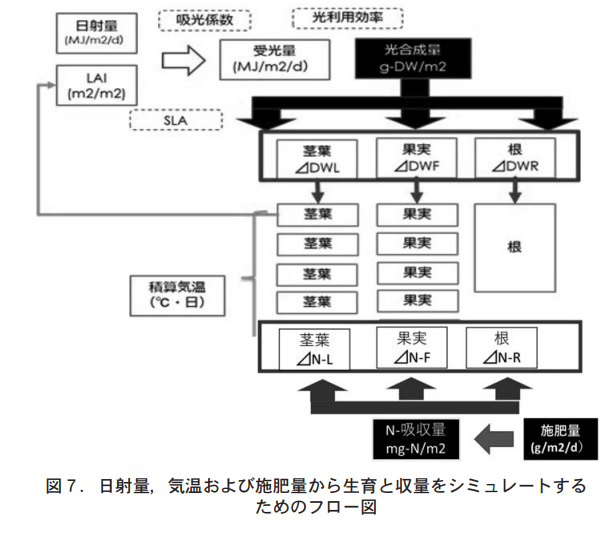
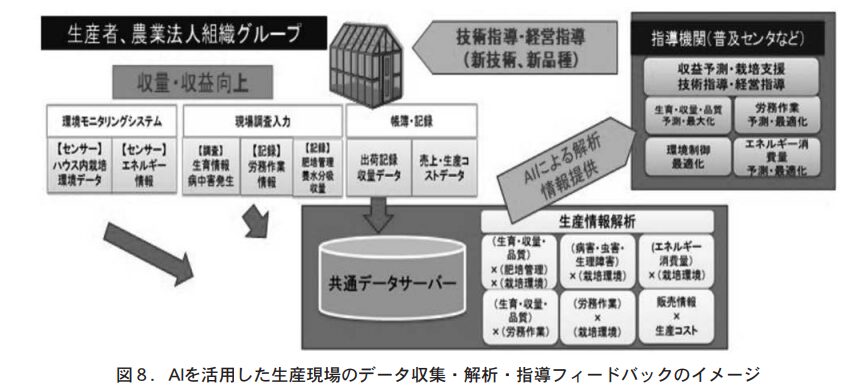
A method for estimating nutrient status in three dimensions and automatically measuring the number of flowers and fruit set is also being developed at the same time. Once such systems are available in the field, the collection of growth information should be greatly enhanced. We are also developing a growth simulation model to analyze environmental and growth data (Figure 7). If environmental management and growth information can be automatically collected and used for subsequent management, and if information can be accumulated and shared for mutual use, the value of this information will greatly increase, and the collection and accumulation of this information will further advance (Figure 8).
3. environmental management and culture medium management
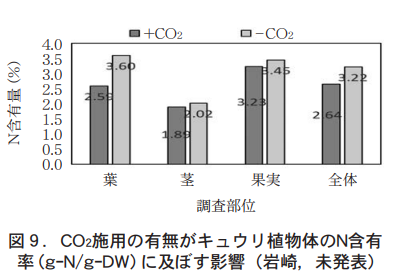
作物が正常に生育するためには,体内の養分含有量,とくに窒素濃度がある範囲内に維持される必要がある。したがって,光合成量が多くなればそれに対応して養分の必要量も多くなる。CO2施用によって収量が増加すれば,それに伴って施肥量を増やさなくてはならない。光合成量は日射量に対応して変化するので,養分供給量は日射量に合わせて増減させるべきである。Maruoら (2001)は日射量を積算し,積算日射量に応じた養分量を日単位で施用する日射比例低濃度量的管理を提唱している。CO2施用によって光合成量が増加した場合は,養分供給量をそれに合わせて増加させないと,養分含有率が低下し(図9) ,生育が遅延したり,病害が発生しやすくなる。
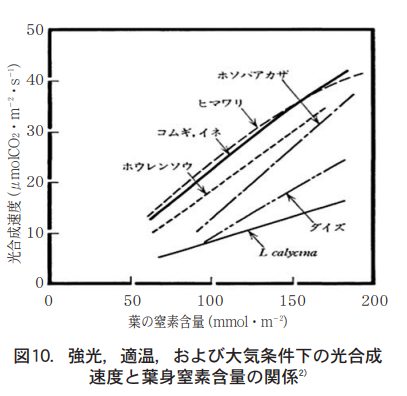
葉身窒素濃度と単位葉面積あたりの光合成速度には比例関係があることが知られており(牧野・前,1994,図10) ,窒素欠乏状況の作物では,CO2施用の効果は期待できない。CO2施用を効率よく行うためには,適切な作物の養分状態が前提となる。つまり,日射量やCO2濃度に応じて,養分管理を最適化する必要がある。
4. sink-source balance control
In the cultivation of fruit and vegetable crops, it is important to maintain moderate grass vigor throughout the growing season, and for this purpose, it is necessary to adjust the sink-source relationship to an appropriate range. Even if the amount of photosynthesis (source intensity) increases, the yield will not increase unless the number of flowers and other factors such as photosynthetic product "sink intensity" are increased accordingly. If photosynthetic output continues to be excessive (excess source intensity), grassiness will become stronger, and the plant will tend toward nutrient growth, resulting in delayed flower bud differentiation and more malformed fruit. Conversely, under-sourcing of photosynthesis results in a weakening of grass vigor, a decrease in leaf area, and lower yields. Sink intensity is often regulated by controlling the average temperature. Newly emerged new leaves also function as sinks, so increasing average temperatures speeds up leaf development and increases sink intensity in the short term.
従来,環境制御の技術や知見が一般的ではなかったときは,草勢や栄養成長と生殖成長のバランスはもっぱら養水分管理によって調節されてきた。例えば,土耕でトマトを栽培する場合には定植直後は水分を与えず,肥料の吸収を抑えて,栄養成長が強くなりすぎることを避け,また,草勢が弱いときは潅水を多めにして,養分の吸収を促進するといった管理が一般に行われてきた。光合成量は主として受光量,CO2濃度および葉面積によって決まる。養分供給量の調節は葉面積の調節を通して,光合成量(ソース強度)を調節し,草勢の調節を行ってきたといえる。中野ら(2006)が提唱している養分供給量の「量的管理」は,窒素供給量を日単位で制限し,葉面積を調節することに意味がある(図11) 。
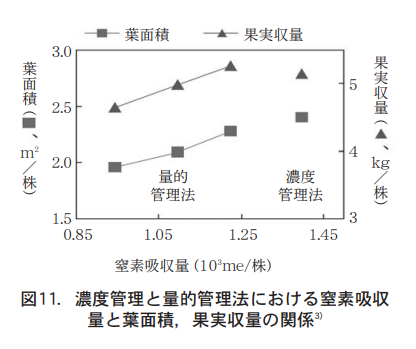
In general concentration management (EC management), it is difficult to control nutrient absorption because the rate of nutrient absorption varies with transpiration rate and irrigation frequency. Quantitative management controls the amount of light received by limiting the expansion of leaf area, regulating photosynthesis, matching sink and source intensities, and at the same time increasing the fruit distribution rate by distributing the photosynthetic products invested to produce new leaves to the fruit. However, concentration control (EC control) is still commonly used in hydroponic cultivation. Recently, in addition to regulating average temperature, techniques to regulate sink-source balance by leaf plucking and additional lateral branch elongation are becoming more common. Combining these techniques with leaf area control by nutrient supply (mainly nitrogen) may provide more efficient regulation of sink and source strength.
5. culture medium management under semi-closed management conditions
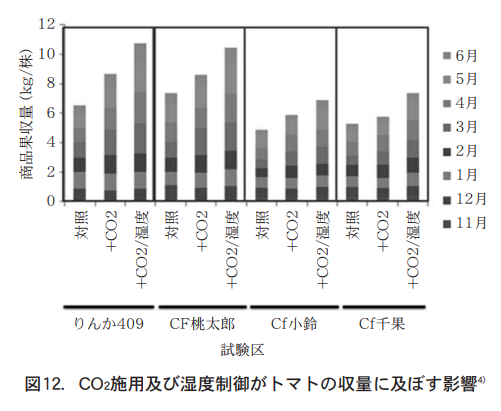
半閉鎖型管理とは,日中できるだけ換気を抑制し,CO2供給装置やフォグ発生装置を用いてCO2濃度や湿度を作物の生育に好適な範囲に維持するもので,環境制御の基本となる考え方である。天窓や側窓の換気開始温度を高めに設定したり,遮光・遮熱資材(フィルム,カーテン,塗料)やヒートポンプを冷房運転して換気を抑制し,湿度を高めに維持することによって,気孔開度が増加し,葉内CO2濃度が高くなり,光合成速度が増加する。過度の蒸散が抑制されるため,水分ストレスが緩和され,細胞肥大が促進されることによって葉面積が拡大して受光量が増加して光合成量の増加につながったり,生育速度が向上し収量が増加する(岩崎ら,2011,図12) 。
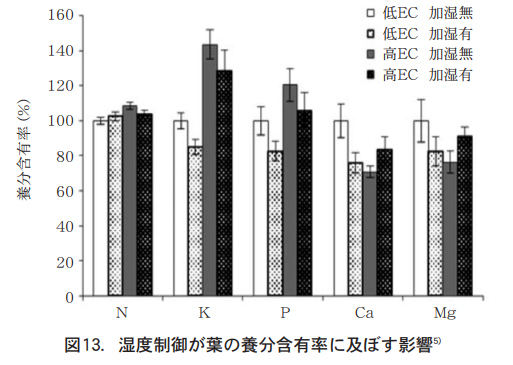
On the other hand, the transpiration rate from leaves decreases, leading to a decrease in the rate of water absorption from the roots, which may result in a shortage of fertilizer components absorbed together with water (Suzuki et al., 2015, Figure 13). In other words, under semi-closed management conditions, humidity needs to be regulated to maintain transpiration rate within an appropriate range, and at the same time, culture medium concentration and composition need to be optimized; however, to date, culture medium management suitable for semi-closed management has not been clarified.
In cold climates, however, the temperature inside the greenhouses does not rise during the winter due to low solar radiation and low outdoor temperatures, resulting in little ventilation during the daytime. The humidity inside the greenhouses increases easily both at night and during the day, and nutrient deficiencies are likely to occur due to reduced evapotranspiration. In the past, tomatoes and cucumbers were planted twice a year in such areas, and in many cases, there were no crops in the greenhouses during the severe winter season. Recently, large-scale corporate farms in such areas have begun to introduce an annual, long-duration cropping system in which crops are planted in the fall, over-wintered, and harvested until early summer of the following year, and similar problems are becoming apparent.
Nakano et al. (2015) compared the exit rate of conduit liquid coming out of the cut end of a Dutch and Japanese cultivar grown in nutrient solution after cutting the above-ground portion at the time of 7th flower cluster flowering, and reported that the Dutch cultivar had significantly higher Ca concentration in the exit liquid. Because the Netherlands receives less solar radiation than Japan, ventilation through skylights tends to be lower. As a result, the humidity in the greenhouses is likely to remain high, and varieties that can absorb nutrients under high humidity and low transpiration may have been selected.
6. Conclusion
In the past, temperature settings for skylights and heaters were often determined according to local practices. Recently, with the spread of knowledge and technology for environmental control in production, there are many cases where settings are intentionally determined, such as changing the temperature setting to adjust the growth rate. On the other hand, the amount of fertilizer applied and the amount of nutrients supplied are probably still determined according to conventional practices in both soil cultivation and hydroponics. Techniques for predicting crop growth and yield based on solar radiation and temperature are also being developed. Tools are being developed to estimate leaf area, photosynthesis, and yield from solar radiation, temperature, and fertilizer application (first of all, nitrogen supply), and to consider optimal environmental control and culture medium management.
Bibliography
(1) Maruo, T., Hoshi, H., Hohjo, M. et al. (2001):Acta Hortic. 548: 133-140.
(2) Makino, Shu and Tadahiko Mae (1994): Chemistry and Biology, VOL.32:409-413.
(3) Nakano Y., Watanabe S., Kawashima H., et al. (2006) :Zonogaku Zasshi 75 (5) : 421-429. 2006.
(4) Yasunaga Iwasaki, Shin-ichi Miura, Yusuke Otsuki (2011) :Sonogakken 10 (Supplement) 2:455.
5) Suzuki, M., Umeda, H., Matsuo.S., et al (2015) : Scientia Horticulturae,187, 44-49.
6) Nakano, A., Ando, H., and Higashide, T. (2015) :Vegetable Tea Research Report. , 14, 57-63