

Site Search
Search within product
第743号 2022(R04).08-09発行
Click here for PDF version
§露地夏秋どりねぎにおける被覆燐硝安とリン酸質肥料のチェーンポット内施肥技術
地方独立行政法人 北海道立総合研究機構
Donan Agricultural Experiment Station, Agricultural Research Division
Research Department Production Technology Group
主任主査(栽培環境) 大橋 優二
§上益城地域における農協営農活動の変遷と私の出合
農事組合法人 かしま広域農場
Former President and Representative Director
(現 特別顧問)工藤 健一
No § Soil - No. 14
養分源が堆肥から化学肥料へ変化する時代
−その歴史的経緯−
Jcam Agri Co.
北海道支店 技術顧問
松中 照夫
Coated phosphorus nitrate and phosphorus nitrate in open field summer/autumn green onion
リン酸質肥料のチェーンポット内施肥技術
地方独立行政法人 北海道立総合研究機構
Donan Agricultural Experiment Station, Agricultural Research Division
Research Department Production Technology Group
主任主査(栽培環境) 大橋 優二
Introduction
全国のねぎの出荷量(令和元年)は千葉県の約59千tに次いで埼玉県,茨城県,群馬県が上位を占め,北海道は約20千tを出荷する全国5位のねぎ生産地である1)。北海道のねぎ栽培は主に渡島地域(北海道の南西部)や空知地域(同中央部),十勝地域(同南東部)で盛んに行われている。とくに渡島地域は道内収穫量の37%(令和元年)と多くを占めており,道外への出荷量が約5千tと他地域に比べ5〜10倍多い2)The following is a list of the most common problems with the "C" in the "C" column.
露地ねぎ栽培では秋冬期に生産量が多い関東の生産地に対し,気象条件が異なる北海道は夏秋どりが主流である。露地春まき夏秋どり作型の窒素施肥量は作付け前の土壌診断に基づく施肥対応3)で「9〜18kg/10a(分施1〜2回)」と示されているが,生産現場では多肥栽培を行う事例も多く見受けられ,環境負荷低減やコスト削減の観点からも窒素減肥技術の開発が求められる。
こうした中,他作物の生産現場では作物の生育ステージに見合う養分供給が可能となる肥効調節型肥料の利用が進んでいる。本肥料には土壌中の温度と水分に反応して徐々に窒素養分が放出される「被覆燐硝安」があり,とりわけ初期の窒素溶出が抑制される「シグモイド型」は苗の生育に悪影響を与えずに育苗段階での利用が可能とされる。これにより,定植後の露地圃場(以下,本圃と略)での栽培に必要な窒素の全量を育苗段階で施肥することができ,施肥効率向上による減肥や本圃の施肥作業の省力が期待できる。
これまでに被覆燐硝安系を利用した育苗ポット内への施肥技術がキャベツ4),たまねぎ5),トマト6)等で報告されている。また,ねぎでは関東地方の夏どり,および冬どりの作型で被覆燐硝安を育苗時のチェーンポット内へ施肥し,施肥効率の向上ならびに本圃の施肥作業の省略が可能となる技術が開発されている7),8)。本技術はねぎの作型や施肥量が異なる北海道においても有用と考えられる。一方,リン酸については育苗ポット(セル)内へのリン酸施肥により,キャベツではリン酸施肥量の慣行比50%以上の削減効果9)や,たまねぎでは初期生育の向上ならびに収量の安定化10)が報告されている。
In this paper, we report on the development of a technique for applying nitrogen and phosphoric acid, either separately or simultaneously, in chain pots during seedling growth using coated phosphorus nitrate and phosphate fertilizers in open field summer/fall leek cultivation in Hokkaido, Japan.
2. test conditions
道南農業試験場(北海道北斗市)の無加温ビニールハウスで育苗し,本圃(褐色低地土)に定植する栽培試験を2011〜2013年に行った(3年連作)。供試品種は「白羽一本太」,作型は春まき夏秋どりの「9月どり(3月播種)」と「10月どり(4月播種)」で実施した。
育苗は無加温ビニールハウス内でチェーンポットCP303(264穴/冊)に1穴2粒まき(地床育苗),育苗培土は「ニッテン葱培土D(窒素660mg/L−リン酸2500mg/L−カリ100mg/L)」を用いた。また,チェーンポット内施肥では肥料混合機を使って調製した被覆燐硝安,リン酸質肥料と育苗培土の混和物をCP303に充填し,同様に播種・育苗した。定植は定植器「ひっぱりくん」を用い,栽植密度44,444本/10a(畦幅90cm×2本仕立て,株間5cm)で,9月どりは5月中下旬,10月どりは6月上中旬に行った。
対照区の本圃施肥量は作付け前の土壌分析値(熱水抽出性窒素-トルオーグリン酸-交換性カリ=1.2−32−43mg/100g)に基づき施肥対応11)を行った。すなわち,9月どりでN−P2O5−K2O=[12+7]−15−[3+3]( [ ]内は基肥+分施),10月どりでN−P2O5−K2O=[10+4+4]−15−[4+2+2]とした。
3. nitrogen fertilization in chain pots of coated phosphorus nitrate
被覆燐硝安(ジェイカムアグリ株式会社)は育苗期間中の窒素溶出を極力抑えるため「シグモイド型」を選び,窒素の溶出速度が異なる3タイプを用いた(80日,100日,140日タイプ,数字は25℃の土壌中で含有窒素の80%が溶出する日数)。
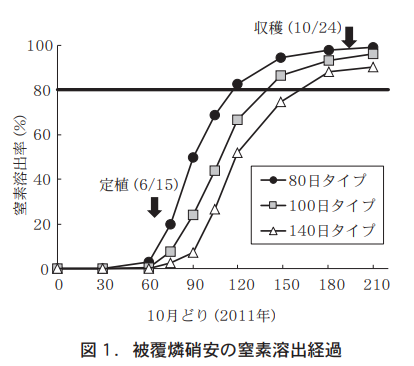
埋設試験により,育苗〜定植後の本圃における被覆燐硝安の窒素溶出日数(含有窒素の80%)を検討した。その結果,9月どりでは80日タイプで約150日,100日タイプで約170日,140日タイプで約190日であり,10月どりではそれぞれ約120日,約130日,約160日であった(図1)。80日タイプは育苗期間中に被覆燐硝安からの窒素溶出が10%程度認められたことから,ポット内窒素施肥で用いるには不適と判断した。
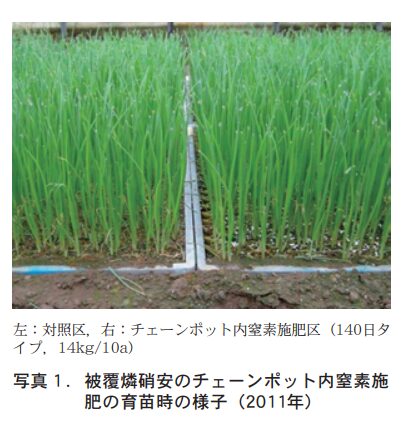
次に,被覆燐硝安100日,140日タイプとチェーンポット(以下,ポットと省略)内窒素施肥量(11,14kg/10a)を組み合わせたポット内窒素施肥系列(写真1)および対照区を設置した。なお,ポット内窒素施肥系列は本圃の窒素を無施肥とし,リン酸とカリはいずれの試験区も対照区と同一とした。
ポット内窒素施肥系列の苗乾物重(育苗終了時)はいずれの年次も9月どり,10月どりで対照区と処理間差はみられなかったが(表1上段),規格内重はポット内の窒素施肥量が多いほど概ね増加する傾向を示した(表1下段)。また,9月どりでは同一施肥量における規格内重に明瞭な差はみられなかったが,10月どりでは100日タイプと比較して140日タイプで規格内重が優る傾向を示した。
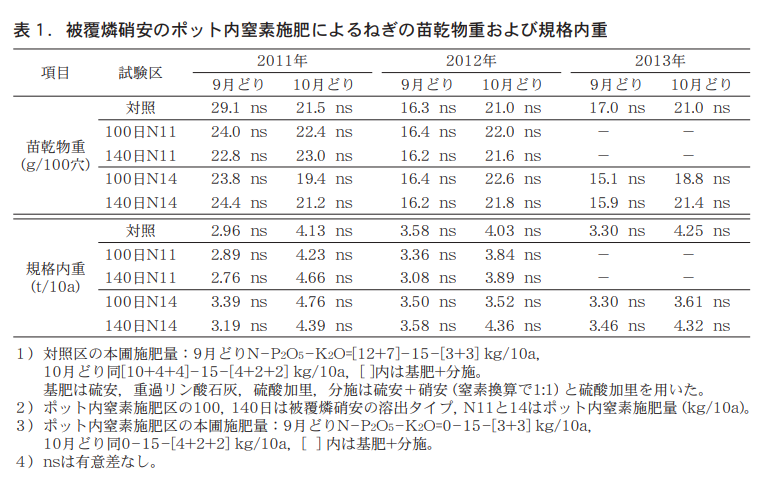
以上から,ポット内窒素施肥の施肥量は9月どり,10月どりのいずれも14kg/10aが適するとともに,溶出タイプは140日タイプが最も有用であった。
4. phosphate fertilization in chain pots of phosphate fertilizers
ポット内リン酸施肥に適するリン酸質肥料および施肥量を明らかにするため,過リン酸石灰(過石),重過リン酸石灰(重過石),重焼リン,熔成リン肥(熔リン)とポット内リン酸の施肥量2水準(6,9kg/10a)を組み合わせた試験区を設置した。なお,ポット内リン酸施肥を行った試験区は本圃のリン酸を無施肥とし,また窒素とカリの本圃施肥量はいずれの試験区も対照区と同一とした。
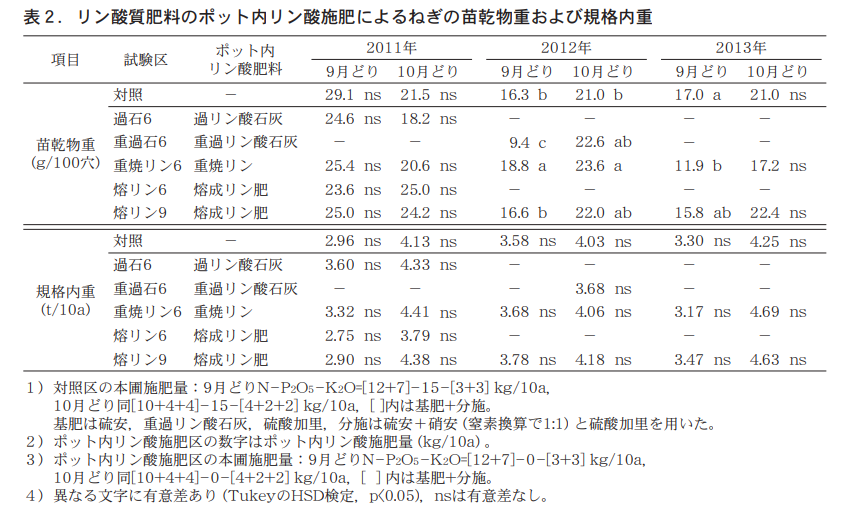
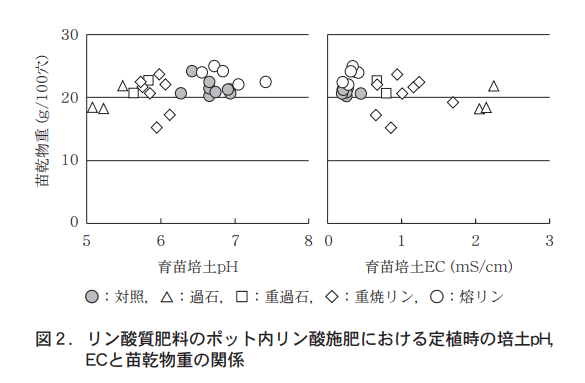
苗乾物重に及ぼすリン酸質肥料の影響について3年間の試験結果を通覧すると,過石,重過石,重焼リンは対照区に比べて苗乾物重の低下または低下する傾向が認められたが,熔リンはみられなかった(表2上段)。この要因を明らかにするため,定植時の培土pHおよびECと苗乾物重の関係を検討した。
水溶性のリン酸成分を含む過石や重過石,重焼リンを用いた場合,培土のpH低下およびEC上昇が認められ,苗乾物重が低下する傾向を示した(図2)。一方,水溶性リン酸成分を含まない熔リンでは培土pHおよびECの変化は他のリン酸質肥料に比べて小さく,苗乾物重に対する影響も小さかった。以上から,ポット内リン酸施肥に伴う苗乾物重の低下は,培土のpH低下およびEC上昇に起因することが示唆された。
次に3年間の規格内重をみると,いずれの年次も9月どり,10月どりで処理間に明瞭な差は認められず,本試験の供試圃場と同等以上のリン酸肥沃度(32mg/100g)であれば,初期の肥効が遅い熔リンの施肥量「6〜9kg/10a」でも対照区と同程度の規格内重が得られることが示唆された(表2下段)。
以上から,ポット内リン酸施肥では熔リンが適するとともに,リン酸施肥量は6〜9kg/10aの範囲が適量であった。
5. simultaneous application of coated phosphorus nitrate and phosphate fertilizer in chain pots
被覆燐硝安とリン酸質肥料のポット内同時施肥として,被覆燐硝安140日タイプで窒素施肥量14kg/10aに対し,熔リンのポット内リン酸施肥量6,9kg/10aを組み合わせた試験区を設置した。なお,ポット内同時施肥を行った試験区は本圃の窒素およびリン酸を無施肥とし,カリの本圃施肥量はいずれの試験区も対照区と同一とした。
2カ年の試験結果を通覧すると,ポット内同時施肥区の苗乾物重および規格内重は対照区と明瞭な差はみられず,同程度の値が得られた(表3)。
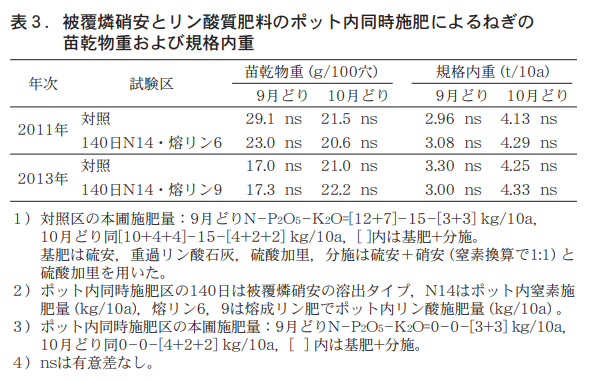
以上から,被覆燐硝安とリン酸質肥料のポット内同時施肥では,被覆燐硝安140日タイプを窒素施肥量14kg/10aと,熔リンをリン酸施肥量6〜9kg/10aで組み合わせることにより,健全な苗の生育が確保され,対照区と同程度の規格内重が得られることが明らかになった。
6. utilization aspects and points to note
本成果は,窒素肥料として初期の溶出を抑えたシグモイド型の被覆燐硝安を用い,定植後の本圃の窒素肥沃度が低く(熱水抽出性窒素3mgN/100g未満),またリン酸肥沃度が「基準値(トルオーグリン酸20〜40mg/100g)」に該当する圃場で得られたものである。この場合は本技術の利用により,現行の施肥対応3)と比較して窒素は最大で4kg/10a,リン酸は6〜9kg/10aの施肥量削減が可能であり,本圃での窒素およびリン酸施肥の手間を省略することができる。
In fields where phosphate fertility is below the standard value (toluoglinic acid less than 20 mg/100 g), it is recommended that the soil be amended to the standard value before introducing this technology.
References
(1) Ministry of Agriculture, Forestry and Fisheries 2019.Vegetable Production and Shipment Statistics.
(2) Hokkaido Agricultural Cooperative Central Association and Hokuren Federation of Agricultural Cooperatives 2021. map of Hokkaido vegetables, p58.
(3) Hokkaido Agricultural Administration Department 2020. hokkaido Fertilizer Guide 2020, p113. hokkaido Agricultural Extension Association, Hokkaido.
4)岩佐博邦・大塚英一・真行寺 孝・井上 満・小林広行 2005.セル培養土内基肥施用によるキャベツの減窒素栽培.千葉農総研研報,4.p23−31.
5)小野寺政行 2011.移植タマネギにおける肥効調節型肥料を用いたポット内施肥法.土肥誌,82,p312−315.
6)小杉徹・中村仁美・若澤秀幸 2007.肥効調節型肥料を用いたトマト育苗鉢内全量施肥法.土肥誌,78,p207−211.
7)山本二美・松丸恒夫 2007a.夏どりネギにおけるチェーンポット内施肥の施肥窒素量と追肥窒素量の検討.土肥誌,78,p179−186.
8)山本二美・松丸恒夫 2007b.ネギのチェーンポット内全量窒素施肥が生育および収量に及ぼす影響.土肥誌,78,p371−378.
9)千葉県農林総合研究センター平成26年度試験研究成果普及情報課題一覧「野菜4.リン酸のセル内施肥によるキャベツのリン酸減肥」 .
10)小野寺政行・板垣英祐・古館明洋・木谷祐也・日笠裕治 2014.移植タマネギにおける葉面散布およびポット内施肥を用いたリン酸減肥技術.土肥誌,85,p245−249.
(11) Hokkaido Agricultural Administration Department, 2010. Hokkaido Fertilizer Guide 2010, p. 108. Hokkaido Agricultural Extension Association, Hokkaido.
Changes in Agricultural Cooperative Farming Activities in the Kamimashiki Area and My Encounters
農事組合法人 かしま広域農場
Former President and Representative Director
(現 特別顧問)工藤 健一
Introduction.
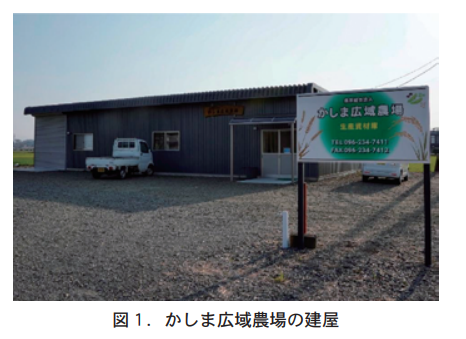
かしま広域農場は,熊本市南部に位置する嘉島町にあり,農地の広さは477ヘクタールと九州最大規模である(図1)。現在,私はかしま広域農場の特別顧問として,水稲,麦,大豆を中心とする水田農業の確立と農家所得の向上に尽力している。本稿においては,私が長年にわたって携わってきた農協営農活動を振り返ってみたい。
Progression to becoming an employee of an agricultural cooperative
I was born the eldest son of a farmer, and my parents farmed rice, wheat, and silkworms on 1.5 ha of their own land. I graduated from a prefectural agricultural high school in 1959 as the successor to my parents, and went on to become a farmer.
しかしその当時,管内は水害常習地であり安定的な米・麦の生産が不安定だった為,集落内の同級生3名でハウス園芸の栽培に取り組み,ハウストマトの栽培に昭和35年連棟ビニールハウス(20a)を導入し,米・麦・ハウストマトの複合経営で農家所得の向上にまい進していた。昭和45年,地元の六嘉農業協同組合も管内の将来に向けた営農ビジョンの中で米・麦を主体とした農業でなく,施設園芸,畜産業も視野にいれた農協体制強化の為,農協営農職員としての要請があり入組した。
As a farm advisor for agricultural cooperatives, I have explained the advantages of cooperative system production materials to members and provided them with inexpensive, high-quality production materials to encourage them to engage in planned crop cultivation in the hope of improving productivity.
2. 2. Meeting with strain Kumiai Chisso Vinyl
In 1970, Kumamoto Keizairen (Kumamoto Economic Federation) launched a plan to establish cooperative farming complexes as a means of transport gardening, and worked to put cultivation into practice with the goal of becoming Japan's top producer of watermelons and melons.
六嘉農業協同組合もプリンスメロンのハウス栽培に取り組んで30戸でのメロン部会を立ち上げ,共同育苗からパイプハウスの共同ビニール張りを2班に分かれ共同作業での効率化に取り組む。ビニールのメーカーは三菱モンサント・三井ビニール・赤線ビニール系統クミアイビニール等,多種のビニールが農家で使用されていたが,私が推進するチッソクミアイビニールの共同作業は,朝5時より開始の為,ビニールの張り・縮み・伸び等品質の粗悪が他メーカーより目立っていた。
その様なことでチッソミナマタビニール研究室に現状を報告し品質改善の要請をした。研究室では,カソ剤の添加等,改善に取り組み,メロン部会でも研究室の視察も実施しながらクミアイビニール(チッソ)の高品質化に六嘉農協メロン部会総力を結集し栽培者の目線に添ったチッソクミアイビニールの高品質化に取り組んだ。
There were 15 to 16 agricultural cooperatives established in Kamimashiki County at that time, and the Kamimashiki County Economic Promotion Committee, which coordinates the production materials of the Kumamoto Economic Federation, had established a headquarters for promoting the business of the system, consisting of executives and employees of each agricultural cooperative. Each agricultural cooperative's share of the market for vinyl in the system was about 20%. In the meeting in charge of handling "Chisso Kumiai Vinyl," we proposed the expansion of 100% Chisso vinyl as a lineage product, explained the efforts of the Melon Club of Rokka NNK, and worked to strengthen the cooperative system for receiving orders for lineage vinyl (Chisso). The quality of Kumiai Vinyl was improved over the next three to four years, and it became a production material that can withstand year-round use as a strain of vinyl for spring and fall melon cultivation and continues to be used by horticultural farmers.
3. Special Cultivation Rice Initiatives
平成元年3月に嘉島町・御船町・甲佐町の3町の農協合併で旧上益城農業協同組合が発足した。その中で主食米の政府米と自主流通米の販売系統があったが,当農協は自主流通米の生産による農家所得向上の販売体制方向に「カジ」を切った。
In order to meet the needs of consumers for staple rice 10 years in the future, Kumamoto Prefecture also set a guideline for growing "health-conscious and environmentally friendly" rice. The efforts were discussed at a meeting of the agricultural cooperative's board of directors, the initiatives were announced, publicized and put into practice at a regional roundtable meeting, and a plan for profitable sales was formulated.
In 1997, three agricultural cooperatives in the prefecture were involved in this project. A joint meeting was held with related organizations to discuss a cultivation plan for 1,000 ha of flat land, but it was difficult to consolidate opinions at the meeting.
4. plan to collect the entire amount of agricultural cooperative country rice and introduce special rice cultivation
(1) The variety "Morinokuma-san" is designated as a unified special cultivation variety.
(2) Prepare a manual for the use of specially cultivated rice, exclusive fertilizers, exclusive designated pesticides, and use of the specially cultivated rice.
③嘉島,御船,甲佐管内で流通している生産資材(肥料)は,肥料成分を有機で取る為,価格高が生じるので栽培者に向けた説明マニュアルを作成する。
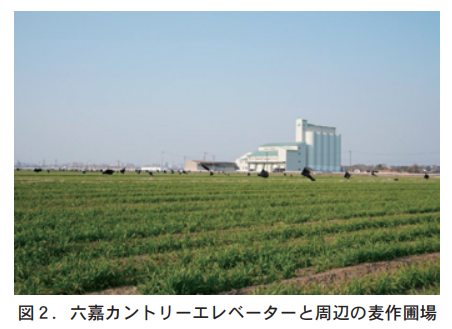
④農協カントリーエレベーター(以下,CEと表記)5,700t集荷体制(全量集荷)の内訳(図2)。
六嘉CE 2,000t, 大島CE 2,000t,甲佐CE 1,000t, 御船CE 700t,
Total 5,700t
⑤米販売体制は,自主流通協議会の販売計画の中で経済連・農協は中卸業者に特別栽培生産資材の品目別説明を行い有利販売に努める。
⑥特別栽培米各圃場には,特別栽培圃場の立板を用意し全筆に実施する。(嘉島管内で4,000筆)
5. special cultivation practices and meeting with JCAM Agri Co.
In 1997, 350 hectares of the then new paddy rice variety "Morinokuma-san" was introduced as a new special cultivation rice in Kumamoto Prefecture within the jurisdiction of Oshima CE and Rokka CE, and new challenges arose.
One reason was that some 40 individual farmers in Kashima had continued to deal with fertilizer suppliers outside of the system for paddy rice fertilizer, which made it difficult to deal with them. We explained to these farmers the purpose of the manual, which states that fertilizers other than those produced by the agricultural cooperatives are not to be discussed in price negotiations, in the course of voluntary price negotiations in accordance with the manual for the introduction of special rice cultivation. In addition, since fertilizers for special cultivation are about 20% more expensive than chemical fertilizers, a competitive bidding system was introduced for five fertilizer manufacturers to reduce costs for farmers, and JCM Agri Co. The JA Kamimashiki Agricultural Cooperative's one-shot fertilizer system for rice and wheat was introduced from 1997 to 2021 as "Morinokuma-san Fertilizer," and with an annual transaction price of 1 million yen with the manufacturer, orders of approximately 2.3 billion yen over 23 years (from 1997 to 2021) have been placed through system utilization, and a movement to utilize all agricultural cooperatives in the Zen-Noh and Keizairen units has been developed. The campaign to utilize all of the agricultural cooperatives in the Zen-Noh and Keizairen units is being developed.
Since 2021, JA Kamimashiki has been contributing to quality improvement and the production of high-quality rice as the first fertilizer for the cultivation of the new paddy rice variety "Kumasan no Shine".
Conclusion
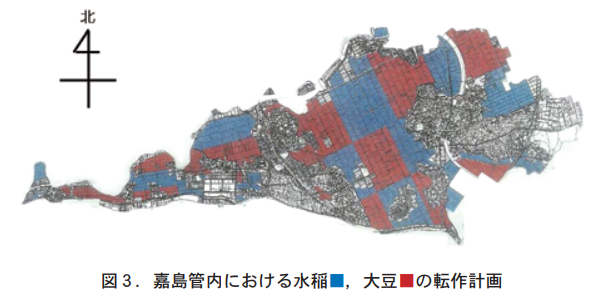
以上,水稲を中心にこれまでの営農活動について述べてきたが,かしま広域農場では,水稲に加えて,今後の消費者ニーズを踏まえた大豆や麦の生産拡大のための施策にも取り組んでいる。たとえば,国が推進する麦・大豆収益性・生産性プロジェクトに参画し,大豆・麦の生産基盤の強化と効率化のために農地の流動化・団地化を図っている(図3)。
Finally, my motto is "Guidance with passion," and I will continue to lead farming activities with passion to improve farmers' income and establish sustainable paddy field agriculture in the area.
No Soil - No. 14
養分源が堆肥から化学肥料へ変化する時代
−その歴史的経緯−
Jcam Agri Co.
北海道支店 技術顧問
松中 照夫
堆肥が作物の生産に大きな効果を持つというのは,古くアリストテレスの時代にまでさかのぼることができる。その堆肥を農地への養分移転資材として積極的に利用し,食料増産へ向かったのは19世紀のノーフォーク農法の時代からである(本年5月号参照)。今月は,養分源が堆肥から化学肥料へ交代していく時代の話である。きっかけは農業不況だった。どんな経緯があったのだろうか。
1. what the Flemish saying teaches
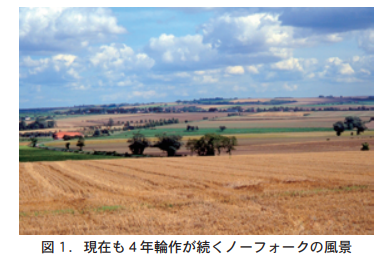
ノーフォーク農法は,養分循環からたどりついた4年輪作(コムギ−飼料用カブ−オオムギ−アカクローバ)の農法であった(図1)。
It is a recycling-oriented agriculture in which nutrients in the soil are absorbed by fodder crops (fodder turnips and red clover) that serve as livestock feed, the feed is fed to livestock, the nutrients are collected from the livestock in the form of manure, and finally the manure is transferred to the fields for human food production. This was the very essence of the old adage "No feed, no livestock; no livestock, no manure; no manure, no harvest" passed down from generation to generation in the Flemish region of mainland Europe (present-day southern Netherlands to western Belgium and northern France) across the river from Norfolk, England. This saying eloquently describes the major role of compost as a nutrient transfer material (fertilizer) for maintaining crop production in the European crop rotation.
しかし,この格言には見逃せないもう一つの指摘がある。それは肥料となる堆肥を得るには,家畜のエサとなる飼料が必要だということである。フランドルの格言が指摘するように,人の食料ではなく家畜のエサとなる作物(飼料作物)を生産しなければ,養分源としての堆肥が生産できない。だからこそノーフォーク農法では,農場内の土地面積の半分を飼料作物生産に割り当て,飼料用カブとアカクローバを輪作に加えている。
これによって飼養できる家畜の頭数が増えただけでなく,家畜を冬期も家畜舎で飼い続けることが可能になった。その結果,家畜ふん尿の回収率が高まり,養分源となる堆肥が増産されるようになった。それは,人の食料を生産する畑への堆肥投入量の増加を可能にした。そのことによってコムギやオオムギの収量水準が一気に2倍近くまで増加した。
2. alternative sources of compost nutrients needed to escape agricultural depression
化学肥料の利用が一般化するまで,この農法はその画期的な高収量から広く普及した。そして19世紀,イギリスの農業はノーフォーク農法の絶頂期に黄金時代をむかえた。しかし,この黄金時代は長続きしなかった。それまで穀物の輸入に規制をかけていた穀物法が撤廃され,アメリカやカナダから安価なコムギが大量に輸入されるようになったからである。これによってイギリスのコムギ栽培は大打撃を受け,農業不況におちいった。この不況は1875年ころからはじまり,第一次世界大戦中に一時中断したものの,およそ60年間もつづいた(McLean,1991)。
The agricultural depression was severe in the Norfolk region as well. In Norfolk farming, fodder turnips and red clover plots, which are grown to feed livestock, generate no direct income. They are grown for manure production as a source of nutrients. In order to get out of the recession, farmers have been tempted to stop the unprofitable forage production and grow cash crops to feed people. This would increase their profits. However, there was a problem. If they stopped producing fodder, they would no longer be able to feed their livestock, which would also mean that they would no longer be able to produce compost, and crop production itself would decline. Therefore, the important thing was to find a source of nutrients that could be substituted for compost. This is where chemical fertilizers, which were beginning to be sold and distributed at the time, came into the spotlight.
3. results of agricultural experiment stations established with farmers' investment
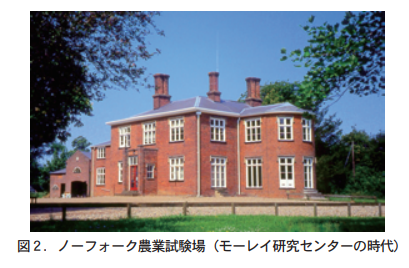
市販化学肥料として過リン酸石灰が世界で初めて登場したのは1843年7月1日。農業不況が始まる少し前のことだった。もちろん,化学肥料が一般の農家に広く使われるという状況ではない。化学肥料の普及にはまだまだ時間が必要だった。使用経験のない化学肥料が,本当に堆肥の代替養分源となるのかどうか,誰もが不安だった。それを解消するには科学的裏付けが欲しかった。そこで,ノーフォークの農家は自ら出資してノーフォーク農業試験場(後にモーレイ研究センターの時代を経て,現The Morley Agricultural Foundationに継承)を1908年に設立した(図2)。
ノーフォーク農業試験場での12年間にわたる長期輪作試験結果は,作物の収穫残渣(ムギワラやテンサイ地上部など)を土にすき込む時,化学肥料を併用すれば,堆肥が施与されなくてもコムギやオオムギの子実収量を堆肥が施与された処理区と同等に維持できることを明らかにした(Raynsand Culpin,1948)。この結果に基づき,化学肥料の併用を条件に,飼料用カブのかわりに同じ根菜類のテンサイを,アカクローバのかわりにバレイショの栽培が推奨されるようになった(McLean,1991)。こうして化学肥料への不安が少しずつ解消され,ノーフォーク農法の養分源が堆肥から化学肥料へ徐々に移行し,世の中に化学肥料が受け入れられていった。
4. dilemma associated with compost production in recycling-oriented agriculture
The main reason for the introduction of chemical fertilizers into Norfolk farming was the need for land to produce fodder for livestock, which is the key to the nutrient cycle. The agricultural depression made it impossible to allocate that land for feed production. Moreover, as crop yields increase, the amount of nutrients taken out of the field also increases. This requires a large amount of compost as a source of nutrients to replenish the crop. Increased production of manure requires an increase in the number of livestock, as well as more farmland for the production of feed for the increased number of livestock. However, the profitability of that farmland is low. This is the dilemma that arises when trying to rely solely on compost as a source of nutrients in recycling-oriented agriculture.
More importantly, as Liebig, who with Sprengel argued that plant nutrients are inorganic, once criticized, there can be no perfect cycle in any cyclical agriculture. The produce is taken off the farm to be sold. The nutrients absorbed by the farmland are surely taken out of the circulation path. Unless the nutrients are brought in from outside the circulation path, the nutrients contained in the farmland in the circulation path are gradually depleted. Liebig called this plunder agriculture and recommended the use of chemical fertilizers to replenish nutrients.
5. another test to confirm fertilizer efficacy of chemical fertilizers
It was Rose of England who first introduced chemical fertilizers to the world. Rose was also concerned about whether chemical fertilizers were really as effective as compost. He therefore founded the Rothamsted Agricultural Experiment Station on his own to test the efficacy of fertilizers. This was 65 years before the Norfolk Agricultural Experiment Station, the oldest agricultural experiment station in the world. The testing began in 1843, the year chemical fertilizers were first sold. These tests have continued to the present day, some 180 years later. We will discuss the results in next month's issue.