

Site Search
Search within product
第747号 2023(R05).01発行
Click here for PDF version
§Aiming to be a company that continues to contribute to Japanese agriculture
Jcam Agri Co.
代表取締役会長 浅野 進
§ Super-efficient fertilization of sudachi
Tokushima Prefectural Technical Support Center for Agriculture, Forestry and Fisheries
Natural Resources and Environment Research Division
新居 美香
§土のはなし−第18回
植物が難溶性物質を吸収するしくみ
−根から溶解を助ける物質を分泌する−
Jcam Agri Co.
北海道支店 技術顧問
松中 照夫
Aiming to be a company that continues to contribute to Japanese agriculture
Jcam Agri Co.
代表取締役会長 浅野 進
新年明けましておめでとうございます
At the beginning of the year 2023, I would like to take this opportunity to extend a few words to all of you who read this issue of "Agriculture and Science.
私は,昨年6月22日付でジェイカムアグリ株式会社の代表取締役会長に就任いたしました。設立時からの経営方針である「日本の農業に貢献し続けられる会社」であることを肝に銘じて,皆様の信頼と期待に応えるべく誠心誠意努力してまいる所存ですので,何卒変わらぬご指導ご鞭撻を賜りますようお願い申し上げます。
Last year, the agriculture and fertilizer businesses faced unprecedented changes in the environment and business risks. Specifically, in addition to the impact of the Corona disaster, the Ukraine crisis triggered (1) food shortages and a sharp rise in international prices due to export restrictions in grain exporting countries, (2) difficulties in procuring raw materials for fertilizers, which are highly dependent on imports, and a sharp rise in prices, and (3) increasing demands to address global warming and biodiversity conservation.
In response to (1) and (2), the Ministry of Agriculture, Forestry and Fisheries (MAFF) launched the "Emergency Measures to Support Procurement of Chemical Fertilizer Raw Materials" in April, and in July decided on the "Project to Cope with Soaring Fertilizer Prices," which was followed by prompt support measures. The latter measure is a short-term measure to protect farmers' businesses by compensating for 70% of the fertilizer price hikes through a combination of effective use of fertilizers (20% reduction in fertilizer use), but the long-term vision also includes a deeper discussion on the essentials of improving food self-sufficiency from the perspective of food security, and measures to increase farm incomes through the large-scale conversion of farmlands are being implemented. It is my earnest hope that the implementation of measures that lead to larger farmland and higher farm income will foster young successors and boost agricultural production.
In January 2022, against the background of the "Law Concerning the Promotion of Resource Recycling of Plastics" enacted in June 2021, the fertilizer industry formulated a policy based on measures to prevent environmental pollution, such as "implementation of measures to control runoff of coated fertilizer shells from farmland" and "development and diffusion of new technologies" with regard to coated fertilizer processed with plastics and the like. In January 2022, the fertilizer industry announced a policy based on measures to prevent environmental pollution, including "implementation of measures to control runoff of coated shells from farmland" and "development and dissemination of new technologies.
In response to these changes in the environment, JCM Agri is working to contribute to solving the problems of Japanese agriculture by providing a stable supply of chemical fertilizers to ensure the stable production of domestic agricultural products, and by launching a new coated fertilizer that reduces the amount of resin in the coating and inhibits runoff from farmland. In addition, we are also developing technologies to completely decompose fertilizers in the natural environment ahead of our competitors.
In addition to stabilizing yield and quality and reducing the amount of wasted fertilizer that is not used for crop growth, it also has environmental benefits, such as reducing the runoff of nutrients into groundwater and other bodies of water, and reducing the emission of dinitrogen monoxide, a greenhouse gas. This fertilizer also has environmental benefits, such as reducing nutrient runoff into groundwater and other bodies of water and inhibiting the generation of nitrous oxide, a greenhouse gas. By addressing environmental issues with our superior technological development capabilities, we hope to realize the government's policy of "effective utilization of fertilizers - reduction of fertilizer use" and "increase in farmers' income through stabilization of yield and quality," and thereby contribute to the advancement of agricultural production in Japan.
We will continue to make company-wide efforts to meet your expectations. We look forward to your continued support and encouragement.
In closing, I would like to wish you a happy and prosperous New Year and hope that you will continue to read our journal "Agriculture and Science" in the coming year.
Super-efficient fertilization of sudachi
Tokushima Prefectural Technical Support Center for Agriculture, Forestry and Fisheries
Natural Resources and Environment Research Division
新居 美香
Introduction
徳島県内の中山間地域では,スダチ,ユズ,ユコウなどの香酸カンキツが多く栽培されている。特にスダチは徳島県が全国生産量の95%を占める主要な品目である。しかし,生産者の高齢化,労働力不足,生産経費の高騰により,施肥回数や肥料の内容,特に窒素の施肥量の減少が懸念されている。また、当センターの土壌モニタリング調査の結果から,果樹園土壌にはリン酸,加里は連年施用により土壌に蓄積していることが明らかになっている一方で,最近頻発する集中豪雨などによる施用した肥料成分の流亡等を心配した生産者が,スダチの重要な外観品質である果皮緑色を維持するために,過剰とも考えられる量の肥料を施用する例も見られる。
そこで,県の施肥基準では,年間4回(3月,5月,6月,10月)施肥が慣行とされているが,年1回の施肥で慣行施肥と同様の肥効が得られるスダチ専用一発肥料を開発し,それを用いた栽培試験を実施した。本試験は全農委託試験として実施した。
2. Method
The test plot consisted of a one-shot fertilizer zone where fertilizer mixed with coated fertilizer was applied ("one-shot zone") and a control zone where a sudachi-specific fertilizer containing organic fertilizer was applied according to the prefectural standard (Table 1).
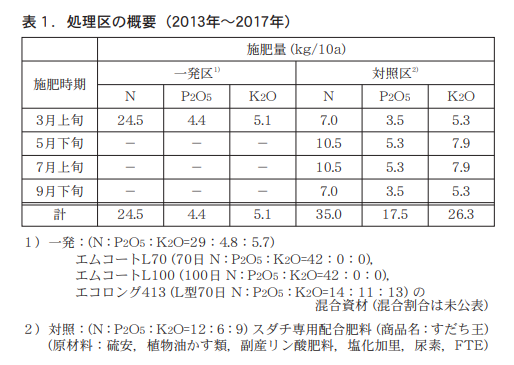
対照区の肥料は,県内スダチほ場で一般的に使用されているスダチ専用肥料(N:P2O5:K2O=12:6:9,原材料:硫安,尿素,塩化加里,副産リン酸肥料,菜種油かす,FTE)を表層施用した。施肥量は県施肥基準に基づき,窒素成分で年間35kg/10a,リン酸成分で17.5kg/10a,加里成分で26.3kg/10aであった。
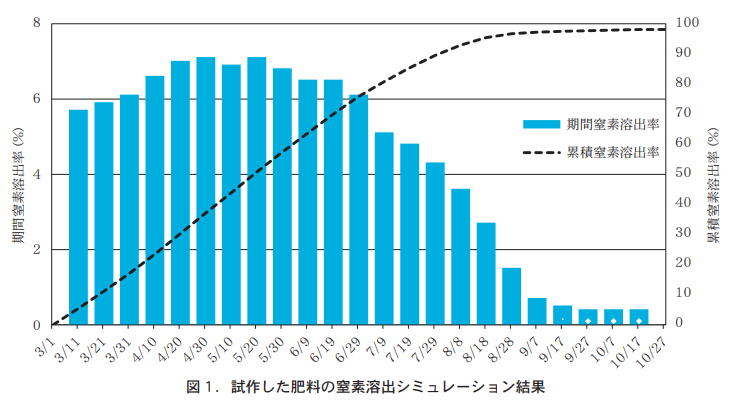
One-shot plots were produced by blending Emcoat L70, Emcoat L100, and Ecolong 413 (L-type 70 type) based on the leaching simulation shown in Figure 1. The amount of fertilizer applied for nitrogen component was 24.5 kg/10a, which is 301 TP3T less than the control, phosphoric acid component was 4.4 kg/10a, about 751 TP3T less, and potassium component was 5.1 kg/10a, about 80% less, referring to the amount carried out of the field through harvest (5.2 kg/10a).
試験場所は徳島県名西郡神山町の現地ほ場(褐色森林土)で,1処理区45㎡,植栽間隔3m×3mのスダチ樹5樹を供試した。
Results
(1) Nitrogen leaching of prototype one-shot fertilizer
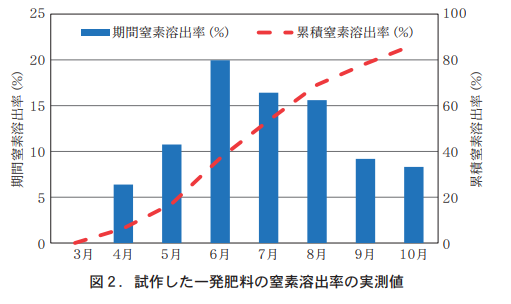
Figure 2 shows the results of nitrogen leaching measured according to the composition of the prototype one-shot fertilizer. The one-shot fertilizer gradually leached from one month after burial, and in June, the leaching rate exceeded 201 TP3T of the fertilizer amount and the cumulative leaching rate exceeded 371 TP3T. 781 TP3T was leached at the end of the harvest in late September. In the simulation of the trial, it was assumed that nitrogen components would be leached stably from immediately after fertilizer application to the harvesting period, but actual measurements showed that nitrogen leaching was delayed more than originally assumed, with a maximum in June.
(2) Changes in soil chemistry
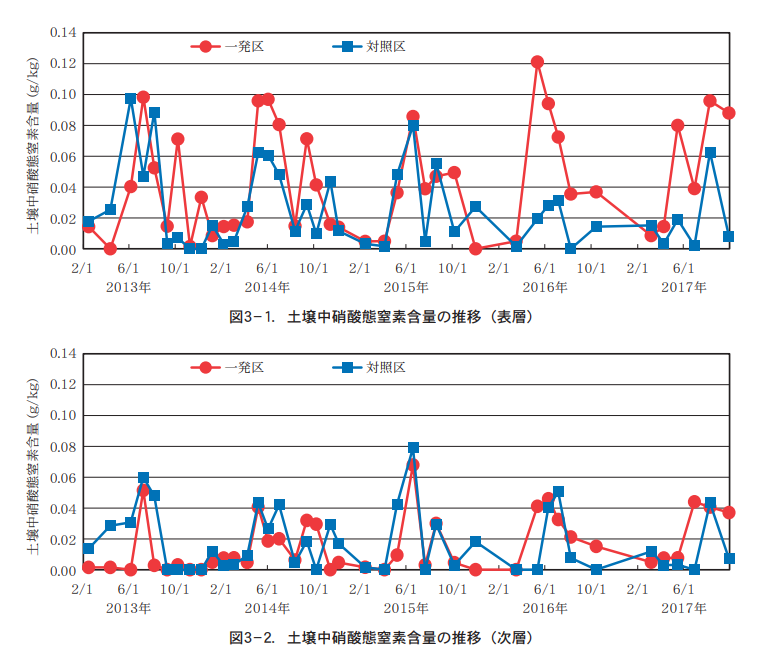
(1) Nitrate nitrogen (Figures 3-1 and 3-2)
表層では,2014,2016,2017年は一発区で高く推移したが,2013年,2015年には対照区との差は見られなかった。次層(10〜20cm)では,処理区間差は認められなかった。
(2) Available phosphoric acid (data omitted)
一発区のリン酸施肥量は,1/5程度であったが,土壌中の可給態リン酸は,2015,2016年は一発区で高く推移した。
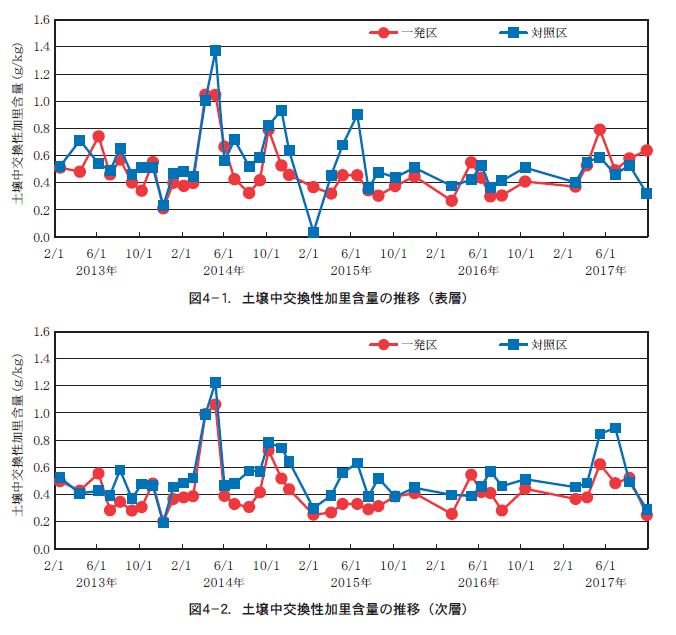
(iii) Exchangeable potassium (Figures 4-1 and 4-2)
There was a trend of lower exchangeable potassium in the next layer of one-shot plots starting around 2015, the third year of the project.
(3) Changes in inorganic constituents in leaves
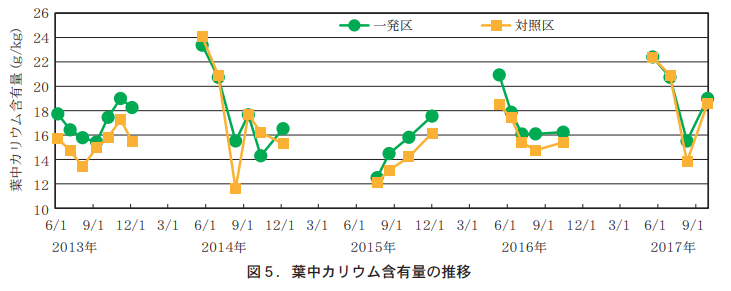
Leaf constituent content did not differ among treatments for nitrogen and phosphorus, but potassium tended to be higher in the one-shot treatments than in the control treatments (Fig. 5).
(4) Yield and fruit quality
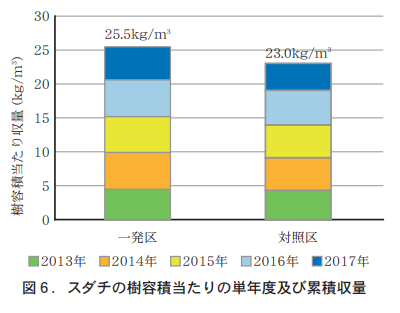
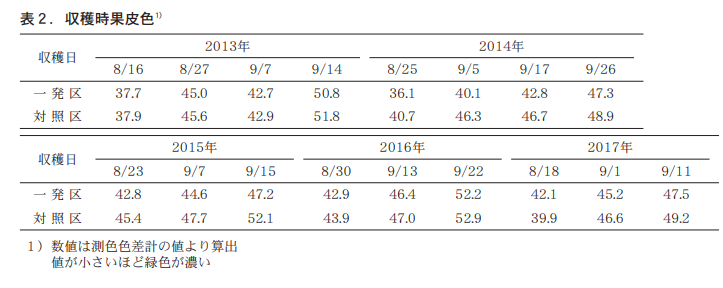
収穫期(8月下旬〜9月中旬)に販売単価の高い2L級果(横径3.6〜4.0cm)に達した果実を順次収穫し,果実個数,収穫時重量を計測した。図6に示した5年間の累計収量調査結果では,一発区の単位樹容積当たりの収量は25.5kg/㎥,対照区は23kg/㎥であり,一発区の収量が対照区よりも10%程度多い傾向がみられた。収穫時の果実品質調査は,1樹につき2L級果を10果ずつ採取し,果皮色は測色色差計で測定し,緑色度を算出した。表2に示すように,処理間差は見られなかったが,収穫終期には一発区で果皮緑色が濃い傾向が認められた。
(5) Cost estimation
The trial one-shot fertilizer was launched by JA Zen-Noh Tokushima in March 2021 under the trade name "Sudachi Haru Ippatsu." The fertilizer cost per 10 a was calculated based on the fertilizer amount and price of this one-shot fertilizer and a conventional compound fertilizer (Sudachi King) exclusively for Sudachi. The annual nitrogen fertilizer application rate was reduced by 301 TP3T, assuming 24.5 kg N/10a, because fertilizer with a regulated fertilizer effect generally has high fertilizer application efficiency, and because it has been reported that fruit quality and yield are excellent even with a 301 TP3T reduction in the application of coated fertilizers to Onshu mandarins.
According to the estimation results shown in Table 3, the annual cost of fertilizer was 40,326 yen for the one-shot fertilizer, while the cost was 53,229 yen for the control area, where the annual nitrogen fertilizer application was 35 kg N/10a (based on interviews with JA Meisei-gun).
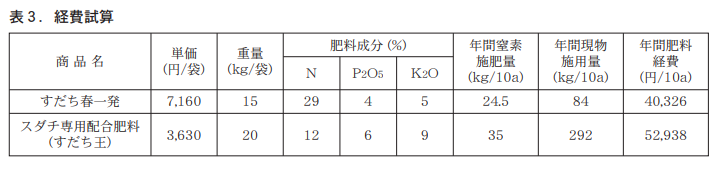
This means that the Sudachi one-shot fertilizer developed here can be applied to reduce the cost of fertilizer to about 761 TP3T of conventional Sudachi-specific fertilizer, and the number of annual fertilizer applications can be reduced from four to one, which is considered a significant labor saving in terms of both cost and work.
At the end.
A wide variety of fertilizers with different leaching periods and leaching patterns are now on the market. In rice and vegetable cultivation, fertilizer application techniques such as total basal application, total seedling application, and local application are widely used to save labor and improve fertilizer application efficiency. On the other hand, fruit tree cultivation has also been introduced to fruit production such as Onshu mandarin oranges and ponkan orange, as well as to the cultivation of young trees, etc. However, these techniques have not yet been widely used in fruit tree production sites in Tokushima Prefecture.
スダチやユズ,温州ミカン等のカンキツ類は,30年以上の長期にわたり,継続して栽培される。また,樹体内に養分を蓄積しているため施肥の効果が短期間では現れにくい。このため,長期にわたる一発肥料のみの施肥が土壌及び植物体に与える影響が懸念されるが,ここで紹介した5年間の試験期間では,樹体生育及び窒素,リンの葉中無機成分には影響は見られなかった。しかし,土壌の交換性加里は一発区で3年目以降減少する傾向が見られた。
The yield of the one-shot area during this test period was about 2 t/10a, and the potassium component in this crop was about 5.2 kg/10a. The amount of potash applied by one-shot fertilizer is 5.1 kg/year, and considering the loss of potash due to runoff, etc., the potash balance may be deteriorated. Therefore, it is necessary to analyze the soil regularly and pay attention to the deficiency of potassium components.
However, the fertilizer is also applicable to fertilizer application using drones, which are expected to be introduced in the future. We would like to introduce and promote the use of this super-laborsaving fertilization technology in production sites as an effort to solve labor shortages and improve efficiency in field management operations.
No Soil - Part 18
植物が難溶性物質を吸収するしくみ
−根から溶解を助ける物質を分泌する−
Jcam Agri Co.
北海道支店 技術顧問
松中 照夫
Plants select and absorb the nutrients they need from the water (soil solution) in the soil. In the last issue, I explained how this works. If nutrients are easily soluble in soil solution, it was explained. But what do plants do when nutrients exist in the soil as insoluble substances that are difficult to dissolve in water?
In this article, I would like to look at the amazing mechanism by which plants absorb nutrients from substances that are difficult to dissolve in soil solution.
1. phosphorus and iron are insoluble substances in the field
Among plant nutrients, phosphorus and iron exist in the soil in the form of substances that are insoluble in water (insoluble substances, such as aluminum phosphate, iron phosphate, and iron hydroxide). However, when the soil surface is covered with water and the soil is in a reduced state due to lack of oxygen, as in paddy fields, the insoluble iron phosphate and iron hydroxide are transformed into water-soluble substances. Therefore, rice plants are seldom significantly deficient in these nutrients.
On the other hand, in field soil, oxygen is connected to the atmosphere and remains in an oxidized state. For this reason, phosphorus and iron exist as insoluble substances, which are difficult to dissolve in soil solution, making them difficult for plants to absorb. However, plants absorb such nutrients by taking measures as described below.
2. mechanism of phosphorus absorption from insoluble phosphorus
In field conditions, phosphorus is often present as the insoluble substances aluminum phosphate and iron phosphate. In addition, phosphorus may also be present in the form of organic phosphorus, which cannot be absorbed without modification. To facilitate the absorption of such water-insoluble phosphorus, plants produce organic acids (citric acid, oxalic acid, piscic acid, etc.) and an enzyme called acid phosphatase in the root cells and discharge them into the soil around the roots (this phenomenon is called secretion) (Figure 1). Of course, these secreted substances must also pass through the cell membrane to exit the root. The transport of these substances is handled by the respective transport proteins (transporters).
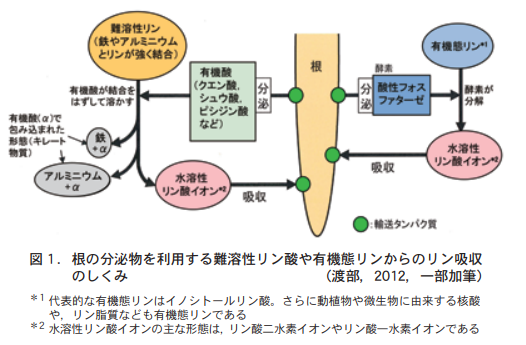
Organic acids secreted by the roots have the ability to dissolve iron phosphate and aluminum phosphate in the soil by stripping their bonds. The dissolved phosphorus in ionic form is transported into the cell membrane through transport proteins and absorbed by the plant. The iron and aluminum that are stripped from their bonds do not remain in the soil solution as ions. They are transformed by organic acids into an encapsulated form (this kind of reaction is called chelation, and the resulting substance is called a chelating substance), which prevents them from rejoining phosphorus.
Acid phosphatases act on the organic phosphorus present around the roots and deliver water-soluble phosphate ions to the soil solution by enzymatic degradation (Figure 1). The delivered phosphate ions are absorbed into the cell membrane through transport proteins as plant nutrients.
3. expand rooting to absorb phosphorus
Since phosphorus exists as an insoluble substance, the concentration of phosphorus in the soil solution is low. Therefore, plants sometimes try to absorb phosphorus in low concentrations by increasing root growth and expanding the root surface area. A similar mechanism is used by filamentous fungi (a member of the fungus family, mycorrhizal fungi) that live symbiotically in the roots. Mycorrhizal fungi spread their mycelium widely in the soil, take up phosphorus from the soil solution, and provide it to the host plant, which in turn supplies phosphorus to the plant.
4. two mechanisms of iron absorption from insoluble iron
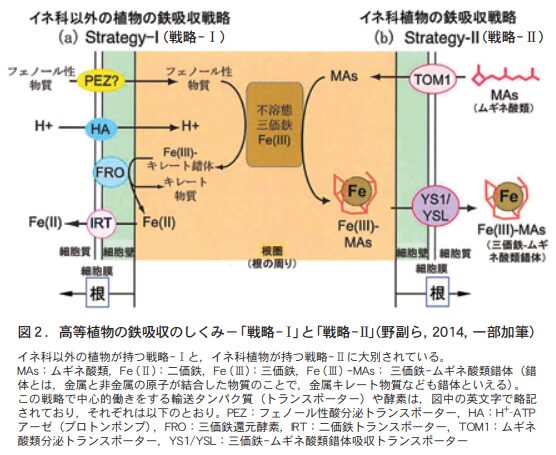
畑状態の鉄は難溶性の酸化鉄(これは,鉄のサビと同じ物質。この鉄の形態は,三価鉄・Fe(Ⅲ)・Fe3+)で土の中に存在し,土壌溶液には溶けにくい。このままであれば,植物は鉄を吸収しにくく欠乏してしまう。しかし,畑状態で生育する植物は,リンの場合と同じように根から難溶性の鉄(三価鉄)を溶かす物質を分泌することで鉄を吸収している。ただし,イネ科以外の植物とイネ科植物とでは,鉄吸収のしくみが大きくちがう(図2) 。
(1) Mechanism of iron absorption in plants other than grasses
これはStrategy−Ⅰ(戦略−Ⅰ)といわれる(図2の左側) 。まず,難溶性鉄(三価鉄)を溶かすゆるいキレート物質(フェノール性酸)を根から分泌する。この物質で三価鉄を包み込んで(キレート化して)細胞壁に持ち込む。すると,細胞膜表面に存在している酵素(三価鉄還元酵素,FRO)が働き,三価鉄を二価鉄(Fe(Ⅱ)・Fe2⁺)に変える。そしてこの二価鉄の輸送タンパク質(IRT)によって細胞膜内に吸収される。
Other mechanisms utilize trivalent iron, which is more soluble in acidic conditions. There is a transport protein (proton pump, HA) that releases hydrogen ions from root cells to the outside of the root. This proton pump lowers the pH around the roots, making it easier for trivalent iron to dissolve in water and be absorbed.
(2) Mechanism of iron absorption by rice plants
This is known as Strategy-II (right side of Figure 2). Organic acids such as mugineic acids and their analogues (MAs in the figure, see note in Figure 2 for explanation of the English letters), which are produced by the plant inside the root cells, are secreted outside the cell wall around the root through a transport protein (TOM1). This acts on trivalent iron, which is transformed into a substance (chelate called Fe(III)-MAs) encapsulated in mugineic acids. The chelates made from the iron and mugineic acids are absorbed into the plasma membrane by transport proteins (YS1 and YSL) responsible for their transport (Nozoe et al., 2014).
This mugineic acid was discovered by Professor Seiichi Takagi of Iwate University in Japan in 1976. Until then, the mechanism of iron absorption by plants other than grasses could not fully explain the iron absorption of grasses. However, this discovery clarified the mechanism. This was truly a major historical discovery.