

Site Search
Search within product
第749号 2023(R05).04発行
Click here for PDF version
§気象変動条件下における水稲に対する「苗箱まかせ」の有用性の考察
Farm Frontier Inc.
取締役会長 藤井 弘志
No § Soil - No. 20
農産物のおいしさに影響するタンパク質と炭水化物はトレードオフの関係
前 ジェイカムアグリ株式会社
北海道支店 技術顧問
松中 照夫
Under Climate Variable Conditions
水稲に対する「苗箱まかせ」の有用性の考察
Farm Frontier Inc.
取締役会長 藤井 弘志
Introduction
令和4年の山形県酒田市における7月~9月の気象条件の特徴として,8月1半旬から9月1半旬までの継続的な著しい日照不足(平年比60)による登熟不良年であったことがあげられる(図1)。
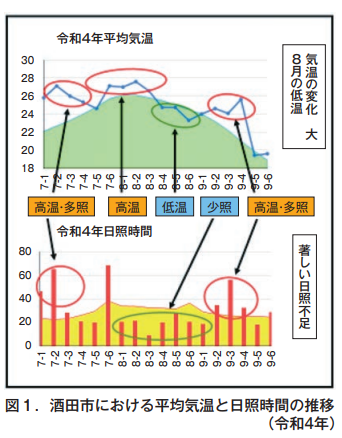
平成3年から令和4年までの過去32年間で8月1半旬から9月1半旬までの積算日照時間の少ない順に並べると,一番少ない年次は作況指数が94であった平成15年(冷害)の114時間(平年比50),2番目に少ないのが令和4年の137時間(平年比60)であり,令和4年も著しい日照不足であった。山形県の庄内地域で,過去に日照不足で作況指数が99未満(平年以下)であった年次と比較すると,作況指数が92の平成7年の173時間(平年比76),作況指数が98の平成10年の159時間(平年比70)よりも,令和4年の日照時間は少ない年次であった。
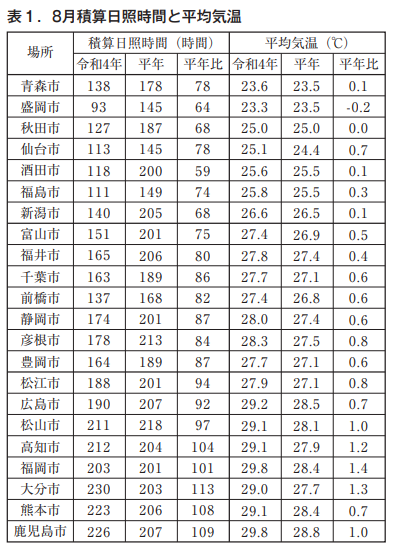
次に,稲作の登熟期間である8月の気象条件(平均気温,積算日照時間)を全国的にみると(表1),8月の平均気温は平年並であるが,積算日照時間が平年よりも著しく少ない地域,積算日照時間は平年並であるが,平均気温が平年よりも高く品質低下が懸念される27℃を越えている地域,および積算日照時間が平年より少なく平均気温が平年よりも高い地域の3つに分類され,いずれの地域も日照不足・高温条件下の登熟で収量低下や品質低下が懸念される状況にある。
With the normalization of rice crop growth under conditions of lack of sunlight and high temperatures in the future, the improvement of paddy rice productivity is particularly important from the viewpoint of food security. Therefore, this paper describes from the viewpoint of photosynthetic capacity (source capacity), which is involved in improving rice productivity, and proposes the usefulness of coated fertilizers such as "seedling box leave" and strategies to further improve productivity.
2. evaluation of the rice side
If there are any relevant items in the evaluation of the rice crop for the current year from the source side (the side that produces and supplies photosynthetic products) and the sink side (the side that accepts photosynthetic products), the viewpoints will be used as improvement measures for the next year's rice crop.
(1) Evaluation of the source side (the side that produces and supplies photosynthetic products)
0■Lower-than-normal leaf color at ear emergence
Low leaf color at ear emergence means low nitrogen per unit leaf area, which is disadvantageous for photosynthesis under sunlight deficit conditions. If the upper leaves are nitrogen-deficient (i.e., low water uptake capacity due to insufficient nitrogen supply from the paddy field or low root vigor), nitrogen translocation from the lower leaves will compensate for the nitrogen deficiency in the upper leaves, resulting in a progressive decrease in leaf color in the lower leaves.
○■出穂後20日以降に葉色(上から3枚目)が低下した
出穂後20日(登熟中期)以降に下位葉の葉色が低下した場合は,根の活力低下(吸水能力の低下,老化抑制ホルモンのサイトカイニン合成量の減少)により窒素不足となり,上位葉に下位葉から窒素が転流し下位葉の葉色低下がさらに助長され,日照不足や高温条件下での光合成量も少なく登熟不良となる。
〇■水田圃場の還元が進行した,■活着が遅延し初期生育が抑制された
When the reduction of the paddy field progresses, delayed transplanting and suppression of initial growth (partial moetting) result in fewer roots, and the number of roots is reduced, and the number of roots is also reduced under the condition that the paddy field is not dried out at the right time due to continuous warm water management (shallow water) to compensate for the suppression of initial growth. This reduces the amount of roots involved in the absorption of nutrients during the ripening period, which is also a factor that suppresses ripening under conditions of insufficient sunlight and high temperatures.
〇■ケイ酸質資材の施用が実施されていない圃場,■ケイ酸供給が少ない圃場
When siliceous materials were not applied and silicon supply was low, the specific leaf weight (thick leaf blade), which plays a role in photosynthetic capacity, was not sufficient to ensure a good light-receiving posture by improving leaf blade erectness, which may also be a factor in reduced photosynthetic output under conditions of insufficient sunlight.
(2) Evaluation of sink side (side that accepts photosynthetic products)
シンク側の評価として,量的評価と質的評価がある。量的評価は1㎡籾数の多少による評価,質的評価は登熟に不利な2次枝伷籾数の多少による評価を行う。
〇■1㎡籾数が,品種毎に示されている指標の1㎡籾数よりも多い
1㎡籾数が多い場合は,光合成産物の分配先が増加するので,日照不足や高温条件下では登熟が不利となる。
〇■初期生育が抑制されて1㎡穂数が少なくなり,1穂籾数が増加した
初期生育が抑制され1㎡穂数が少なくなり,穂籾数が多い場合は,登熟に不利な2次枝梗籾数が増加するので登熟が不利となる(1穂籾数と2次枝梗籾数は正の相関関係)。
〇1㎡籾数を構成する1㎡穂数と1穂籾数(2次枝梗籾数)とのバランスが大事で,気象変動条件下では,初期生育を確保し,必要とする穂数を早期に確保することが重要となる。
3. characteristics of factors involved in photosynthesis under conditions of lack of sunlight and high temperature
Factors on the leaf blade side that affect photosynthesis, which indicates source capacity, include
(i)Photosynthetic capacity of single leavesis the leaf bladeNitrogen concentration(per leaf area)Nitrogen content)との正の相関関係があり,葉面積当たりの窒素量はLeaf thickness(比葉重)と関係が深く,厚い葉を有する稲体ほど葉面積当たりの窒素量が多くなる。silicic acidhas the effect of increasing specific leaf weight.
(2) Photosynthesis rate of leavesagingに伴って低下し(二酸化炭素固定系の老化),葉の老化に影響を与える要因としてNitrogen absorption(Fertilizer nitrogen has the effect of reducing leaf senescence.)cytokinin(根で合成されるホルモンで葉に転流される)があり,Root FunctionsKeeping the "+" level high inhibits leaf senescence.
(iii)Amount of photosynthesis in the communityTo improve theerectnessの向上による受光態勢を良化させることが根に養分を供給している下位葉の受光量を増やし光合成量を維持するので,silicic acidが重要な役割を果たしている。
To maintain the source capacity, theSustained nitrogen supply (fertilizer application, soil fertility)andsilicic acidによる下位葉の光合成能力の維持(老化抑制),日照不足・高温条件下でも乾物生産が重要となる。
Root-side factors that play an important role in photosynthesis include
(1) For high yields, high physiological activity of the root system during the ripening period and a slow decline inRoot agingを遅らせることが籾の登熟の向上につながる(特に,2次枝梗籾)
(2) Since the availability of an active root mass determines photosynthesis during the ripening period, it is important to ensure that the root mass is high enough to maintain the photosynthesis rate during the ripening period.taproot(medium dry), (medium dry), (medium dry)outer root(間断潅水)などの形成を促進する適切な水管理と初期生育の確保が重要である。
③葉身の老化が遅く,長期間にわたり葉色を維持できること,すなわち,根から葉に転流するサイトカイニン総量が多く,lower leaves withering awayis slow, so theLeaf color of upper leavesが維持され,結果的に光合成が維持され,登熟が良好で収量も多くなる。
(4) If the ability to absorb nitrogen is reduced during the ripening period and the leaf blade is deficient in nitrogen nutrition, the下位葉の窒素を上位葉に転流This will cause a decrease in leaf color in the lower leaves, and alsoRoot Vitality(water absorption capacity) decreases.
The nutrients especially needed to improve photosynthetic capacity of rice plants under low sunlight and high temperature conditions are (1) nitrogen (nitrogen content in single leaves, suppression of leaf senescence by continuous small nitrogen supply, and maintenance of root vitality by continuous supply of photosynthate products from lower leaves to roots) and (2) silicon (improvement of leaf blade specific leaf weight, better photosensitive condition, and root oxidative capacity of roots), which are truly the two wheels of the wheel. In addition, the roots that support photosynthesis of the leaf blade are important (there are "nadir roots" that extend deep into the paddy soil and "epiphytic roots" that expand and extend in the surface layer of the soil, each of which plays an important role during the ripening period).
さらに,葉身と根の相互作用の向上により,光合成産物の生産量を増やしても分配先である籾(シンク)能が重要であり,生産された光合成産物の分配が適正に行われる1㎡籾数の形成とこれを構成する1㎡穂数と1穂籾数(1穂籾数が過剰にならないような)のバランスが重要となる。
In years with fewer hours of sunlight, silicon and nitrogen uptake by paddy rice tends to be lower and yields decrease regardless of the silicon supply from the soil (Figure 2).
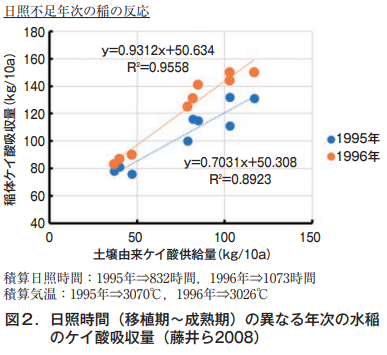
光合成能向上には窒素とケイ酸の吸収量を増加させる必要があり,日照不足年では土壌からのケイ酸供給量だけでは不十分な場合もあり,ケイ酸質資材の施用が有効となるとともに,「苗箱まかせ」による根域の近くからの少量の窒素の持続的な供給は,稲体の窒素栄養を維持する重要な技術である。
Apparent photosynthetic rates were measured under different photon conditions of 2000 (sunny), 1000 (lightly cloudy), and 500 (cloudy) for the no-silica and silica (Silica 200) treatments (Table 2).
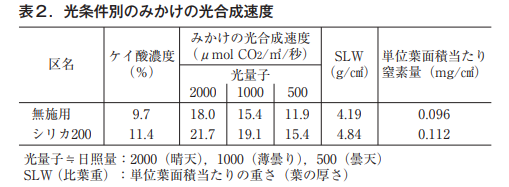
The rate of photosynthesis of the leaf blade tended to be higher in the high-silica zone than in the low-silica zone, regardless of light conditions. The photosynthetic rate in the silicate-applied zone was 121 on sunny days, 124 on lightly cloudy days, and 129 on cloudy days when the rate in the no-silicate-applied zone was 100, indicating the effect of silicate application. This may be due to the higher amount of nitrogen per unit leaf area in the silicon-applied area due to the increase in SLW (specific leaf weight), which also suggests that silicon is highly effective as a countermeasure under conditions of insufficient sunlight.
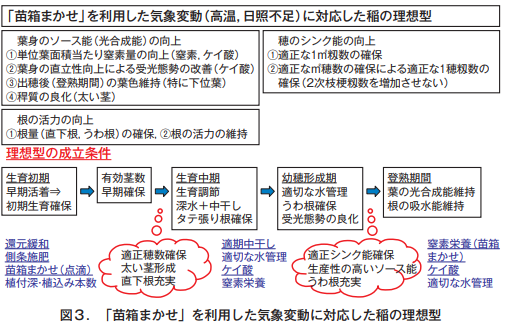
4. what is the strongest all-weather system (Figure 3)
(1) The response of paddy rice to
①土づくり(製鋼スラグ)や稲わら腐熟促進(酵素資材のピンポイント施用)により土壌還元の緩和と側条施肥+苗箱まかせ(点滴効果)によるスタートダッシュで早期に必要とする茎数を確保(3号分げつ:下位分げつ)できる。
②生育調節(深水,中干し)を適期に行うことができ,1茎乾物重の重い茎(太い茎)の確保,「直下根」および「うわ根」の十分な確保につながる。
③さらに,効率的な土づくり効果(ケイ酸)と水稲の表層根への近接施肥の「苗箱まかせ」による持続的な少量窒素供給による生育後期の持久力(後期凋落の抑制,窒素栄養の維持,根の活力維持)を向上できる体制が確保される。
However, the current rice paddy is vulnerable to weather disasters (high temperatures, lack of sunlight, etc.) due to poor early growth and root elongation, delays in securing the required number of stems, inadequate timing of growth adjustment such as drying out, resulting in suppressed root mass, and a lack of silicon due to stagnant soil preparation, combined with insufficient nitrogen supply in the latter half of growth, leading to reduced leaf color and withering of the lower leaves. This situation can be changed by the methods (1) to (3) above.
(2) Next-generation fertilizer application system Information-linked soil preparation + "side-row fertilization + leaving the fertilizer to the seedling box
The following procedure of information-linked soil preparation + "side-row fertilizer application + leaving the seedling box" in the next-generation fertilizer application system will be implemented.
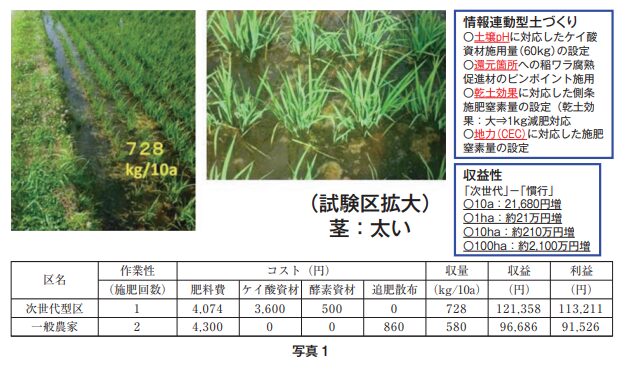
The information-linked fertilizer application system determines the amount of nitrogen for fertilizer application based on the soil fertility of each field, target yield, and variety (whether or not the field has fallen over), etc., and the amount of nitrogen for side-row fertilizer application is determined based on the dry-soil effect information for each field in the current fiscal year. The amount of nitrogen for side-row fertilization is determined based on the dry-soil effect information for each field in the current year. This reduces fertilizer application and soil fertility costs while ensuring stable yields (high quality) even under variable weather conditions (lack of sunlight, high temperatures, etc.) (Photo 1).
concrete method
0Information-linked soil preparation
siliceous material
①施用するケイ酸質資材の選択:圃場の還元リスクを評価して還元リスクがある場合,ケイ酸・石灰の他に還元の進行を緩和する鉄・マンガンを含んでいる製鋼スラグを選択する。
②ケイ酸質資材の施用量:土壌分析(pH,CEC),ケイ酸質資材の施用履歴などから,圃場毎にケイ酸質資材の施用量を可変して施用することによってコスト低減につながる。
reduction measure
①実施する対策の選択:圃場の還元リスクを評価して実施する対策を選択する。選択する対策としては,排水対策(サブソイラ),稲わら腐熟促進(酵素資材,石灰窒素),製鋼スラグ施用,苗質向上・浅植え等がある。
②稲わら腐熟促進材のピンポイント施用:ドローンセンシングやスケッチにより圃場内・圃場間の還元リスクの高い場所を特定して,その場所だけにピンポイントで酵素資材などを施用する。
Fertilizer application linked to 0 information
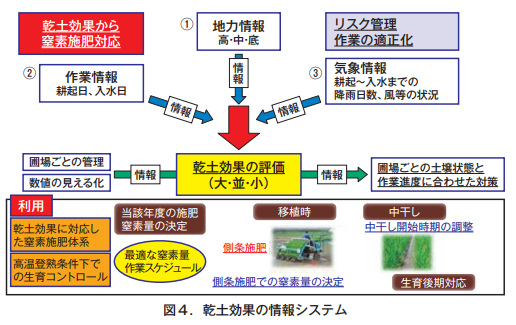
By changing the amount of nitrogen applied to each field based on the evaluation of the field soil fertility (regional variation) and dry-soil effect (annual variation), which are factors that cause variation in the soil nitrogen absorbed by paddy rice, it is possible to reduce the variation in soil fertility from field to field. Specifically, the amount of nitrogen in side-row fertilizer (fast-acting N: equivalent to base fertilizer) is optimized based on information on soil fertility (regional variation) and dry-soil effect (Fig. 4), and variable fertilizer application is performed for each field (in fields with high dry-soil effect, the amount of nitrogen in "side-row fertilization" is reduced). Select and implement the optimized amount of nitrogen and fertilizer type (leaching type) of "seedling box application" (slow-release N: equivalent to additional fertilizer) for each field based on soil fertility, variety, yield target, and weather conditions.
Effects of "information-linked soil preparation" + "side-row fertilization + leaving the seedlings in the box
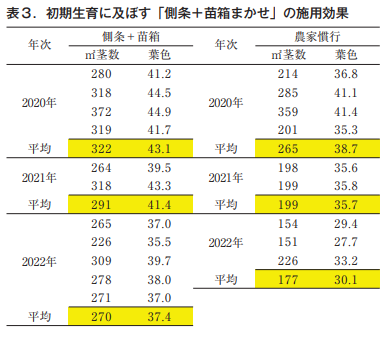
0Ensuring initial growth (Table 3)
(1) The number of stems per square meter and leaf color about one month after transplanting were compared between the "side-row fertilizer + seedling box-applied" and the farmer's customary treatments.
「側条施肥+苗箱まかせ」区ではいずれの年次も目標茎数である1㎡当たり300本程度を確保しており,葉色も高く維持している。農家慣行区では移植後(5月10日~6月10日)の気象条件が高温年の2021年,低温・日照不足の2022年では(表4),茎数減少・葉色低下が見られた。
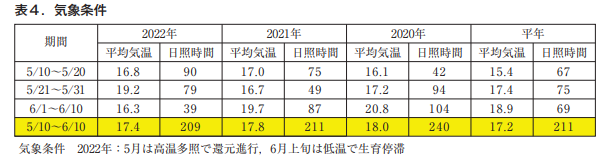
Even under severe post-planting weather conditions, theSide-row fertilizer application + seedling box leave-as-you-goは現場の課題である初期生育確保に安定的に有効であることが示された。
②排水対策,製鋼スラグ施用および稲わら腐熟促進材(酵素資材)のピンポイント施用による還元対策もSide-row fertilizer application + seedling box leave-as-you-goによる窒素供給と相まって安定的な初期生育確保が可能であった。
Improvement of culm leaf fullness
0Maintaining high culm and leaf fullness until maturity without decreasing it after the ear-justification stage leads to improved ripening without decreasing photosynthesis. If nitrogen supply to the rice body is low after the ear setting stage, culm leaf fullness will decrease, leading to a decrease in yield.
0The establishment of a sustained small amount of nitrogen supply system after the earning stage of rice leads to the maintenance of photosynthetic capacity by the leaf blade under conditions of lack of sunlight and high temperatures that affect photosynthesis. From this point of view, theContinuous supply of small amounts of nitrogen through "leave it to the nursery box" or other meansIn addition, it is also important to manage fertilizer to secure root volume, which is the absorbing side of nutrients, and to maintain root vigor during the ripening period.
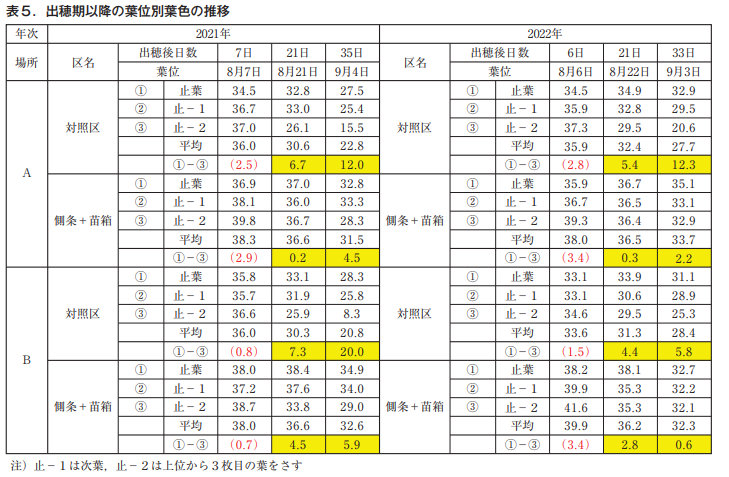
Leaf color at the time of maturity (Table 5)
Comparing the leaf color trends after ear emergence in the "side-row fertilizer + seedling box" and the control (farmer's practice), there was a significant decrease in leaf color in the third leaf from the top in the control. In the control, senescence pressure was observed in the lower leaves from 20 days after ear emergence, indicating a wilting pattern.
〇「側条施肥+苗箱まかせ」区の葉身の枯れあがりが他の施肥法に比べて緩やかで,上から3枚目の葉色が維持され,根の活力(吸水能)が高く,気象変動に強い(令和4年は日照不足,令和3年は高温)ことが示された。
〇還元の緩和による初期生育の良化,ケイ酸による光合成能の向上と苗箱まかせによる持続的な窒素の供給が令和4年の著しい日照不足年次でも葉色の低下を抑制した。
Significance of continuous nitrogen supply during the ripening period by using "Seedling Box Leave" and other coated fertilizers.
The intensity of nitrogen uptake by leaf position is higher in the upper leaves, and when the amount of nitrogen supplied by the paddy soil (fertilizer nitrogen and soil nitrogen) is high, the intensity of nitrogen uptake in the upper leaves depends on the nitrogen in the soil and not on the translocated nitrogen from the lower leaves.
On the other hand, when the amount of nitrogen supplied by the paddy soil (fertilizer nitrogen and soil nitrogen) is low, the uptake intensity of nitrogen in the upper leaves depends more on the translocated nitrogen from the lower leaves than on the nitrogen in the soil. In other words, the decrease in leaf color of lower leaves during the ripening period indicates a nitrogen deficiency in the upper leaves, and weather conditions unfavorable to photosynthesis, such as lack of sunlight and high temperature, further promote the decrease in leaf color of lower leaves, which, combined with the decrease in root vigor (decrease in photosynthetic product supply to roots due to decreased photosynthetic capacity caused by decreased leaf color in lower leaves), causes late wilting of the rice plant Late wilting of rice plants is occurring.
〇上記のような稲が増加している傾向であり,それを打破するには,適正な量の窒素を持続的に供給できる施肥体系が重要であり,その視点から「苗箱まかせ」などの被覆肥料が有用The following is considered to be the case.
土のはなし-第20回
農産物のおいしさに影響する
タンパク質と炭水化物はトレードオフの関係
前 ジェイカムアグリ株式会社
北海道支店 技術顧問
松中 照夫
In the previous issue, we introduced the GS-GOGAT system, in which plants absorb ammonium and nitrate ions, which are nitrogenous nutrient ions, and utilize carbohydrates produced by photosynthesis in leaves to produce amino acids, which are the raw materials for proteins. Using this system, plants supply themselves with all the amino acids necessary for protein synthesis. Proteins, along with carbohydrates, greatly affect the taste of agricultural products.
In this article, we will consider the curious trade-off between protein and carbohydrate content in crops, which has a significant impact on the taste of agricultural products, from the perspective of the GS-GOGAT system.
1. what is a trade-off relationship?
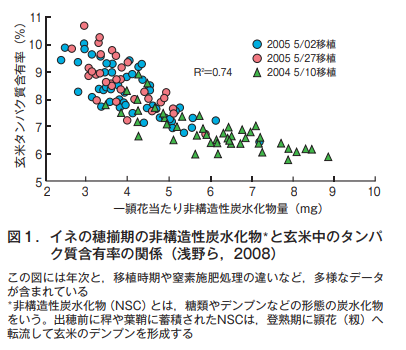
A trade-off is a relationship in which one factor increases while the other decreases, like a seesaw on a playground, and the two factors cannot both increase and be compatible. For example, as shown in Figure 1, when the nonstructural carbohydrate (NSC) content per panicle of rice is low, the protein content in brown rice is high, and when the NSC content is high, the protein content in brown rice is low, indicating that a trade-off relationship exists between the two.
2. why the trade-offs?
The reason for the trade-off between protein and carbohydrate content in plants is that the carbohydrate content in plants (A) is determined by the difference between the amount of carbohydrate produced by photosynthesis (B) and the amount of carbohydrate consumed when the absorbed nitrogen is converted to protein in the body (C) (A = B -C).
This can be well understood from the perspective of the GS-GOGAT system introduced in the previous issue. That is, plants that are given a lot of nitrogen from compost or chemical fertilizers absorb a lot of nitrogen, of course. When more nitrogen is absorbed, it is incorporated into the GS-GOGAT system and amino acid synthesis is activated, resulting in an increase in protein content.
Recall that at this time, in addition to ammonium and nitrate ions absorbed from the roots, another raw material was needed for amino acid synthesis. That is 2-oxoglutaric acid. 2-Oxoglutaric acid is an organic acid that is an intermediate product of the decomposition process of photosynthetic carbohydrates produced in leaves by plant respiration. Therefore, in order to supply large amounts of this organic acid, the decomposition of carbohydrates must be increased through active respiration. As a result, the amount of carbohydrates remaining in the plant body is inevitably reduced.
Conversely, if only a small amount of nitrogen is provided, plants synthesize only a few amino acids and have low protein content. Since not much is used for amino acid synthesis, not much is needed for the intermediate products of carbohydrate breakdown by respiration. As a result, more carbohydrates are left over, resulting in a relatively high carbohydrate content. This is the main mechanism that causes the trade-off relationship between protein and carbohydrates in plants.
Nitrogen fertilization and crop quality
The trade-off between protein and carbohydrate content in crops means that nitrogen fertilization has a significant effect on the carbohydrate content of crops. We would like to consider this relationship in terms of the eating quality of rice and the relationship between different cultivation methods and the taste of the crop.
1) Protein content and eating quality of rice
The overall eating quality rating of rice (milled rice) is clearly higher the lower the protein content (Figure 2).
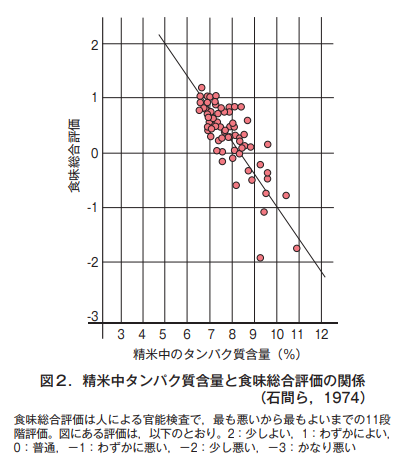
This is because the lower the protein content, the higher the carbohydrate (starch) content, resulting in a taste that the Japanese prefer. Therefore, nitrogen fertilizer management that does not unnecessarily increase the protein content of rice is required to improve the taste of rice. However, too low nitrogen application in pursuit of low protein content will result in lower brown rice yield. In other words, producing high starch, good-tasting rice requires a high level of technology to manage nitrogen fertilization in a way that strikes the right balance between taste and yield.
However, the eating quality of rice (milled rice) is not only affected by protein content, but also by low amylose content, which constitutes the starch of rice. The amylose content of rice is more influenced by variety characteristics than by nitrogen fertilization. Therefore, good-tasting rice varieties are selected from breeding material that has characteristics that result in low amylose content in the rice.
(2) Differences in cultivation methods and the taste of agricultural products
It is often pointed out that organically grown produce tastes better than conventionally grown produce (conventionally grown using chemical fertilizers and pesticides). Is this a general fact? This can also be explained in terms of the relationship with the amount of nitrogen applied.
Compost is used as the nutrient source for the crop in organic farming, while chemical fertilizer is used in conventional farming. Let us now consider a case in which crops are grown using these two sources of nutrients with the same amount of total nitrogen applied. Even if the amount of total nitrogen applied is the same for both sources, the amount of nitrogen in a form that is easily absorbed and utilized by the crop (inorganic nitrogen) is usually much higher with chemical fertilizer than with compost. This is because the nitrogen in compost contains organic nitrogen that cannot be immediately absorbed by the crop.
In other words, from the crop's point of view, the amount of inorganic nitrogen that can be absorbed immediately is greater with conventional chemical fertilizer than with organic compost, even though the total amount of nitrogen given is the same. Then, the nitrogen absorption of the crop is higher under conventional cultivation than under organic cultivation, resulting in a higher protein content and, consequently, a lower carbohydrate content. Since the taste of agricultural products is considered to increase with carbohydrate content, such as sugars and starches, the result is that organic produce is evaluated to be better tasting, even though the total nitrogen content fed is the same.
However, this is not due to differences in cultivation methods, but mainly to differences in the amount of inorganic nitrogen contained in the nutrient sources used. If the amount of nitrogen applied from chemical fertilizers is equal to the amount of inorganic nitrogen contained in compost, the carbohydrate content of the crop, such as sugars, will not differ much between the two.
In other words, the fact that organic produce generally has lower protein content and higher carbohydrate content than conventional produce is not due to differences in cultivation methods, but rather to differences in the amount of inorganic nitrogen applied, even when the total nitrogen content fed is the same.