

Site Search
Search within product
第755号 2023(R05).11発行
Click here for PDF version
§Jコート肥料を用いた水稲の全量基肥施肥と被覆樹脂殻の崩壊性
Nagano Prefectural Agricultural Experiment Station
上原 敬義
吉川 直人
§土のはなし-第26回農業と環境問題-その1
わが国の窒素循環の問題点
前 ジェイカムアグリ株式会社
北海道支店 技術顧問
松中 照夫
Jコート肥料を用いた水稲の
全量基肥施肥と被覆樹脂殻の崩壊性
Nagano Prefectural Agricultural Experiment Station
上原 敬義
吉川 直人
Introduction.
In recent years, there has been concern that the resin shells of coated fertilizers (fertilizer with a resin coating to regulate fertilizer efficacy) are leaking out of paddy fields as an environmental problem. Fertilizer manufacturers have been developing resins with improved disintegrating properties for coating fertilizers. On the other hand, we in the agricultural industry are also investigating the amount of residual resin shells flowing out of the field and examining methods to prevent them from flowing out. In this paper, we introduce our study on the nitrogen leaching characteristics, fertilizer effect, and collapsibility of resin shells when rice plants are grown using a coated fertilizer with new resin with enhanced collapsibility from 2019 to 2021.
Nitrogen leaching characteristics from coated fertilizer
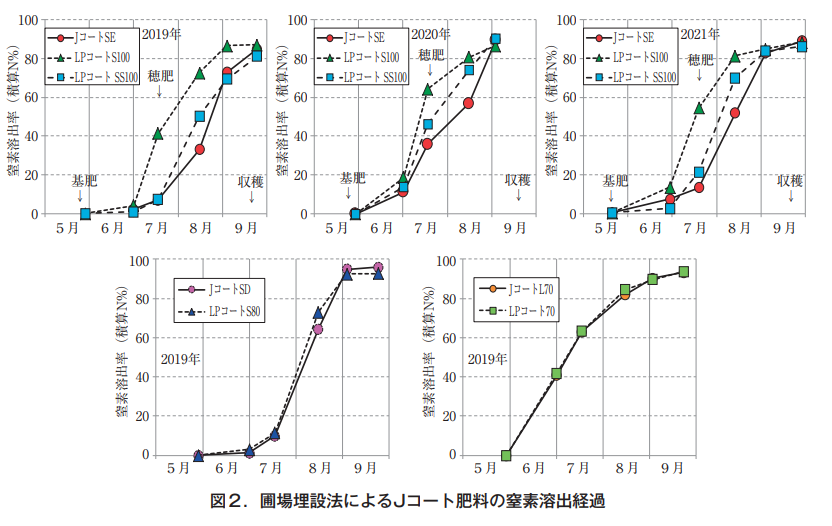
被覆肥料の窒素溶出特性には,溶出日数の長短の種類があるほか,リニア型とシグモイド型がある。本県水稲作において,全量基肥施肥の代表的な肥料はLPコートS100(シグモイド型100日タイプ)を用いた肥料であり,これを代替する肥料としてJコートSEを供試して溶出特性を調べた。また,このほかに,LPコートS80相当としてJコートSDを,LPコート70相当としてJコートL70を用いて溶出特性を調べた。
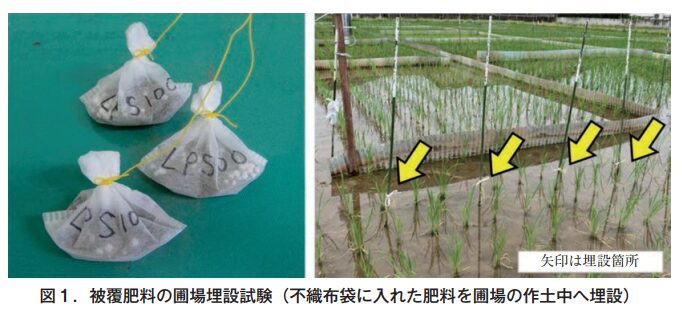
Fertilizer and soil were placed in non-woven fabric bags and buried in the field soil, and the bags were periodically collected to wash out the fertilizer and analyze the amount of residual nitrogen. The amount of nitrogen remaining in the bag was analyzed by periodically collecting the bag, washing out the fertilizer, and calculating the amount of nitrogen that had decreased since the beginning of the burial as the leaching rate (Figure 1).
栽培試験に用いたJコートSEは,当初,LPコートS100と同SS100の中間的な溶出特性を想定して用いた。試験結果は,LPコートSS100に近い溶出特性であった。また,JコートSDはLPコートS80と,JコートL70はLPコート70とほぼ同じ溶出特性であり,Jコート肥料は対応する既存のLPコート肥料と同等の溶出特性を有することが示された(図2)。
Growth and yield of paddy rice under total basal fertilizer application
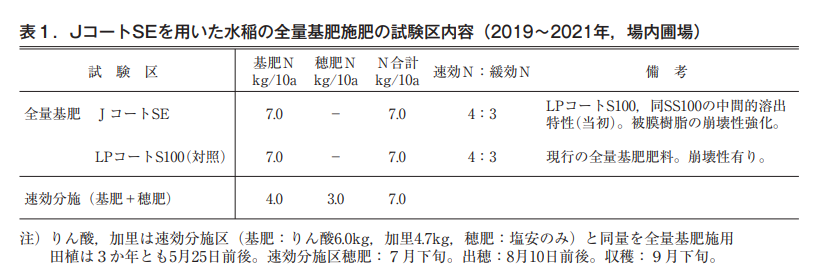
長野県は地域により気象条件や品種が異なり,主要品種のコシヒカリ栽培地帯においては,以前の基肥+穂肥の分施体系に代えて速効性+被覆肥料の全量基肥施肥がかなり増加している。地域により穂肥量等が異なるが,この窒素量をシグモイド型100日程度の肥料で代替し,リン酸,加里等を実情に合わせて配合した地域銘柄肥料が数多く使用されている。栽培試験は,場内圃場(須坂市)において,LPコートS100を対照としてJコートSEを用いて実施した(表1)。
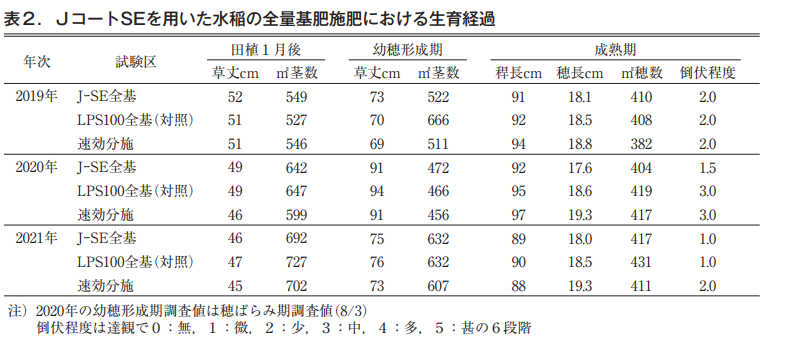
主に速効性窒素の影響を受ける初中期の生育は,いずれの試験区も同程度であった。穂肥や被覆肥料の影響が大きい幼穂形成期頃以後の生育も同様に経過し,成熟期におけるJコートSE区の稈長,穂長,穂数,倒伏は,対照と同程度の値であった(表2)。
水稲の収量調査では,JコートSE区の精玄米重は対照のLPコートS100区よりやや低い年もあったが,統計処理による有意差は見られなかった。そして,いずれも600kg/10a以上を収めることができた。また,収量構成要素でも,JコートSE区は登熟歩合以外には2020年の速効分施区との有意差は認められなかった(表3)。
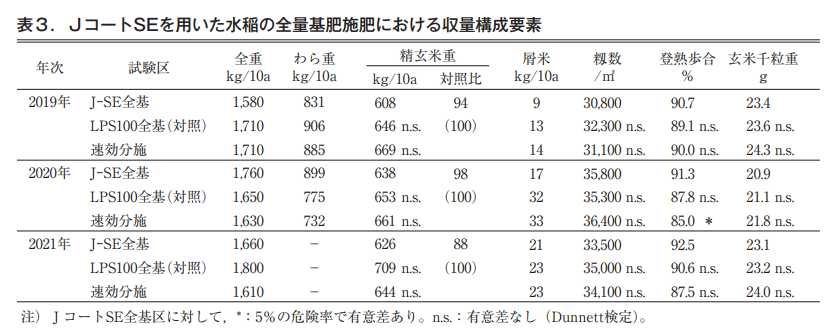
本県コシヒカリの全量基肥施肥は,施肥法が普及して30年近くが経過した現在,温暖化が進行している。このため,LPコートS100より窒素溶出の立ち上がりがやや遅いLPコートSS100の方が適しているとの論議もある。今後,この点も含めて,JコートSEによる代替の可否についての更なる検討が必要である。
Brown rice quality in full basal application of paddy rice
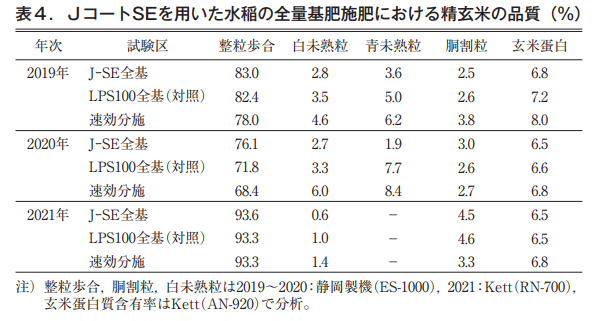
精玄米の整粒歩合,白未熟粒,青未熟粒の粒数割合では,年次や品質判定機器の種類による差はややあったものの,JコートSE区は対照のLPコートS100区と同等の品質であった。また,速効分施区との比較ではやや優れる傾向であった。精玄米の蛋白含有率は,いずれもほぼ6.5~7.0%(現物水分条件)であり,試験区による差はほとんど認められなかった(表4)。
Nitrogen absorption in total basal fertilization of paddy rice
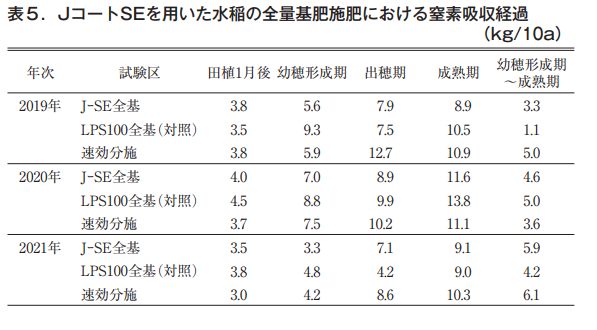
JコートSE区の水稲の窒素吸収量は,成熟期時点で対照のLPコートS100区より1~2kg/10a少ない年もあった。しかし,主に被覆肥料に由来する幼穂形成期調査時から成熟期までの吸収量は,LPコートS100区より多い傾向であった。これは,肥料埋設試験の窒素溶出特性のように,LPコートS100は7月に入った頃から窒素溶出が始まったのに対して,JコートSEはこれよりやや遅れて溶出が開始したことに由来すると考えられる(表5)。
Collapsibility of coated resin shells of J-coat fertilizers
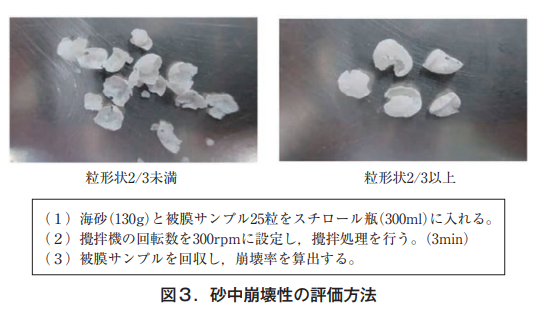
In the first year, fertilizer and soil were placed in non-woven bags and buried in the crop soil in the field in conjunction with rice planting in May 2019, and the coated resin was periodically collected and examined for collapsibility until the harvest season in 2021 (September), two years and four months later. Collapsibility was examined by visual inspection and by the in-sand collapsibility evaluation method, in which the coated resin shell was subjected to a force (Figure 3). The method was developed by ZEN-NOH and conducted by JCAM Agri Co.
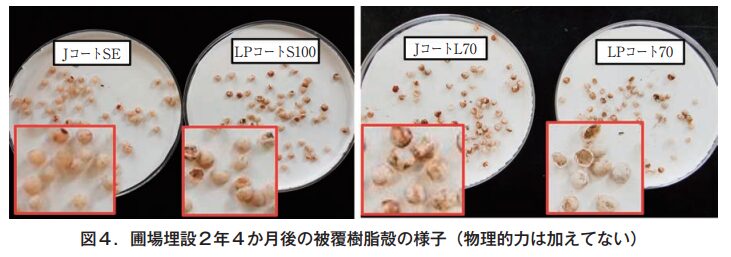
Under the conditions of this test, where the seedlings were buried in the soil, no physical force such as plowing or raking was applied, which is usually done in paddy field operations, and although crushed shells were visually observed, no broken or fragmented shells could be seen until the last survey (Figure 4).
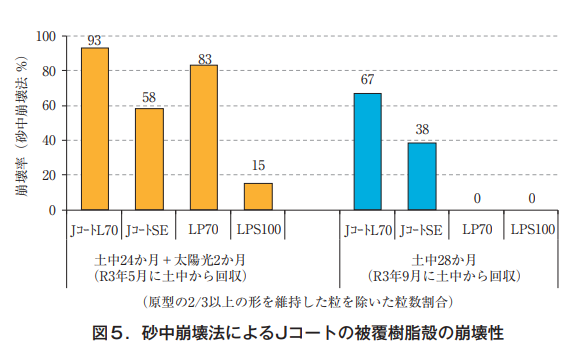
一方,物理的に力を加える砂中崩壊法の尺度による評価では,2年目の調査において,LPコート70,LPコートS100は崩壊率(原型の2/3以上の形を維持した粒を除いた粒数割合で,数値が大きいほど崩壊が進んでいる)が0%であったのに対し,JコートL70は67%,JコートSEは38%であった。また,肥料を回収後,太陽光に2か月間曝露(水田土壌表面に露出している条件を想定)したところ,LPコート70は83%,LPコートS100は15%に上昇し,従来から示されている紫外線による崩壊性も認められた。そして,JコートL70では太陽光曝露で93%,JコートSEは58%まで崩壊率が向上した(図5)。なお,リニア型溶出肥料のJコートL70は,シグモイド型溶出肥料より樹脂量が少ない(厚さが薄い)ため,崩壊率が高まったものと考えられる。
Jコート及びLPコート肥料の被覆樹脂の比重は1.0より大きいため,幾つかに割れると,空気を孕まないため,代かき時に田面水中に沈んで浮遊しない。これにより,翌年春までに肥料の樹脂殻が完全に分解・消失しなくても,仮に,田植え前に田面水が圃場外へ流出したとしても,殻の流出量は多くないと考えられる。このため,実際の耕耘等の物理的力が加わった条件を想定した今回の崩壊性試験結果から,JコートはLPコートより崩壊率が高く,太陽光により崩壊率が更に促進されることが示され,水田外への流出量の軽減に有効と考えられる。
Conclusion
Jコート肥料は,窒素溶出特性や水稲の生育,収量等の成績から,既存のLPコート肥料と同様に水稲の全量基肥施肥に有望であることが示された。また,被覆樹脂殻の水田外への流出に関しては,今後,崩壊しなかった肥料殻に対して,耕種的な,物理的な方法によって水田外への流出を防止する方法の検討が急務であるが,崩壊性が向上したJコート肥料を用いることにより,一定の効果があると考えられる。
Coated fertilizers are available in a wide range of slow-release rates, with linear and sigmoidal leaching characteristics, and have a temperature dependence that responds to the weather (growth) of the year to some extent. For this reason, various fertilizer application methods have been developed for rice and many other crops as stable fertilizer with regulated efficacy, contributing greatly to labor saving and cost reduction. By solving the problem of fertilizer shell runoff, which is currently being faced, it is expected to become more widely used in the future.
No Soil - No. 26 Agriculture and Environmental Issues - Part 1
わが国の窒素循環の問題点
前 ジェイカムアグリ株式会社
北海道支店 技術顧問
松中 照夫
The beginning of agriculture was the first human challenge to nature. In the sense of adding human intervention to the natural environment, it can be said to be the beginning of environmental destruction. Later, after the Industrial Revolution, human activities became so active that they altered the natural environment. Agriculture is no exception.
In many countries today, environmental pollution originating from agriculture is a problem. When the amount of nutrients applied to agricultural land exceeds the nutrient holding capacity of the soil, the excess nutrients flow into the groundwater, rivers, and air in the surrounding environment, causing environmental pollution. This month, we will consider the relationship between agriculture and environmental pollution.
The first issue is unique to our country, which has a low food self-sufficiency rate.
Changes in Japan's food self-sufficiency rate
In 1960, the Japanese government made two major cabinet decisions. The first was to accelerate economic growth through the Income Doubling Plan, and the second was to enact the Basic Agricultural Law. In 1960, Japan's food self-sufficiency rate (hereafter referred to as the calorie-based total calorific value of food supply) was 79%. Since then, however, Japan's food self-sufficiency rate has continued to decline, stagnating at 38 to 39% since 2010. The target for food self-sufficiency is 45% by 2030. Achievement of this goal is in jeopardy.
過去60年間にわたってわが国の食料自給率を低下させた主な要因は,食料を国内でまかなうという基本姿勢が維持されなかったこと,さらに食料の消費形態が変化したことにある。例えば,1965年度と2021年度の56年間で比較すると,1人1日当たりの各品目の供給熱量を合計した総供給熱量は,1965年度が2,459kcalで,2021年度はやや少なくなって2,256kcalだった(図1)。
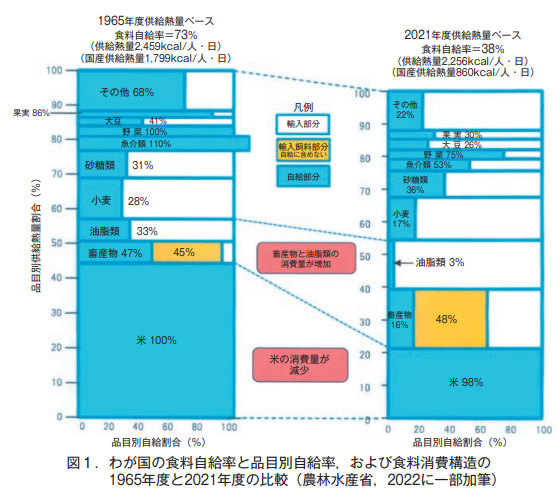
ところが,この56年間で米の消費は大きく減少し(供給熱量の減少),その減少は畜産物(肉類,鶏卵,乳製品など)と油脂類(大豆油,菜種油など)の消費拡大(供給熱量の増加)で相殺されている(図1)。さらに,総供給熱量に占める割合は56年間で大きな変化がないにもかかわらず,供給熱量の自給率が大きく低下した品目として果実,魚介類,小麦,大豆,野菜,そして「その他」に区分される品目がある(図1)。
こうした食料の消費形態の変化や品目別の自給率の低下は,国民の食傾向がごはんと魚という「和風」から,パンやパスタ,乳肉製品という「洋風」へ変化したことに起因する。ただし,この食料の消費形態の変化は,それが国民の単なる嗜好の変化や,所得の増加といった「成り行き」の結果とは考えにくい。むしろ,第二次世界大戦後のアメリカの余剰農産物輸出戦略に呼応した,わが国の政策的誘導の結果と見るべきだろう(柏,2012)。
Food production, consumption and nitrogen cycle in Japan
食料自給率の低さは,いいかえると外国の土にあった養分が作物に吸収され,それが含まれたまま輸入食料となって多量にわが国に持ち込まれていることを意味する。なかでも窒素(N)は,次回で述べるように,環境に悪影響を与えやすい。そのわが国でのN循環量が,自給率の低下によってどう変化したかを,データが報告されている1961年と2005年で比較してみる(図2)。
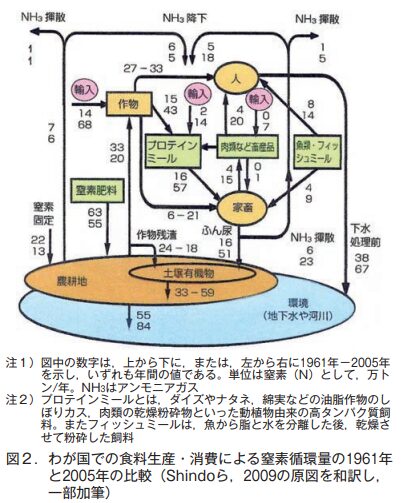
(1) N circulating volume in 1961
食料自給率が78%だった1961年,輸入されたNは,作物から14万トン,プロテインミールから2万トンで,年間わずかに16万トンだった。一方,農耕地に供給されるNは化学肥料由来(年間63万トン)が最も多く,家畜のふん尿由来のN(同16万トン)は,生物的N固定で土にはいる量(同22万トン)より少なかった。飼養されている家畜の頭数が少なかったからである。最終的に1年間で地下水や河川へ流出したNは,農耕地からの55万トンと,人間の排泄物(下水処理前の値)からの38万トンの合計93万トンだった。このほか大気に揮散したN(アンモニアガスとして)は,化学肥料や家畜ふん尿由来の合計で2万トンだった。
(2) Amount of N circulating in 2005
これに対して2005年,この年の人口は1961年より35%増えて1億2,800万人になった。食料自給率は40%に低下し,結果として輸入N量の合計は,1961年の5.6倍,89万トン(作物の68万トン,プロテインミールで14万トン,畜産品から7万トン)に大きく増えた。逆に,生物的N固定や化学肥料,作物残渣として農耕地にはいるNは減った。国内の食料生産が減ったからだ。
消費量が増えた畜産物は,その生産を支えるために家畜の飼育頭数を増やす必要がある。増えた家畜の飼料は輸入に依存する。このため,輸入された飼料に含まれたNが,家畜のふん尿になって農耕地へ流入する。その流入量は2005年に51万トン。1961年の3.2倍に増えた。さらに,人間の排泄物由来の流出N量も1961年の1.8倍だった。これは人口の増加率(35%)以上であり,食料の高タンパク質化を裏づけている。
結果として,2005年に農耕地から地下水や河川へ流出したNは年間84万トンに増え,これに人間の排泄物由来で環境へ流出する67万トンを加えた,年間151万トンが地下水や河川へ流出したと推定された。この量は1961年の1.6倍である。また,肥料や家畜ふん尿由来で大気環境へアンモニアガスとして揮散したN量は6万トンで,1961年の3倍になった。
わが国の低い食料自給率と食料消費動向の変化は,海外から持ち込むN量を大きく増やした。それがわが国の地下水,河川などの水質汚濁や,大気環境の悪化を招く可能性は大きい(Shindoら,2009)。まさに低自給率ゆえの問題である。次回は,この環境に流出するNが具体的にどのような環境汚染源となっているかを考える。
次回は,この環境に流出するNが具体的にどのような環境汚染源となっているかを考える。