

Site Search
Search within product
第757号 2024(R06).01発行
Click here for PDF version
§ジェイカムアグリがなすべき事
Jcam Agri Co.
営業統括本部長 河村 光太郎
§コーティング肥料マイスター細粒の芝地における肥料効果試験
一般財団法人 関西グリーン研究所
所長 森 将人
§土のはなし-第28回
農業と環境問題-その3
農地由来の窒素による大気汚染-アンモニア揮散
前 ジェイカムアグリ株式会社
北海道支店 技術顧問
松中 照夫
What JCAM Agri should do
Jcam Agri Co.
営業統括本部長 河村 光太郎

Happy New Year!
平素は「農業と科学」をご愛読頂き,この場をお借りして厚く御礼申し上げます。
At the beginning of the year 2024, I would like to offer a few words.
As you are well aware, the fertilizer industry has experienced price volatility over the past several years, mainly due to raw material prices.
The abnormal price hikes of raw materials continued due to the global unrest in Ukraine and other countries, China's policy of prioritizing its own country, and the continued depreciation of the yen. Although there have been similar cases in the past (the oil shocks in the 1970s and the world food crisis in 2008), I believe that the difference between "having or not having things" was one of the reasons for the rise in raw material prices this time.
Although prices of various raw materials are now lower than at the peak, the global environment for fertilizer raw materials has not changed significantly, and the future remains unpredictable.
In any case, we were made keenly aware of "the harshness of not being able to procure goods domestically and not being able to own things.
In this environment, the industry experienced major changes in distribution due to price fluctuations, and we were pressed to respond to these changes.
On the contrary, since the second half of the last fiscal year, when prices began to decline, cargo movements have slowed down completely, and the current fiscal year has been very difficult. I have been in the business for about 16 years, and at that time, I used to make product allocation based on the feeling of "about the same level as the same month of the previous year," and the results were not so far off, but that method is not applicable at all now.
However, this is not the way it should be.
What we are looking for now is "on-site ability. The goal of sales work is to increase sales, and the field skills needed to reach that goal are "information gathering," "improvement of technical skills," "networking," "handing over to the next generation," and, I believe, "analytical skills" necessary for demand forecasting.
We believe that there is probably still inventory in circulation in various places today, and we believe that we will be able to determine to some extent how much demand has been distributed by making full use of this analysis capability.
However, it is difficult for us to grasp the inventory situation in the entire prefecture by ourselves, so we would appreciate your advice to our sales staff as we will continue to forecast demand and conduct appropriate production, while receiving important information from the people who are usually our customers.
As a pioneer in the field of coated fertilizers, we will continue to do our utmost to control the outflow of coated shells. We are currently working to promote the use of "J Coat," which has a lower resin ratio than LP Coat, but unfortunately we cannot reduce the resin ratio to zero in order to ensure sigmoid elution that is almost the same as that of LP Coat.
However, with the recognition that "J Coat" is not a goal but a starting line, we are steadily moving in the direction of resin reduction, and new technologies are being considered not only in-house but also with external research partners.
We will continue to work as one to provide you with a good report as soon as possible, and we look forward to your continued guidance and encouragement.
Lastly, I would like to conclude my New Year's greeting by asking for your continued patronage of this issue of "Agriculture and Science" and wishing you a happy and prosperous new year.
Coating Fertilizer Meister Fine Granules
芝地における肥料効果試験
一般財団法人 関西グリーン研究所
所長 森 将人
1. golf course turf and manure management
(1) Differences in the type of lawn and where it is used.
関西地域のゴルフ場で利用している芝品種としては,グリーンではベントグラスやコウライシバ,ティグランド,フェアウェイではコウライシバ(学名:Zoysia pacifica),ラフではノシバ(学名:Zoysia japonica)が一般的であり,グリーン以外の場所は暖地型芝草で構成されている。グリーンで利用しているコウライシバはヒメコウライシバと呼ばれるもので,フェアウェイ等で利用するコウライシバより葉は細く,より低く刈り込む環境で使用している。
Warm-season turfgrass is characterized by new leaves (sprouts) that emerge around April, grow through the summer, turn brown in late fall, and stop growing in winter. This is the reason why turf grass looks brown in winter on golf courses. Some golf courses use coloring agents to make the grass look green as an evergreen effect, in order to make the boundary between fairways and roughs clear.
(2) Lawn fertilization
Fertilizer management on golf course turf can be broadly classified into two categories: greens and non-greens. In particular, the current fertilizer management of greens is divided into two main categories: greens and non-greens. The reason for this change is that the tendency to reduce the amount of fertilizer (mainly nitrogen) applied at one time has changed, and instead of promoting rapid turf growth, fertilizer management has shifted to minimizing uneven growth through frequent application of fertilizer.
On the other hand, as for fertilizer management of fairways and rough terrain, granular chemical fertilizers are generally applied in spring and fall, and teeing grounds may be fertilized more frequently and in larger quantities because they are often damaged by wear and tear per area and shots. The amount of fertilizer to be applied at one time would be about 3-5 g/m2 of nitrogen.
2. various tests on the use of Meister fine granules on turf
Many golf courses use fast-acting chemical compound fertilizers, which are easy to release. In other cases, urea is used for cost reasons, and coated fertilizers are used to maintain the fertilizing effect by gradually dissolving the fertilizer. In this study, we conducted tests using Meister fine granules (coated urea fine granules), which is classified as a coated fertilizer, to confirm the growth on lawns and to confirm yield during post-fertilization management.
(1) Korai Shiba growth test on Meister fine granules
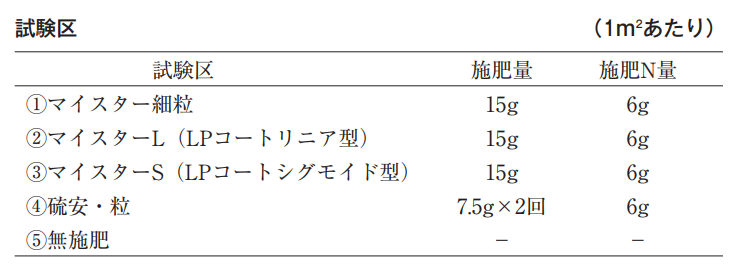
主な目的は,コウライシバ試験地に秋施肥として各種肥料を施用し,翌年春以降の芝生育の状況確認や,特にマイスター細粒が狙い通りの溶出をするのかを確認する。
<試験方法>
Test site: Kansai Green Research Institute, Kouraishiba test plot
Testing period: October 6, 2015 - June 24, 2016
Scale: 1m x 3m = 3m2 per plot 2 iterations
Turfgrass: Kouraishi Birch (used on teeing grounds and fairways)
Floor soil: Masago soil
管理:グリーンモアにより刈高13mm・刈込頻度1回/週
Survey items: (1) Leaf color survey (measurement of NDVI value)
(2) Above-ground growth volume survey (measurement of harvested dry weight)
(3) Photographic documentation
<試験結果と考察>
The kouraishiba plots were cut on October 6, 2015, and fertilizer was applied after the NDVI of each test plot was measured. The ammonium sulfate fertilized area was fertilized a second time on April 14, 2016.
The results of the leaf color change study (NDVI values), measured immediately after the start of the test until the end of the test, are shown in Table 1 and Figure 1.
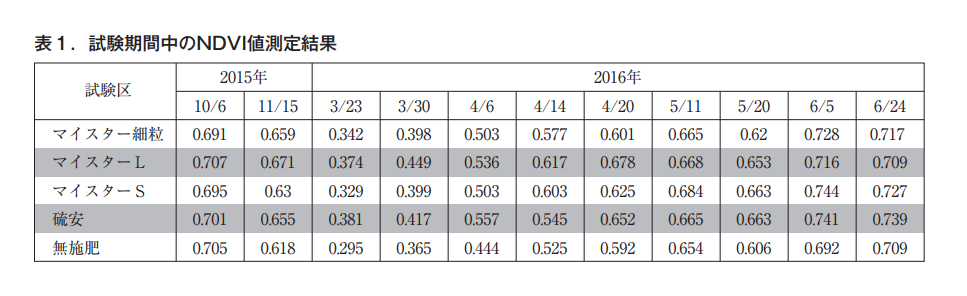
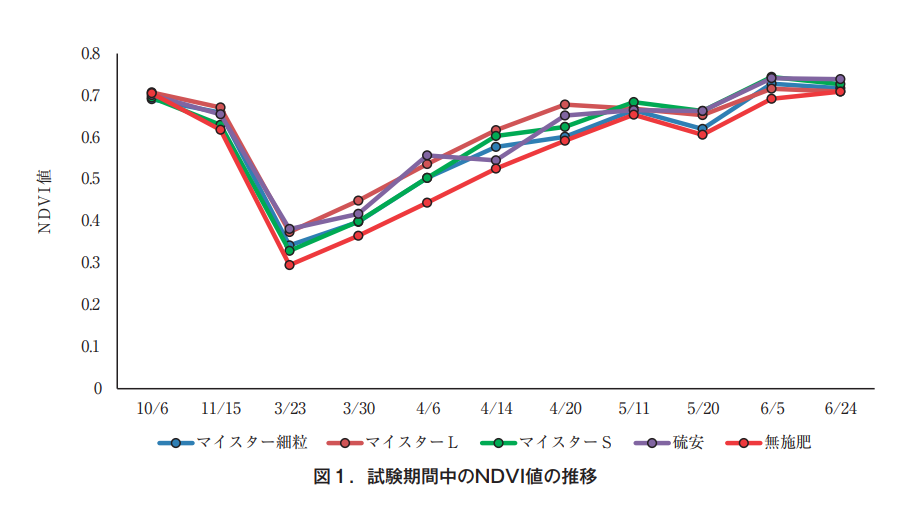
2016年3月から4月頃の葉色調査では,マイスター細粒とマイスターSがマイスターL,硫安より緑度は少し低いものの,マイスターSは5月以降から最も高い緑度を示した。
The greenness of Meister fine grains was lower than that of the other fertilizer treatments from March to May. This may be due to the fact that it took some time for the fertilizer effect to appear.
The greenness of Meister L was highest at the time of the survey on April 20, and tended to decrease gradually from May onward.
The study of the growth of common reedgrass was conducted by examining the amount of above-ground clippings since April, 2016. That is, each test plot was periodically mowed with a green mower, and the clippings were weighed after drying at 80°C for 24 hours.
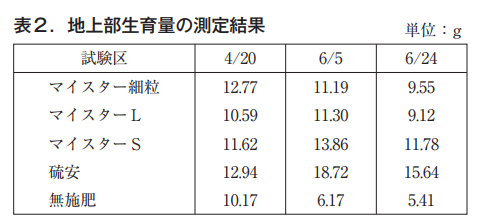
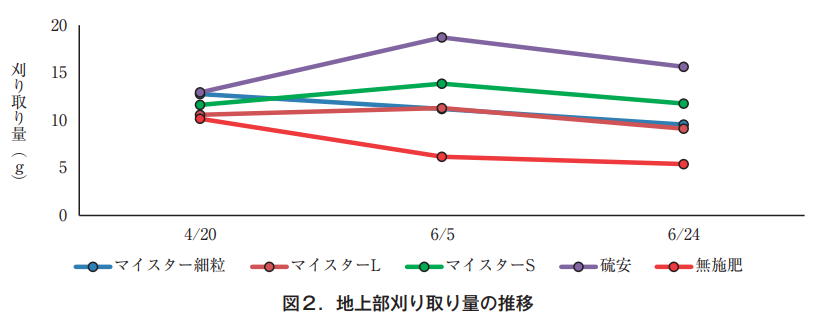
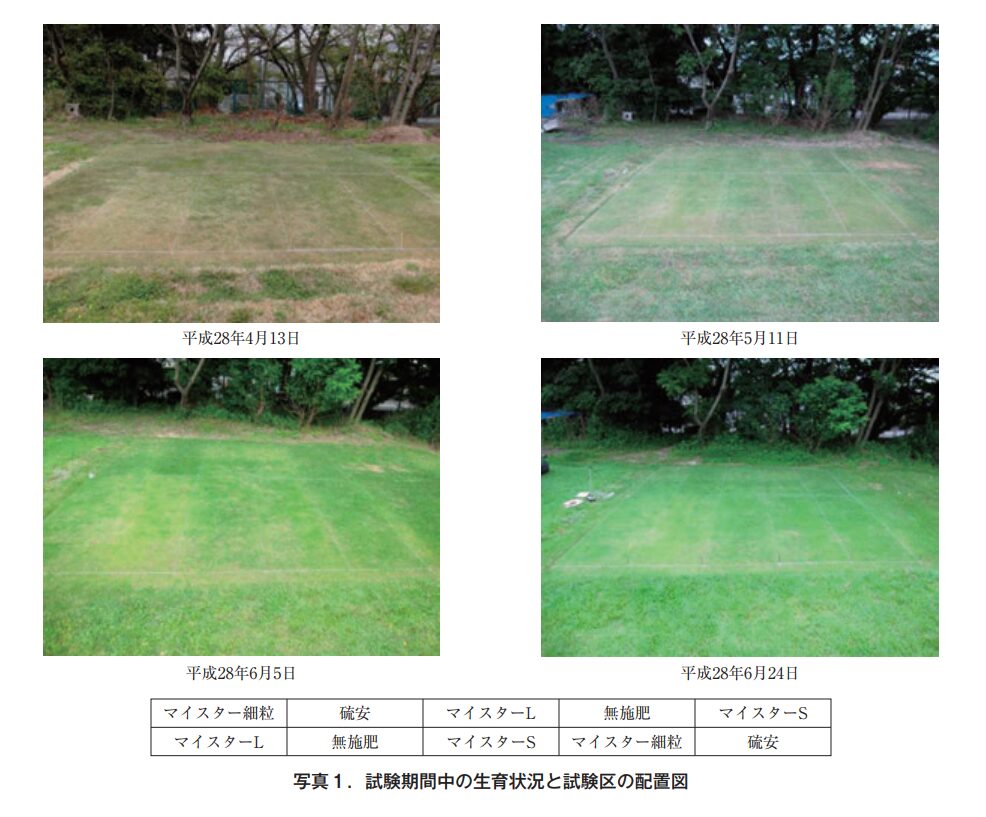
According to the results of the crop yield survey shown in Table 2 and Figure 2, there was no significant difference in the fertilizer-applied areas except for the no-fertilizer area when the survey was conducted on April 20, but after the second application of ammonium sulfate on April 14, the amount of growth of ammonium sulfate increased.
In the comparison of Meister fine grain, Meister L, and Meister S, Meister S was slightly superior in terms of growth rate, but the difference was not so pronounced. The results showed that the performance of Meister L and Meister S as fertilizers was not at all problematic, since each showed a clear improvement in greenness and growth rate compared to no fertilizer application from June onward.
(2) Meister fine grain yield test by control machine
A possible problem when granular fertilizers such as coated fertilizers and chemical fertilizers are applied to fairway and rough turf is the possibility that fertilizers may also be collected by sweeper operations for mowing and collecting clippings and fallen leaves after fertilizer application. Although conditions vary depending on the mowing height and turf density of the lawn, we confirmed the amount of fertilizer that is taken away by the machine after fertilizer application in the white clover and noshiba plots.
<試験方法>
Test product: Meister Fine Granules (tentative name) 40-0-0 Particle size 1.93 mm (tentative)
Test site: Kansai Green Research Institute
Kouraishiba test plot (mowing height: 13 mm, mowing frequency: 1 time/week)
Noshiba test plot (mowing height 50mm, mowing frequency 1 time/2 weeks)
Test fertilizer:
(1) Meister fine granules (particle size 1.93 mm (tentative))
(2) Meister (sigmoid) grain size 2.0-4.0 mm
Test date: Date of fertilizer application, October 5, 2015
刈り込みおよびスイーパー作業日・平成27年10月6日,10月20日(刈り込み作業のみ)
Fertilizer amount: 50 g/m2 each
管理条件:コウライシバ,ノシバ共に,設定した刈高より伸びた状態(コウライシバ約15mm,ノシバ約50mm(刈高は44mmで実施))
<調査方法>
Fertilizer was applied the day before the mowing and sweeper operations, and the mowing and sweeper operations were conducted the following day. After each operation, the weight of fertilizer collected was measured.
<試験結果と考察>
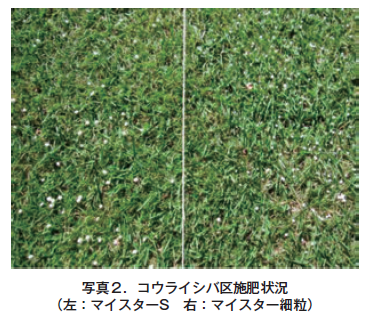
Fertilizer was applied on October 5 in the Korai shiba and Noshiba test plots to conduct the test (Photo 2). On the following day, October 6, mowing and sweeping were conducted.
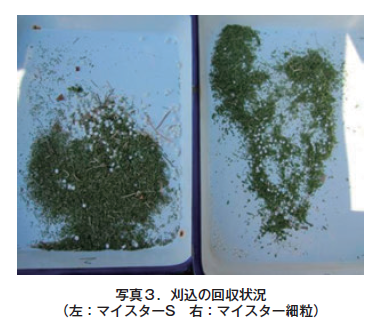
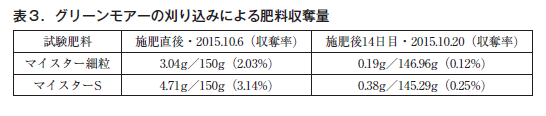
The test plot was mowed with a 13mm mower made by Tsuchiya, and the weight of fertilizer collected in the bucket was measured (Photo 3). A similar mowing operation was conducted on October 20 in the same test plot. The results are shown in Table 3.
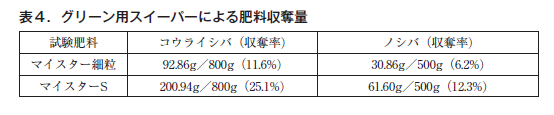
Sweeper operations were conducted in the kouraishiba and noshiba test plots. A Baroness green sweeper was used for the operation, and the weight of the fertilizers taken away in each test plot was measured. The results are shown in Table 4.
In the mowing operations shown in Table 3, there was fertilizer deprivation when mowing was done immediately after fertilizer application, but only a little deprivation when mowing was done 14 days after fertilizer application. Since mowing immediately after fertilizer application is not done under normal management, we believe that mowing after a few days of fertilizer application would have little problem with depredation.
In the sweeper operation shown in Table 4, the amount of yield was particularly high in the white buckwheat test plot. The reason for this is thought to be the use of a sweeper for greens, which increased depredation due to the high ground pressure of the brush. It is not impossible to reduce the amount of fertilizer deprivation by lowering the ground pressure of the machine (reducing the amount of mowing debris deprivation), but it is also necessary to (1) mow more frequently within one month after fertilizer application, mow before the grass grows longer, and avoid using the sweeper to reduce the amount of mowing debris, and (2) apply fertilizer after the last mowing of the year. (2) Fertilizer application after the last mowing of the year.
3. end
Fertilization is an essential part of golf course turf management as a place to enjoy golf play. Although it is desirable to provide turf in as good a condition and quality as possible, the price of fertilizers has been rising since around 2021, and some golf courses are either not applying fertilizer to areas such as rough slope surfaces or reducing the amount of fertilizer applied at one time. If fertilizer has been applied continuously for many years, even if spring and fall fertilization is reduced to fall only, it will not cause a drastic decline in turf quality, but if no fertilization is continued for three or five years, it will cause problems in the landscape and golf play.
In addition, the number of maintenance workers is getting older each year, and it is difficult to recruit new workers, which makes it difficult to make progress in maintenance work. In order to reduce the amount of fertilizer applied to the fairways and roughs, it is effective to apply slow-release fertilizers in the fall, and if the fertilizer effect is maintained until the following year before the rainy season, the spring fertilizer application can be eliminated.
Although there are some negative aspects to the successful use of these fertilizers, such as yield problems as tested and weed growth due to the dissolution of fertilizer components even during the winter season, it would be good to have turf management that matches the fertilizers, such as fertilizer application after mowing around November and thorough winter weed control.
No Soil - No. 28
農業と環境問題-その3
農地由来の窒素による大気汚染-アンモニア揮散
前 ジェイカムアグリ株式会社
北海道支店 技術顧問
松中 照夫
Livestock production in Japan has developed through dependence on imported concentrate feed. This has been the result of policy inducements since the end of World War II. This trend remains unchanged to this day, and the feed self-sufficiency rate is extremely low at 26%. Dependence on imported feed makes it possible to run a livestock business even if the farmland to produce feed for livestock is small. Thus, livestock production detached from the land increased the number of head of cattle raised, regardless of the area of land used for management. However, this means that instead of using the manure excreted daily by livestock as an important source of nutrients, it is likely to become a source of environmental pollution by dumping large amounts of manure on small farmlands.
Continuing from last month, this month we consider the environmental problems caused by ammonia volatilization of nitrogen (N), especially N derived from livestock manure, leaking from agricultural lands into the environment.
1. negative environmental impact of volatilized ammonia
家畜ふん尿に含まれるアンモニア態窒素(NH4-N)は,草地表面に与えられた時のように,大気に触れることでアンモニアガス(NH3)になって大気中に揮散する。
NH3揮散は,与えた肥料養分としてのNの損失だけでなく,揮散したNH3が大気中の硫黄酸化物や窒素酸化物,塩化物などと結合し,硫酸や硝酸,塩酸を含む雨となって降下するため,より強い酸性雨の発生源になる。こうして降下したNH4-Nは,樹木やその他の植物の生育をかく乱し,土に浸透して硝酸化成作用を受けることで土のpHの低下と,それに伴う土の養分バランスを悪化させるなど,環境に大きな悪影響を与える。
なお,化学肥料を土の表面に与えても,その土が特別なアルカリ性でないかぎり,NH3揮散は少なく,尿素でごくわずかに検出できる程度である。また,家畜ふん尿が2cm程度のわずかな厚みでも土に覆われると,NH3揮散はほとんど発生しない(Matsunakaら,2008)。
2.草地表面に与えられた家畜ふん尿からのNH3揮散とそれに関わる要因
草地表面に与えられた家畜ふん尿からの単位時間当たりNH3-N揮散量(NH3-N揮散速度)のピークは,おおむね与えられてから数時間以内に現れ,NH3揮散は数日以内で終了する(図1)。
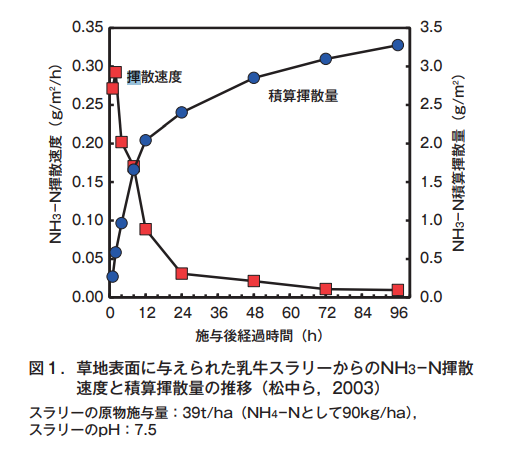
与えられたNH4-N量に対する揮散したNH3-N量の割合をアンモニア揮散率(以下,NH3揮散率と記す)という。乳牛スラリー(乳牛が排泄したふんと尿,それにオガクズのような敷料が加わった混合)を草地表面に与えた場合,アンモニア揮散率はスラリーの与えた量が60t/haまでなら30%程度である(Matsunakaら,2008)。
このNH3揮散率は,スラリーのpHや乾物率が高く,また,与えた時の気温が高いほど高まる。しかし土が乾燥していると,スラリーのNH4-Nが土の中に浸入しやすくなるため揮散率は低下する。これらの要因のうち,気温がNH3揮散に最も大きな影響を与える(Matsunakaら,2002)。
3.草地表面に与えられた家畜ふん尿からのNH3揮散を抑制する対策
草地や土の表面に与えられた家畜ふん尿からのNH3揮散を完全に防ぐことは,与えた後に多量の降雨がないかぎり事実上不可能である。しかし,ふん尿の与え方を工夫し,与えたふん尿を大気に触れにくくすれば,揮散率の低下につながる。
例えば,乳牛スラリーを草地の表面に与える時に利用する方法として,衝突板方式(スプラッシュプレート,図2-a),帯状施与法(バンドスプレッド,図2-b),浅層注入法(シャロウインジェクション,図2-c)などがある。
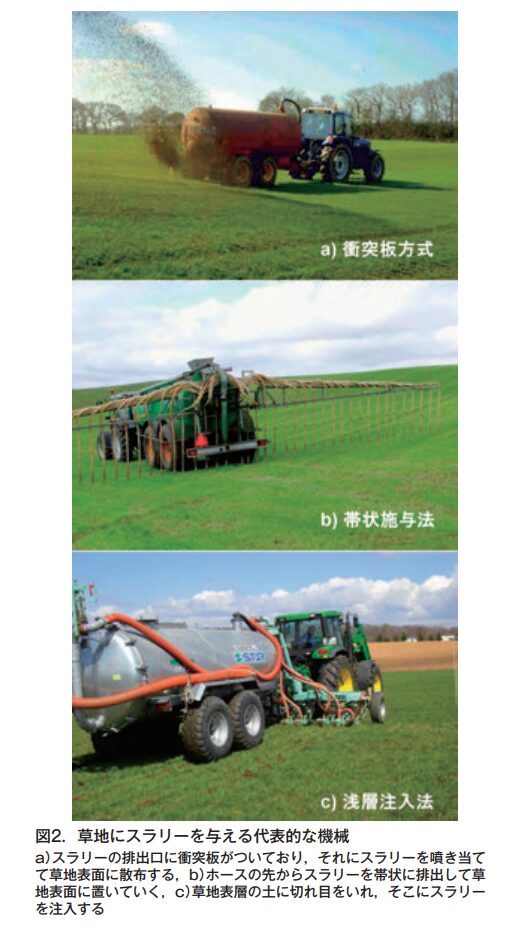
このうち,わが国で一般的に利用されているのが衝突板方式である。この方式は他の与え方に比べて,スラリーが空気に触れやすいため,NH3揮散率が最も高い(図3)。
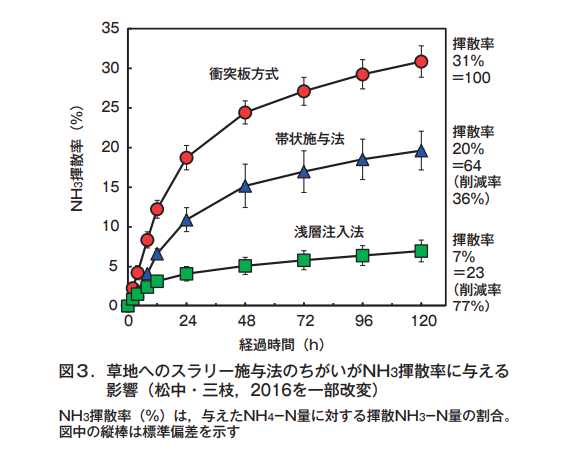
この与え方に比較すると,浅層注入法なら揮散損失を77%削減でき,帯状施与法は揮散損失を36%削減するだけでなく,ふん尿散布後の悪臭強度を低下させる効果も大きい(図4)。
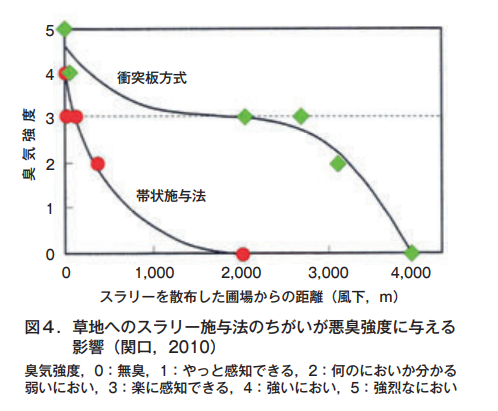
As mentioned last month, the European Union (EU), which is actively working to curb environmental pollution caused by agriculture, has legally regulated the amount of manure-derived N applied to agricultural land to a maximum of 170 kg/ha. In addition, in order to control NH3 volatilization, which has a large negative impact on the environment, the use of dairy cattle slurry sprayed by the impact plate method, which has a high volatilization rate and a strong odor, is prohibited. In Japan, the problem of environmental pollution by livestock manure continues in the absence of such strong regulations.