Site Search
Search within product
第761号 2024(R6).06発行
Click here for PDF version
§育苗箱全量施肥法における稲わら還元の影響について
Fukushima Prefectural Agricultural Center
半澤 勝拓
安田 優衣
§土のはなし-第32回
危機に瀕する世界の土-その2
不適切な人間活動が土を劣化させる
前 ジェイカムアグリ株式会社
北海道支店 技術顧問
松中 照夫
Seedling Box Total Fertilizer Application Method
稲わら還元の影響について
Fukushima Prefectural Agricultural Center
半澤 勝拓
安田 優衣
Introduction
In recent years, rice paddy production has been changing to a "box fertilizer application" (hereinafter referred to as "box fertilization") for the purpose of reducing the amount of nitrogen applied to rice seedlings and saving labor.
The use of the "Aizu" region in Fukushima Prefecture is also widespread, especially in the Aizu region.
On the other hand, according to a nationwide survey by the Ministry of Agriculture, Forestry and Fisheries (MAFF 2022), the amount of compost applied to paddy fields decreased from 215 kg/10a in 1984 to 62 kg/10a in 2020, a decrease of about 1/3 in 30 years, and it is pointed out that 20% of paddy fields are lacking in edible nitrogen in the paddy soil, which is a cause of concern for a decrease in soil fertility. This is a cause for concern. In Fukushima Prefecture, since the Great East Japan Earthquake in 2011, as a countermeasure against radioactive cesium, the return of rice straw to paddy fields has been instructed in order to maintain exchangeable potassium content (25 mg/100 g or more) in the soil, and the application of rice straw has increased since before the earthquake.
However, in recent years, yield and quality decline due to abnormally high temperatures during the growing season has become a problem. In the case of box fertilization, because the nitrogen leaching of the fertilizer used is highly temperature-dependent, there are concerns that under extremely high temperature conditions, the fertilizer efficacy may be delayed or not sustained until the latter half of the crop's ripening period. In addition, there is concern about the rapid decomposition of rice straw due to extremely high temperatures, resulting in abnormal straw reduction and the generation of methane gas, which may lead to growth disorders.
Therefore, as basic data for fertilizer management under high temperature conditions, we decided to investigate the effect of continuous use of rice straw in box fertilization using "Seedling Box Makase".
2. Testing Method
農業総合センター内の水田において2020年,2021年の2年間試験を行った。
供試水田は,稲わら還元によるカリの施用効果も検討するため,土壌中の交換性カリ含量が15mg/100g以下で,2017年から毎年,収穫後に稲わらを全量搬出している水田と稲わらを還元している水田の2筆を選定した。
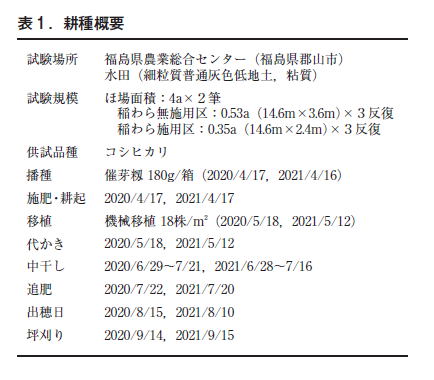
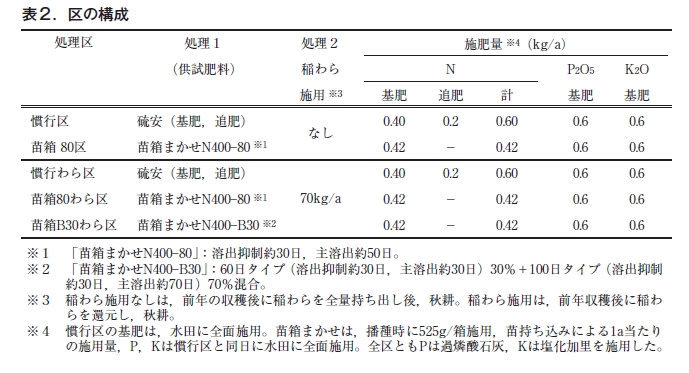
The test was conducted using two types of fertilizers, "Seedling Box Makase N400-80" and "Seedling Box Makase N400-B30," under the standard fertilizer system for Koshihikari rice in this prefecture (nitrogen: 4 kg/10 a of base fertilizer and 2 kg/10 a of additional fertilizer, 6 kg/10 a in total) as a conventional culture. The cultivation was conducted as outlined in Table 1 and the composition of the test plots (Table 2).
Results and Discussion
(1) Summary of growing season weather
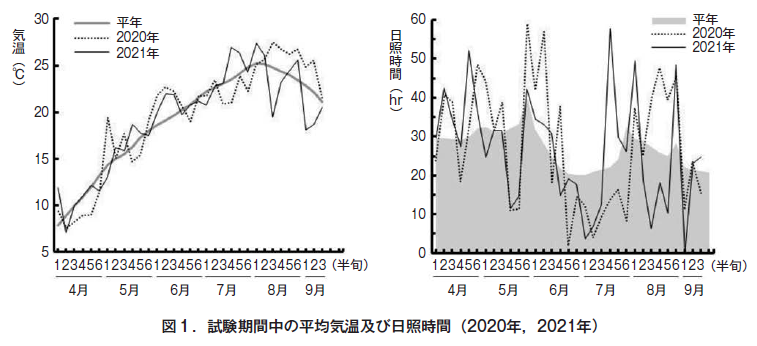
Average temperatures in 2020 were 5°C above normal in the first half of May, but the monthly average in May was 2°C below normal due to days with temperatures below 10°C in the fourth and fifth halves of May. The number of days of sunshine was 127% of the normal.
In 2021, the temperature was about 2°C below normal until the second half of May, 0.9°C above normal in June, and 0.6°C above normal in July, 5.4°C below normal in the third half of August, and 1.8°C below normal after the third half of August. Sunshine duration was 76% of the normal from the 3rd half of August, and was considerably shorter than the normal, especially from the 3rd to 5th half of August (45% of the normal) (Fig. 1). (Figure 1).
(2) Seedling quality at transplantation
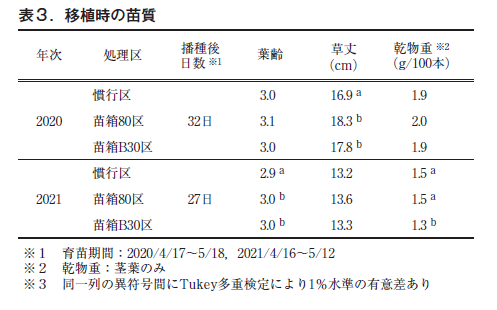
In 2021, there was no significant difference in height, but dry matter weight was slightly lower in seedling box B30. In 2020, the seedling period was 32 days, and the high temperature in the first half of May caused the nitrogen in the "seedling box leave" to leach out earlier, so the grass height in seedling box 80 and seedling box B30 was larger than that in the conventional method (Table 3). However, in 2021, because temperatures were below normal during the seedling growth period, little nitrogen was released from the "leave it to the seedling box" method during the seedling growth period, and grass height growth was considered to be similar to that of the conventional method, even when the leaf age advanced.
(3) Growth in rice paddies
In 2020, 40 days after transplanting, the growth of plants without rice straw was longer in the 80-seedling box (33.6 cm in the 80-seedling box and 32.5 cm in the conventional box), and the number of stems was lower in the 80-seedling box (15.7 stems/plant) and the conventional box (16.3 stems/plant) (Table 4, Figure 2 and Figure 3).
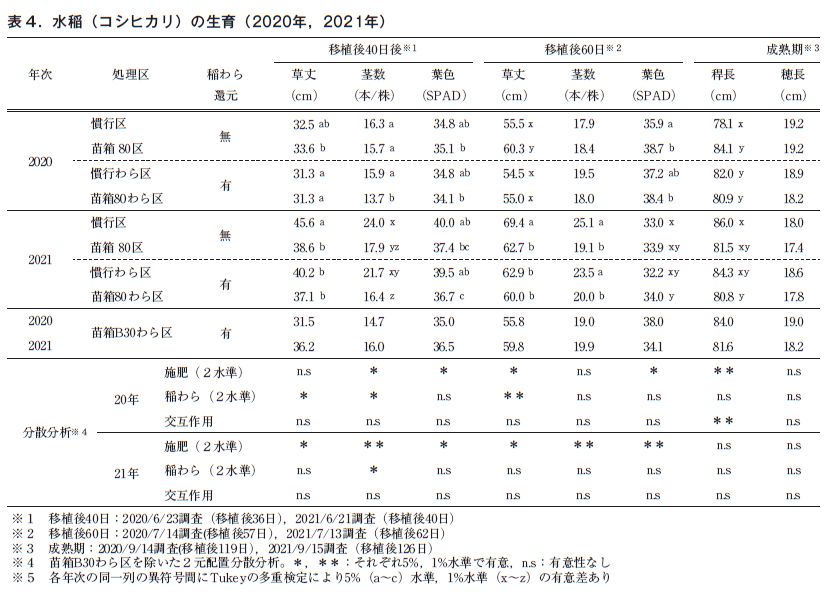
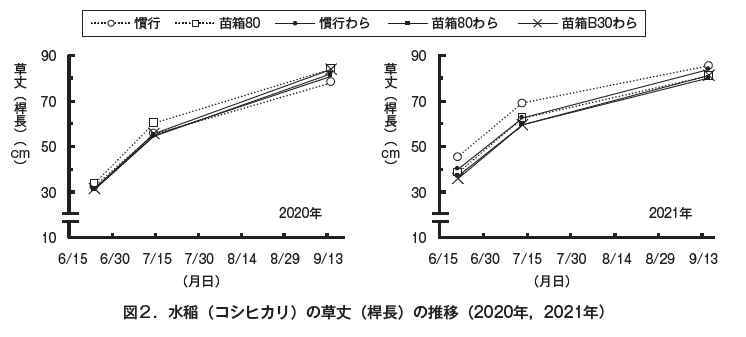
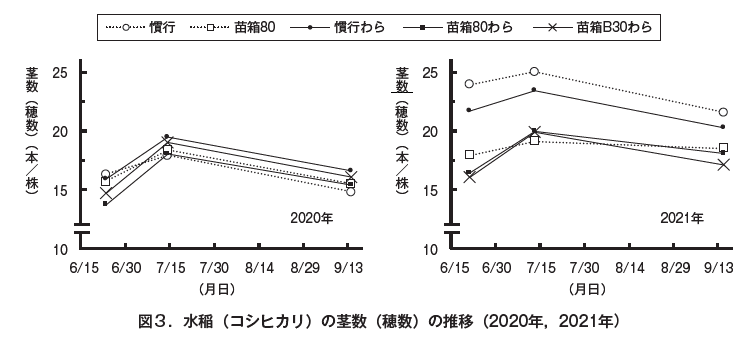
The number of stems was 13.7 stems/plant in the 80 straw seedling box, 14.7 stems/plant in the B30 straw seedling box, and 15.9 stems/plant in the conventional straw seedling box. The number of seedlings in the box-fertilized area was less than that in the conventional straw-fertilized area.
At 60 days after transplanting, the number of stems in the 80 seedling box was higher than that in the conventional box, but with the application of rice straw, grass height was higher in the conventional straw box than in the 80 seedling box, the number of stems in the B30 seedling box than in the conventional straw box, and leaf color in the 80 seedling box than in the B30 seedling box, in the order of conventional straw box, B30 seedling box and 80 seedling box. The difference in grass height was larger in the 80-planting-box straw area than in the B30-planting-box straw area, and the difference in number of stems was smaller in the 80-planting-box straw area.
At maturity, as 60 days after transplanting, the number of ears and culm length of seedlings without rice straw was greater than that of seedling box 80 and that of seedling box B30, while the number of ears was greater than that of seedling box B30 and that of seedling box 80, in the order of seedling box 80, conventional straw and B30, with the culm length and number of ears being lowest in the seedling box 80. The number of ears was the lowest in the 80 seedling box.
In 2021, 40 days after transplanting, the values of grass height, number of stems, and leaf color were all lower in the 80 seedling boxes than in the conventional boxes, and in the application of rice straw, the order was seedling box B30 straw, seedling box 80 straw, and conventional straw, and the box fertilization areas were smaller than the conventional fertilization areas both without and with rice straw (Table 4, Figure 2 and Figure 3).
At 60 days after transplanting, grass height and number of stems in the seedling box without rice straw was lower than that in the seedling box with 80 straw, as was the case at 40 days after transplanting. In the case of rice straw application, the difference between the B30 seedling box and the 80 seedling box was slight, although the order was seedling box B30 straw, seedling box 80 straw, and conventional straw, in that order. Leaf color was in the order of seedling box 80 > conventional, and seedling box B30 > seedling box 80 > conventional straw. The height and number of stems were smaller in the box-fertilized area than in the conventionally-fertilized area, both without and with rice straw, but the leaf color was larger in the box-fertilized area than in the conventionally-fertilized area.
成熟期は,稲わら無施用は移植60日後と同様に稈長,穂数とも苗箱80区<慣行区であった。稲わら施用では,稈長は苗箱80わら区<苗箱B30わら区<慣行わら区の順,穂数は苗箱B30わら区<苗箱80わら区<慣行わら区の順となり,稲わら無施用及び稲わら施用ともに稈長,穂数は,箱施肥の区が慣行施肥の区より低かった。
また,2020年,2021年の両年とも移植40日後の茎数は,慣行区>慣行わら区,苗箱80区>苗箱80わら区,苗箱B30わら区であり,稲わら施用した区の茎数が少ない傾向が見られた。
(4) Yield and yield components
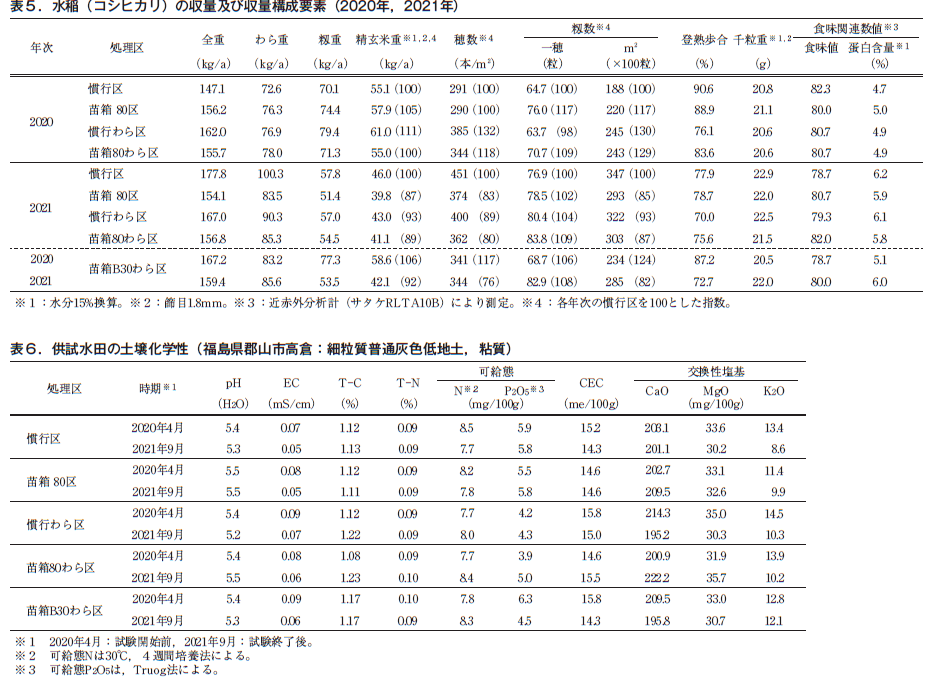
In 2020, the number of rice grains per ear (grains/ear) was higher in the conventional (64.7) < 80 seedling boxes (76.0), conventional straw (63.7) < B30 seedling boxes (68.7) < 80 seedling boxes (70.7), and in the box fertilizer-applied areas, both without and with rice straw application. The percentages of maturity were higher in the conventional straw-less area (90.6) than in the 80 seedling box area (88.9), the conventional straw area (76.1) < 80 seedling box straw area (83.6) < 80 seedling box B30 straw area (87.2), and in the box fertilization area in the rice straw application area.
The weights of polished brown rice (kg/10a) were higher in the conventional (55.1) < seedling box 80 (57.9), seedling box 80 (55.0) < seedling box B30 (58.6) < conventional straw (61.0), and in the no rice straw application, the box fertilizer application was higher, while the rice straw application was higher than the conventional fertilizer application (Table 5).
In 2021, the number of rice grains per ear (grains/ear) was 76.9 (conventional) < 78.5 (80 seedling boxes), 80.4 (conventional straw) < 82.9 (B30 seedling boxes) < 83.8 (80 seedling boxes), and was higher in the areas with no rice straw application or with box fertilizer application as in 2020. The percentages of maturity (%) were 77.9 (conventional) < 78.7 (seedling box 80), 70.7 (conventional straw) < 72.7 (seedling box B30) < 75.6 (seedling box 80), with the conventional fertilizer application being higher in the case of no application of rice straw and the box fertilizer application being higher in the case of rice straw application.
The weight of polished brown rice (kg/10a) was higher in the 80 seedling box (39.8) < conventional (46.0), 80 seedling box straw (41.1) < B30 seedling box straw (42.1) < conventional straw (43.0), in the order of no application of rice straw and application of both conventional fertilizer (Table 5).
なお,㎡当たり籾数(×100粒/㎡)は,2020年は慣行区(188)<慣行わら区(245),苗箱80区(220)<苗箱80わら区(243)であり,2021年は慣行区(347)>慣行わら区(322),苗箱80区(293)<苗箱80わら区(303)であり,箱施肥は両年とも稲わら施用した区が多かったが,登熟歩合は,両年とも慣行施肥,箱施肥の区とも稲わら施用した区で低かった(表5)。
(5) Changes in soil nutrients
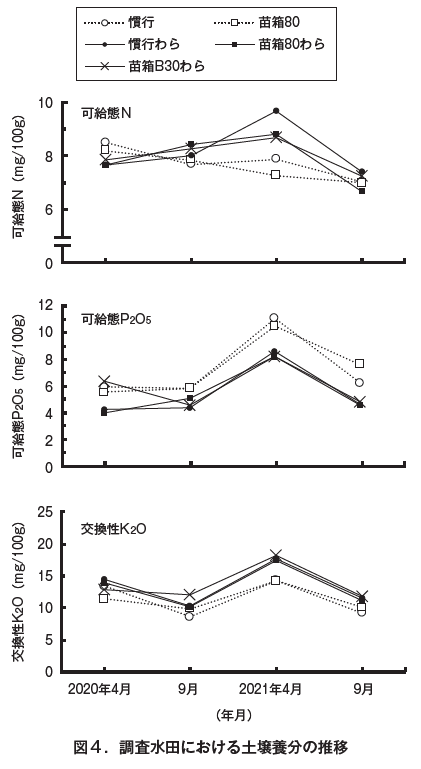
試験開始前(2020年4月)と試験終了後(2021年9月)の土壌化学性の変化を見ると(表6),可給態窒素は,稲わらの無施用区(慣行区,苗箱80区)では試験開始から徐々に低下しているが,稲わら施用区(慣行わら区,苗箱80わら区,苗箱B30わら区)では2020年9月から2021年4月に増加する傾向が見られた。
Exchangeable potassium also tended to increase from September 2020 to April 2021 in the rice straw-applied areas (conventional straw area, seedling box 80 straw area, and seedling box B30 straw area) compared to the area without rice straw application (conventional area and seedling box 80 area).
Concerning dietary phosphoric acid, the values of phosphate without rice straw application (conventional plot, seedling box 80) were higher than those of rice straw application (conventional straw plot, seedling box 80, seedling box B30), and the effect of rice straw application was not clear (Fig. 4).
(6) Consideration
In 2020, although there was an effect of low temperatures immediately after transplanting, growth 40 days after transplanting was inferior to conventional fertilization in the box-fertilized plot, regardless of whether rice straw was applied or not, similar to the results reported by Ueno (2015).
これは,6月上旬時点では,「苗箱まかせ」の肥効は,慣行施肥に比較して明らかに低く経過するためであり,本調査のように乾土効果による窒素発現量が小さい水田では,より顕著になると考えられた。
また,稲わら施用による影響を見ると,稲わら施用した区は,両年とも移植40日後の茎数が少ないことが認められ,特に箱施肥の区で顕著であり,稲わら施用により,初期生育が抑制されるという既存の報告と一致した(千葉ら1980,安藤ら1986,前田1983)。 安藤ら(1986)は,水田に施用された稲わら中の窒素は,移植後の低温条件でも無機化されること,稲わら施用により,肥料由来の窒素が稲わらに取り込まれ減少するが,その量はわずかであると報告している。
The total nitrogen content in the soil of the test paddy in this study was 0.09-0.01%, which was considerably lower than the 0.30% in the rice paddy studied by Ando et al. The available nitrogen in the soil of the test paddy before fertilizer application (April) was also low at 7.3-9.7 mg/100g. This suggests that the proportion of fertilizer-derived nitrogen incorporated into the rice straw was quite high because the effect of dry soil before watering was small and the inorganic nitrogen content in the soil was low in the early growth stage of the test paddy was small.
In both 2020 and 2021, leaf color values 40 days after transplanting were lower in the seedling box 80 straw and seedling box B30 than in the seedling box 80. This suggests that the rice straw-fertilized boxes absorbed less nitrogen after transplanting than the boxes without rice straw, resulting in inferior growth.
Ueno (2014) stated that the initial growth of paddy rice is closely related to the dry-soil effect, and that in paddy fields with low nitrogen soil fertility and low dry-soil effect, box fertilization alone is not sufficient to ensure initial growth, and a combination of side-row fertilization and fertilization at emergence is necessary to achieve the target yield. Therefore, when box fertilization is used, it is important to understand the amount of available nitrogen in the paddy soil and to prepare the soil to increase the expression of nitrogen by the dry-soil effect.
The suppression of early growth by rice straw application may be due to oxygen consumption in the soil by rice straw decomposition, rapid reduction of the soil, and generation of methane and hydrogen sulfide, which may cause poor establishment, delayed root growth, and inhibition of nutrient absorption.
Next, looking at ear number, Ueno (2015) stated that early early stem number is important to obtain ear number to ensure the target yield, but it is also important to save the highest stem number to increase the effective stem yield, which can be achieved in soils with high nitrogenous soil fertility.
Because this study was conducted on soils with low nitrogenous soil fertility, the low number of stems at 40 days after transplanting tended to result in a low number of ears. In particular, in 2020, the number of early stems was lower in the box-fertilized area than in the conventionally fertilized area, and the number of stems was also lower in the area where rice straw was applied in both the conventionally and box-fertilized areas.
Straw application has a negative effect on the number of ears because of the low number of stems 40 days after transplanting, but the results show that the number of ears in 2020 was higher in the 80 straw seedling box than in the 80 seedling box, and the number of rice paddy was higher in the 80 straw seedling box than in the 80 seedling box in both 2020 and 2021.
Chiba et al. (1980) reported that the amount of mineralized soil nitrogen increased rapidly with increasing temperature in rice-straw intercropped fields, and that it was expressed mainly during the juvenile ear formation period. This is assumed to be because the nitrogen expressed was absorbed by the rice plants and acted to secure the effective number of stems and rice paddy.
このため,窒素的地力が低い土壌において,箱施肥を行う場合,稲わら施用は,㎡当たりの穂数や籾数の確保に効果があり,コシヒカリなどの穂数タイプの品種には有効と考えられた。
Comparing the number of ears and the number of ear rice in the 80-straw seedling box and the B30 straw seedling box, the number of ears and the number of ear rice were almost the same in 2020, while the number of ear rice was the same in 2021, but the number of ears was clearly lower in the B30 straw seedling box than in the 80 straw seedling box. This may be due to the fact that the ear emergence date in 2021 was 8/10, 5 days earlier than 8/15 in 2020. The elution period of "Seedling Box Makase N400-B30" is 100 days, and the ear formation period in 2021 was around July 18. This suggests that the number of ears could not be secured in the B30 straw plot, which had a leaching period of 80 days.
Therefore, under high temperature conditions, the ear formation period is expected to be accelerated. Therefore, the application of rice straw was considered effective in box fertilization to supplement fertilizer efficacy, taking into consideration the duration of fertilizer efficacy to secure the number of ears.
The maturity yield tended to be lower when rice straw was applied, both with conventional fertilizer and with box fertilizer. This may be due to the fact that the application of rice straw increased the number of rice paddy, but did not provide sufficient nitrogen to increase the maturity yield after ear emergence.
In this prefecture, continuous application of rice straw for 21 years from 1985 to 2005 resulted in a 6% increase in yield (Miura et al. 2022). However, in the present results, the application of rice straw in 2020 increased the weight of polished brown rice in the conventional fertilizer application, but the box fertilizer application was less in both years. This may be due to the short period of continuous application of rice straw and the fact that soil chemistry did not differ in terms of soil fertility as reported by Miura et al.
On the other hand, considering Chiba et al.'s (1980) report that in rice paddy fields with long-term continuous application of rice straw, the application of ear fertilizer promotes mineralization of soil nitrogen and increases the uptake of soil-derived nitrogen until late in the season, it is expected that the yield of box fertilization will also turn to increase with continued continuous application of rice straw. Furthermore, the continuous use of rice straw also slightly increased the availability nitrogen and exchangeable potassium in the present results, and is also effective in maintaining exchangeable potassium, as reported previously (e.g., Miura et al. 2022).
Chiba et al. (1980) reported that reducing rice straw, applying lime nitrogen and soil improvement materials simultaneously, and fall plowing in the fall season are effective in increasing soil nitrogen. The following is a brief summary of the results of the study.
Summary
In rice paddies with low nitrogen soil fertility, box fertilization may not ensure the amount of nitrogen necessary for early growth, resulting in lower yields.
However, in rice paddies with low nitrogen fertility, it is necessary to promote the decomposition of rice straw before watering by reducing the straw in the fall and plowing in the fall to suppress early stage of growth and to ensure stable ear number.
Rice farming operations are becoming larger and larger, but new measures must be taken to counter soaring prices of fertilizers and other commodities and to realize the Green Food System Strategy, which requires fertilizer application technology that enables further labor savings and cost reduction.
Under these circumstances, box fertilization is a highly effective fertilizer application method, and is considered to be a labor-saving, low-cost, and stable production technology. In order to utilize box fertilization as a more effective technology, it is necessary to conduct soil diagnosis and select the type of fertilizer for box application, "Seedling Box Leave," taking into consideration the fertilizing effect of compost and the amount of available nitrogen in the soil, as well as the nutrients related to soil fertility, such as the content of available nitrogen.
In conclusion, not limited to box fertilization, the most important thing to achieve stable production is to continue to cultivate the soil to increase soil fertility through the continuous use of organic materials such as rice straw and compost.
References
(1)上野正夫.苗箱施肥における本田生育の特徴と留意点.
農業と科学.第667号,p8-p12.(2015)
(2) Chiba M., Shimazu R., Muto K., Uchida S.
水田における稲わら施用と稲作の安定化.
岩手県立農業試験場研究報告 第22号,81‒117.(1980)
(3) Yutaka Ando, Sadao Shoko, Tsutomu Oikawa, Tadayuki Kanno.
水田土壌中での稲わら分解と窒素の挙動.
日本土壌肥料学雑誌 第57巻,第4号,359‒364.(1986)
(4)前田乾一.水田に施用された窒素の行動の定量的評価.
農業研究センター研究報告1,121‒193(1983)
(5)上野正夫.水田土壌の窒素肥沃度と無機化のしくみ.
農業と科学.第658号,p1‒p5.(2014)
(6)三浦吉則,松本 靖,笹川正樹.
三要素,有機物及び土壌改良資材の長期連用が水稲収量や水田土壌化学性に及ぼす影響.
福島県農総セ研報13,33‒48.(2022)
No Soil - No. 32
危機に瀕する世界の土-その2
不適切な人間活動が土を劣化させる
前 ジェイカムアグリ株式会社
北海道支店 技術顧問
松中 照夫
Soil is the foundation of food production. Without soil conservation, food security is impossible and advanced civilization cannot be maintained. In my previous article, I said that we must ask ourselves how we can make the most of this lesson today. Unfortunately, I do not believe that this lesson is being fully applied. This is because soil degradation is still progressing around the world. In this issue, I would like to discuss inappropriate human activities that are the main cause of this degradation.
1. soil degradation due to human activities
Degradation of food-producing farmland refers to the phenomenon in which the soil is degraded and crop productivity is significantly reduced or eliminated as a result of inappropriate soil management and excessive deprivation of the soil in order to increase productivity.
Soil is a product of its environment. Soil changes and is created in the most stable direction under a given environment. Therefore, as long as human activities are within the range of such changes, the soil itself does not deteriorate. When human activities cause changes in the soil that are greater than those caused by the environment, the soil deteriorates. Although the data on soil degradation caused by human activities are somewhat old, it is estimated to be about 2 billion hectares, or about 17% of all vegetated areas in the world (Figure 1).
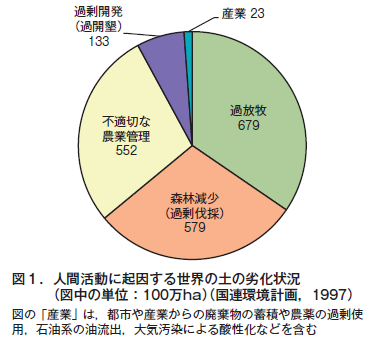
最近,これと同様のデータの公開がない。しかし状況はさらに悪化しているようだ。国連食糧農業機関(FAO)事務総長シルヴァが国際土壌デーと国際土壌年の発足にあたり,世界の土の3分の1が劣化しているとの驚くべきメッセージを発表している(Silva, 2014)。
Major human activities that degrade the soil include improper agricultural management through over-cultivation, overgrazing that allows livestock to graze more than the regenerative capacity of wild grasses, and over-cutting of forests.
2. human activities that degrade agricultural soil
1) Improper agricultural management - over-cultivation
Convenient land suitable for agriculture is cultivated and turned into farmland at an early stage. However, the more such land is cultivated, the more people live there. In order for humans to live, land is necessary. Industrial land is also necessary. At present, most of the land suitable for agriculture has already been developed, and the development of agricultural land has reached its limits. Therefore, as the population continues to grow, the world's per capita cereal production area continues to decline. As a result, increased food production has to be expected on a per-unit-area basis.
In developing countries, where agriculture is practiced with a high degree of abandon, excessive cultivation is repeated with inadequate nutrient supply and soil management, resulting in overuse of the soil. In the past, slash-and-burn shifting cultivation was reused only after both soil fertility and reforestation had been sufficiently restored. Recently, however, this is no longer possible. This is because the land area for shifting cultivation has decreased due to the increase in population. In particular, over-cultivation in arid and semi-arid regions leads to land desertification (Igasaki, 2015). Furthermore, the introduction of inappropriate irrigation in these zones can easily lead to soil salinization as seen in Mesopotamia.
On the other hand, intensive farming areas tend to provide more nutrients than necessary in the hope of increasing yields. This leads not only to environmental pollution but also to soil salinization caused by excess nutrients, making it impossible to grow crops. This improper management of agriculture leads to soil degradation.
(2) Overgrazing
Developing countries in Asia and Africa have used the wild grasses of the land for grazing use by livestock. This is because they provide a living food reserve for livestock. Their manure is used as a source of nutrients for the soil, and dried manure is sometimes used as fuel. However, as the number of grazing livestock increases with population growth, grazing livestock forage for more wild grasses than they regenerate, resulting in a decrease in the density of wild grasses, which exposes the soil. This is the state of overgrazing.
Under overgrazing conditions, not only is the soil exposed, but it also becomes hard and compacted by the treading pressure of livestock. The hard soil surface prevents rainwater from infiltrating the soil, and surface runoff erodes the topsoil, accelerating degradation. Wild grasses also play an important role in helping the soil retain water. However, when wild grasses are lost from the soil due to overgrazing, the soil becomes arid and desertified.
(3) Loss of forests
Forests also play an important role in retaining soil moisture. However, population growth in developing countries increases the demand for wood for housing and fuelwood, and the use of wood expands to include important forests. The expansion and inappropriate use of slash-and-burn cultivation areas and conversion of land to pastureland also lead to the gradual decline of forests. The loss of forests that follows the decline also contributes to soil degradation. In particular, the loss of forests in tropical rainforest areas causes further soil degradation due to soil erosion.
In 2020, 4.1 billion hectares (4.1 billion hectares) of the Earth's surface, or about 31% of the land area, will be covered by forests (FAO, 2021).
In other words, the net forest area lost from the world over the past 30 years has reached 180 million hectares, which is about five times the land area of Japan (37.78 million hectares). This means that 6 million hectares of forest are lost every year. However, the total area of forest loss in the world has been decreasing since 1990.
The largest area of forest loss was in South America, where 129.5 million hectares were lost in the 30 years from 1990. Most of this was lost in Brazil, which lost 92.3 million hectares. On average, Brazil lost 3.08 million hectares per year over the past 30 years. Illegal and inappropriate over-cutting in the Amazon rainforest area is the main cause. This rate of loss is significant, meaning that the total forest area of Japan (24.94 million hectares, FAO, 2020) will be lost in about eight years. In the African region, 110 million hectares of forest were lost in the 30 years since 1990. Unlike other regions, there is no decreasing trend in the area lost per decade since 1990, with 39.4 million ha lost in the last 10 years since 2010.
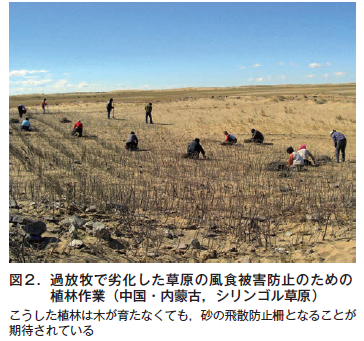
In Asia, on the other hand, forest area increased by 52.7 million ha in the 30 years from 1990. This is largely due to the fact that China increased its forest area by 62.8 million ha during the same 30-year period through afforestation activities (Figure 2), and India also expanded its forest area by 8.22 million ha during the same period. Conversely, Indonesia lost 26.4 million ha of forest area during the same period. This is the result of continued over-cutting of Indonesia's tropical rainforests and peat forests as raw materials for paper production for Japan and other countries (Sagara, 2021).
Excessive logging in tropical rainforests in Brazil, Indonesia, and other countries has a significant negative impact not only on the soil but also on the global environment. I will discuss this on another occasion.