Site Search
Search within product
第763号 2024(R6).08-09発行
Click here for PDF version
§日本ナシ「幸水」に対する根域施肥と表面局所施肥を組み合わせた50%減肥技術
Cultivation Department, Nagano Prefectural Nanshin Agricultural Experiment Station
技師 塩原 孝
§テレビ番組〈満天☆青空レストラン〉にみる付加価値を意識した作物生産について
-果菜類・豆類編-
Miyagi University, School of Food Science and Industry
齊藤 秀幸
§土のはなし-第34回
危機に瀕する世界の土-その4
侵食による土の劣化
前 ジェイカムアグリ株式会社
北海道支店 技術顧問
松中 照夫
Root zone fertilization of Japanese pear "Kosui" and
表面局所施肥を組み合わせた50%減肥技術
Cultivation Department, Nagano Prefectural Nanshin Agricultural Experiment Station
技師 塩原 孝
Introduction
The general method of fertilizer application in fruit tree cultivation is the total surface fertilization method. This method is based on the premise that the rooting zone, which absorbs nutrients and water, is widely distributed throughout the garden area, and the fertilizer is applied to the entire surface of the garden area or is mixed with the soil by plowing the surface very shallow after fertilization.
However, the utilization of fertilizer by tree bodies in this fertilization method is said to be about 20 to 30% when the orchard is under clean tillage management and only 1% under grass management. In addition, the assumption that roots are spread over the entire field is not certain in recent orchards, where the soil has become denser due to the driving of pest control machines and other heavy machinery.
On the other hand, local application of fertilizer in the vicinity of the crop roots increases the absorption and utilization of fertilizer, thus making it possible to reduce fertilizer use. In the past, local fertilizer application was done by digging trenches in the shape of an octopus, horseshoe, or radiating from the main trunk by hand or machine (backhoe or trencher) and applying fertilizer to the trenches. However, this method is rarely used today due to labor and other reasons.
In this study, we examined a fertilizer reduction technique for Japanese pear "Kosui" that combines a simple root zone fertilizer application using a compressed air injection soil conditioner and a localized fertilizer application to the soil surface.
2. soil improvement by compressed air injection type soil conditioner
最初に,今回検討した局所施肥技術の基礎となる圧縮空気噴射式土壌改良機による土壌改良技術について概略を紹介する。
In the field, there are many orchards with dense soils that have not been improved by deep tillage. The aforementioned trenching for fertilizer in the shape of a trestle, horseshoe, or radius, which itself doubles as deep tillage, is no longer used due to lack of labor, excessive root breakage, and concern about the spread of white crest feather disease.
そこで,当試験場では,日本ナシ「幸水」(2000~2002年)及びカキ「市田柿」(2012~2015年)に対して,専用機器を用いて圧縮空気を噴射させ,土壌硬度を低下させる簡易な土壌改良方法の実証試験を行った。
The equipment used was a compressed air injection soil conditioner (product name: Growth Gun GR1000, manufactured by Mack Engineering Co. The nozzle is inserted into the soil and a jet of compressed air is injected from the tip of the nozzle.
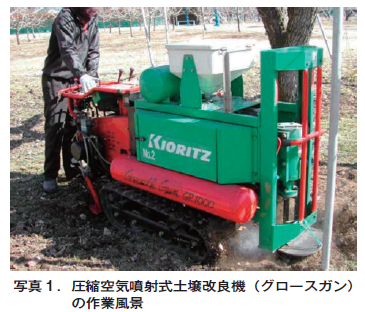
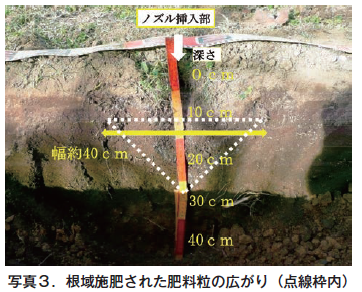
The depth that can be improved is 50 to 60 cm, and the horizontal extent is 40 to 60 cm in radius centered on the nozzle insertion point. The duration of the hardness reduction effect was observed to be about 9 months for heavy fine yellow soil.
The effect of the growth and yield of the pear trees treated with the growth gun was not discernible over the two-year test period, but an increase in fine root mass was observed. For oyster trees, yields increased and root activity tended to be higher from the third year of the trial (data omitted).
3. 50% fertilizer reduction technology by combining root zone fertilization with local surface fertilization using a growth gun
The growth gun can dispense granular fertilizers and soil improvement materials simultaneously with compressed air injection. Therefore, a localized fertilizer application technique that combines soil improvement and fertilizer application was investigated.
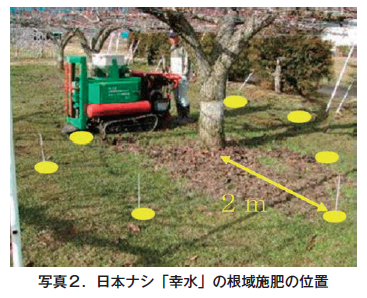
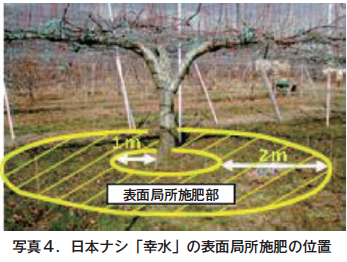
In this fertilization technique, a growth gun is used to improve the soil around the main trunk of the pear tree in late February, just before the roots begin to grow (Photo 2 and 3), and at the same time, base fertilizer is applied to the root zone of the tree (root zone fertilization). This is a technique (Photo 4).
(1) Testing Method
試験は,南信農業試験場の場内ほ場(標高560m,淡色黒ボク土)において5年間(2018~2022年)実施した。供試樹は,日本ナシ「幸水」成木樹(ヤマナシ台,試験開始時の樹齢40年生,改良折衷式平棚仕立て3本主枝)を用いた。植栽間隔は8.0m×7.2m,植栽密度16樹/10a,試験規模は1区3樹反復無しとした。
The test plots were a combination of root zone fertilization with a growth gun and local surface fertilization (hereafter referred to as "root zone fertilization") and a control plot that roughly corresponded to the local practice (Table 1).
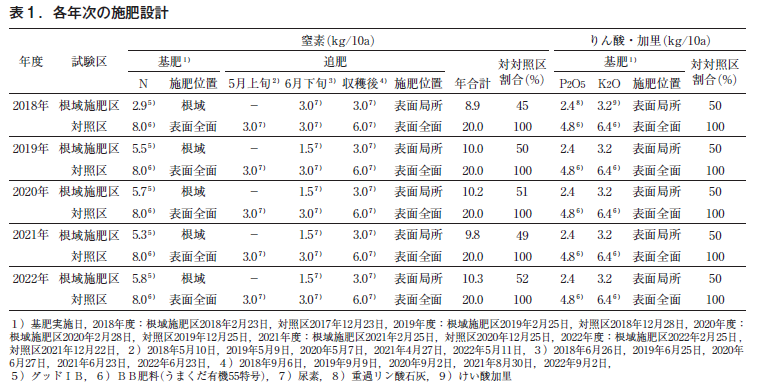
対照区は,施肥時期を基肥(12月)+追肥1(5月上旬)+追肥2(6月下旬)+礼肥(収穫直後)の年4回,年間窒素施用量を,10a当たり基肥8.0kg+5月上旬3.0kg+6月下旬3.0kg+礼肥6.0kgの計20kgとした。使用した肥料は,基肥に有機入りBB肥料(10-6-8),追肥及び礼肥には尿素を用いた。施肥方法はいずれの時期も園地全面への表面施肥とした。
In 2018-2020, the control plot received only compressed air impoundment treatment at the same location as the root zone fertilization plot to have the same effect of soil improvement, but in 2021-2022, no compressed air impoundment was applied and no treatment was applied.
In the root zone, Good IB (isobutyraldehyde condensed urea, 33% total nitrogen content) was injected into the soil at a depth of 30 to 40 cm at eight equally spaced locations around a distance of 2 m from the main trunk in late February (Photos 2 and 3). The actual amount of nitrogen fertilizer applied was about 5.5 kg/10a at a planting density of 16 plants/10a, which was about 50% of the total amount of 11.0 kg of base fertilizer and 1 additional fertilizer applied in early May in the control area, although the amount varied from year to year. The growth gun was a leased machine owned by a local JA.
The fertilizer was applied locally on the surface with urea at 50% of the nitrogen level of the control (1.5 kg in late June and 3.0 kg after harvest) in a 2 m wide ring starting 1 m away from the main trunk (Photo 4).
Annual nitrogen fertilizer application in the root zone was about 10 kg/10 a, about 50% of the local practice.
なお,試験1年目の2018年度は,グロースガンで処理した基肥の実測量が想定より少なくなったため,6月下旬の窒素追肥量を対照区と同量の3.0kg/10aとした。また,リン酸と加里は,根域施肥直後に単肥(重過リン酸石灰,ケイ酸加里)を用いて写真4に示す位置に慣行施肥量の50%を表面局所施肥した。
(2) Nitrogen leaching progress of Good IB fertilized in the root zone
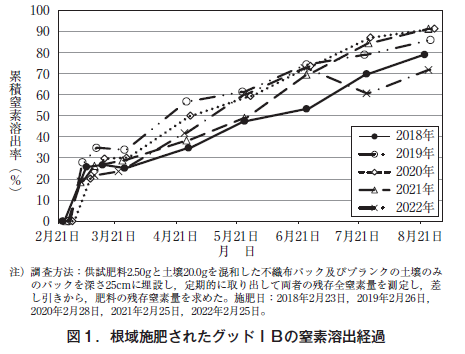
グッドIBは,根域施肥後3週間で窒素の20~30%が溶出し,基肥としての効果が認められた。その後は年度により溶出経過が異なったが,4月下旬から6月下旬の2か月間に各年度とも約20%の窒素溶出が認められ,対照区の5月上旬の追肥1に相当する施肥効果が得られた(図1)。
(3) Effect on tree growth, etc.
(1) New shoot growth
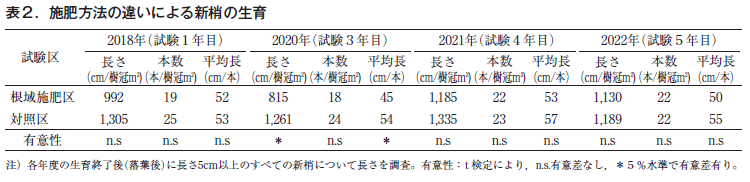
Except in 2020, the third year of the trial, there were no significant differences in shoot growth between the root zone fertilization and control treatments (Table 2).
2020年は,対照区が根域施肥区よりも樹冠1㎡当たりの全新梢長及び平均長が根域施肥区より有意に長かったが,これは試験ほ場の根域施肥区の暗渠の排水機能が不十分だったことにより,6~7月に多量降雨後の園内滞水時間が長くなり,新梢伸長が早期から抑制されたためと考えられた。
(2) Percentage of flower buds on stems
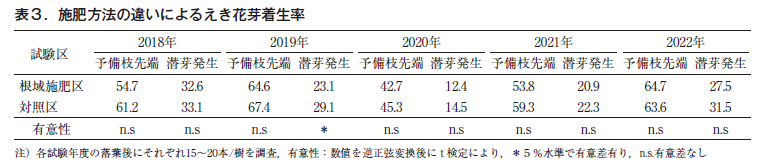
えき花芽着生率は,2019年の潜芽発生新梢を除き,予備枝先端新梢,潜芽発生新梢ともに根域施肥区と対照区の間に有意な差は認められなかった(表3)。
(3) Three-element content in leaves
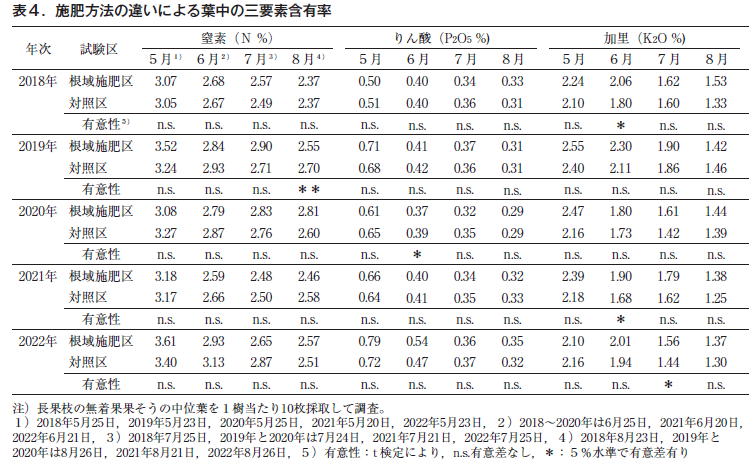
The nitrogen content of the midleaves of long-fruiting branches without fruit set did not differ except for a significant difference between the root zone fertilization and the control in August 2019, the second year of the trial, and no constant trend was observed (Table 4).
Significant differences in phosphoric acid content were observed in late June 2020, the third year of the study, and in potassium content in late June 2018, June 2021, and July 2022, the first year of the study, but not at other times or years and no consistent trend was observed (Table 4).
(4) Root volume after 3 and 5 years of testing
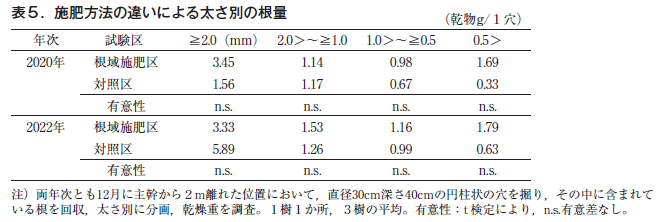
Root volume at a distance of 2 m from the main trunk was examined after defoliation. In 2020, the third year of the trial, both sites were treated with compressed air injection by a growth gun, and no significant differences were observed between the two sites, but there was a trend toward more fine roots less than 1 mm thick in the root zone where fertilizer was applied, suggesting that more fine roots were found in the vicinity of the Good IB distribution. In 2022, the fifth year of the trial, a similar trend was observed as in 2020, although the difference was not significant (Table 5).
(5) Differences in fertilization methods and grass growth
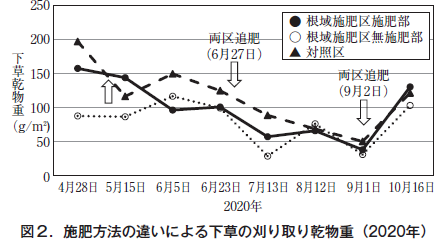
In the root zone fertilized area, the dry matter weight of the underbrush clippings tended to be lower than in the control area until July in both the 2 m wide ring starting 1 m from the main trunk immediately above the root zone fertilized area and the non-fertilized area outside the ring, suggesting that the underbrush used less fertilizer in the root zone fertilized area (Figure 2).
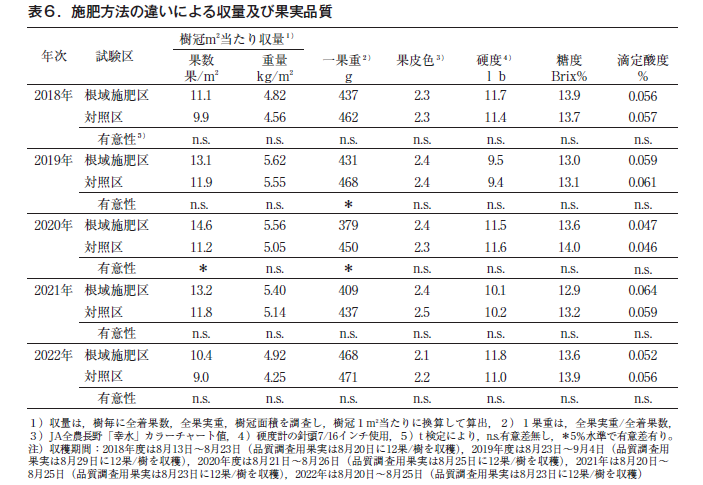
(4) Influence on fruit yield and quality of "Kosui
樹冠1㎡当たりの果実収量(重量)は,5年間とも根域施肥区と対照区の間に有意な差はなかった(表6)。
In 2020, the third year of the trial, the number of fruit set at harvest was higher in the root zone fertilization area because of frequent fruit breakage due to continuous rainfall in June and July, which forced the mid-harvest stop of corrective fruit picking, resulting in lower single fruit weight in the control area (Table 6). In 2022, the fifth year of the experiment, the fruit weights of the root zone fertilization and control were similar.
Fruit quality (peel color, firmness, sugar content and acidity) at the peak of harvest did not differ between the two treatments during the five years (Table 6).
(5) Effects on soil chemistry
Soil chemistry at the end of growth for each test year is shown in Table 7.
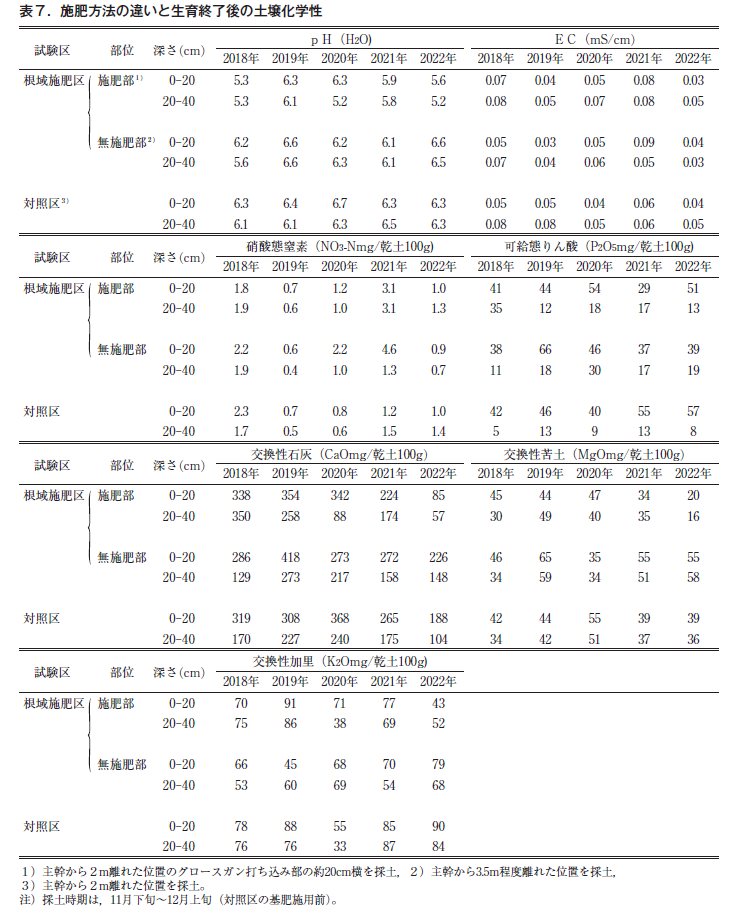
根域施肥区の主幹から2m程度離れた施肥部位では,試験3年後の2020年に20~40cmの深さでpH(H2O)と交換性石灰含有量(CaO)が,2022年には,0~20cm,20~40cmの深さともに,pH(H2O),交換性塩基含有量(CaO,MgO及びK2O)が,対照区及び根域施肥区の無施肥部に比べ低かった。この原因として,根域施肥部のグッドIBや尿素の分解過程で生じたアンモニウムイオン(NH4⁺)や硝酸イオン(NO3⁻)が交換性塩基の「幸水」による吸収量や下層への流亡量の増加に影響したと考えられるが,詳細については今後検討する必要がある。
No significant differences were observed between the control and root-area fertilized areas and the non-fertilized areas for other items and components.
(6) Expenses related to fertilizer application
Based on the actual fertilizer application in 2020, the third year of the trial, we estimated the annual fertilizer cost per 10 a for the root zone fertilization zone and the growth gun use fee (Table 8).
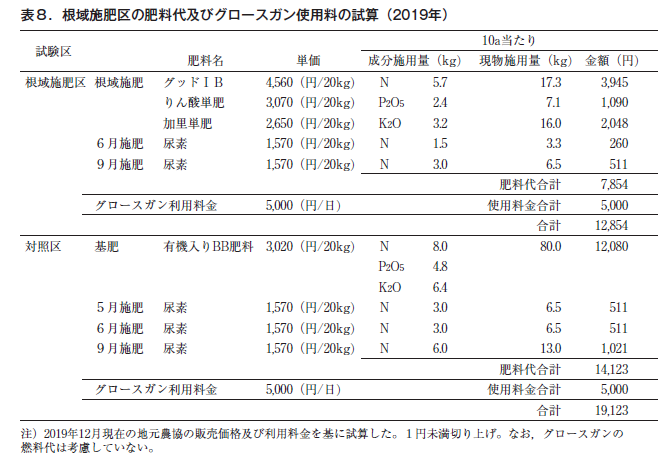
根域施肥区の肥料代とグロースガンの利用料の合計は,12,854円となり,対照区の19,123円の67%であった。肥料代だけの比較では,根域施肥区(7,854円)は,対照区(14,123円)の56%となった。また,対照区でグロースガン処理を行わなかったとしても,根域施肥区の合計額12,854円は,対照区の肥料代のみの14,123円に対し,91%であった。
4. at the end
A combination of root zone fertilization with soil improvement and localized surface fertilization in a ring around the main stem just above the root zone fertilization was applied to Japanese pear "Kosui" using a compressed air injection soil conditioner (Growth Gun). Growth, yield, and fruit quality were maintained at the same levels as conventional fertilizer application.
Although the proportion of expenses related to fertilizer application is small in fruit tree management, this fertilizer application technology is considered to be a positive management technique under the recent situation of high fertilizer prices. In addition, this technology can contribute to the reduction of chemical fertilizers as indicated in the "Green Food System Strategy.
TV program "Manten☆Aozora Restaurant
付加価値を意識した作物生産について
-果菜類・豆類編-
Miyagi University, School of Food Science and Industry
齊藤 秀幸
Introduction.
ふとしたご縁から2022年~2023年にかけてグルメバラエティ番組「満天☆青空レストラン」(日本テレビ)について12本の番組監修を行った。同番組は毎週土曜日18:30~19:00に放送されており,MCの宮川大輔氏が全国各地を回りながら,ゲストとともに各地の面白い食材やそれを使った料理を紹介している。品目の種類は幅広く,野菜はもちろん水産物,畜産物,穀類等と多岐にわたる。野菜の場合,まず実際に栽培されている圃場が案内され,栽培に関する生産者の工夫やこだわりが紹介される。MCの宮川氏やその時々のゲストによる収穫作業が行われ,臨場感がある。
番組監修者(私)の役割は,栽培に関する工夫やこだわりについて,園芸学的な視点から監修を行うものである。おおよその流れは,まず,制作スタッフが現地を訪れる前に,番組監修者(私)に取材に必要な予備知識の確認を行う。次に取材を通して得られた情報について番組監者(私)は制作スタッフとともに妥当性を検討し,その後テロップ・動画等の内容に誤りがないかどうかチェックする。その際,可能な限り専門的な用語を排除し,わかりやすい表現にするように努めるが,案外大変である。やりとりは原則としてメールで行われる。その際,必ずしも放送されることはないが,制作スタッフから科学的なエビデンスを確認されることもあり,先行研究等の確認が必要になることがある。具体的なことは書けないが,試験で記述式の問題を解いている感覚になる。
番組はMCの宮川氏やゲストによる軽妙なやりとりやテンポのある流れが売りであるが,栽培や植物の性質,栄養価に関する部分は吟味を重ねた内容であり,関わってみて制作態度の真面目さを強く感じた。個人的には種々学ぶことも多かったが,付加価値生産の実例としても興味深いものであった。
そこで,本稿では私が監修した各回について,番組監修者の視点で振り返りながら印象に残った点に触れ,野菜を中心に作物の付加価値生産について考えてみたい。番組後半の料理に関することにはあまりタッチすることがないので,前半の栽培に関する点に注目したい。ちなみに,番組の監修にあたって事前に生産者名(団体名)やゲストについて知らされることはなく,また,他に番組監修者がいる場合,その点についても知らされることはない。可能な限り目隠し状態での情報提供であり,客観性は十分に担保されている。監修者の所属・氏名は番組エンディングのテロップに出るので,機会があれば見ていただきたい。やはり地元の大学や研究機関が多い印象である。
そのような中,私が地域を越えて監修させていただくことになった理由は,宮城大学食産業学群附属農場において様々な作目,品種にトライしてきたことを評価していただいたことにあると思う。本稿では果菜類・豆類について,次稿では葉茎菜類・根菜類・果樹について,順に振り返ってみる。
佐賀県 西洋ナス(2022年8月13日放送)
The town of Yoshinogari-cho, Kanzaki-gun, Saga Prefecture, where the program was set, is famous for the Yoshinogari Ruins, which are designated as a special national historic site (Saito, 2023). At the Yoshinogari Ruins, large-scale moat encircling settlements of the Yayoi period, symbolized by rice cultivation, have been discovered. The cultivation of "Western" eggplant in this area, which has a strong flavor of ancient Japan, is an interesting contrast.
舞台となった農場の特徴は,
①標高が260mと比較的高地にあり,昼夜の気温差が大きいこと,
②日本には珍しく,アルカリ性の中硬水地域であること
である(齊藤,2023)。
果菜類の果実肥大には,当然ではあるが,光合成が大きく影響すで促進される。しかし,最近,日本各地において大きな問題となっている35℃以上の猛暑では,ナス等の暑さに強い性質の作物でも体力を奪われる。その点,番組の舞台となった圃場は高地にあり,過酷な高温にはなりにくいとのことであった。そして,葉から果実への光合成産物の転流は,夕方以降,急速に気温が下がることで促進される。いわば天然の変温管理が行われているといえる。
ところで,ナス果実の水分は90%を超える。水分が多いだけに,栽培における水質は重要な要素である。日本の河川の場合,急流が多いため,各種ミネラルが川に溶け込む時間が短く,一般的に軟水である。その点,当地域の水質は比較的ヨーロッパ(硬水)に近いといえる。このように当地では高度や水質といった地理的な条件を活かした付加価値栽培が行われているといえる。
In addition, the growers who appeared in the program grow about 30 varieties of eggplants from around the world (Saito, 2023). The program introduced mainly "Violetta di Firenze," "Dancer," "Macua Po," and "Casper" among them (Saito, 2023). This large number of cultivars is another selling point of the farm.
Violetta di Firenze" is a huge round eggplant (Saito, 2023). It is often eaten in Italy and is considered the king of eggplants. It is less widely distributed in Japan, and the price per fruit is about four times higher than that of a common eggplant. Its shape is similar to that of a tomato. Its texture becomes tender when heated.
Dancer" is a beautiful looking eggplant (Saito, 2023). It is often eaten in Puerto Rico in Central and South America. In the program, it was introduced that the fruit is the most delicious. It is an eggplant with a fairly high sugar content. One reason for this may be that the first fruits have few rivals competing for nutrients.
Makua Po" is a variety commonly eaten in Thailand (Saito, 2023). Eggplant is called "makua" in Thai. In Japan, it is known as "Tamago nasu" (eggplant). It is a small green round eggplant. It is green because it lacks the anthocyanin pigment nasunin. In Japan, the color purple is associated with eggplant, but overseas, green and white eggplants are more common than in Japan. The fruit is quite firm, but softens when heated.
Caspar" is a white long eggplant commonly eaten in France (Saito, 2023). The production staff asked me about the origin of the name of the variety. Although there is no proof, I answered that it may have been named after Caspar (a ghost character in an anime) because of its resemblance. The program introduced this point as "there are various theories," and I felt that they made an appropriate judgment. It was a moment when I felt the program was sincere in its production. Bananas are characterized by their thin skin, soft fruit, and low acidity. In the program, it was introduced as resembling a peeled banana, and it was introduced as resembling a banana.
The producers seemed to receive more than 500 orders per month from restaurants to individuals (Saito, 2023). They were also active in exploring cooking methods that brought out the potential of each variety. The fact that they are exploring cooking methods from the viewpoint of food ingredients, rather than just production, is a characteristic of this program. However, this attitude was common to all the producers introduced in the program.
In a word, the farm itself seemed to be adding value by planting many varieties.
岐阜県 石豆富(2023年5月20日放送)
The setting is Shirakawa Village, Ono-gun, Gifu Prefecture. The "Gassho-Zukuri Villages" of Shirakawa-go and Gokayama are registered as a World Heritage site. Ishi Tofu was featured as a traditional ingredient that preserves the flavor of the past. It is said to be one of the firmer tofu types and does not lose its shape. The area is famous for its heavy snowfall, and the tofu was developed as a preserved food for winter. The hardness of the tofu is what makes it so satisfying to eat. Since he was not a specialist in the area of eating quality, he asked his colleague, Assistant Professor Takashi Akazawa (Department of Food Protein Science, now at Niigata University), to co-supervise the research.
The raw material was Enrei soybeans grown in Toyama Prefecture. It is considered to have a sweet, unctuous, and straightforward taste, and its high protein content makes it suitable for tofu, which is made by firming protein. I supervised the broadcast on the characteristics of this variety. It was characterized by the use of two to three times the amount of soybeans as compared to ordinary tofu and the use of spring water that comes from the mountains. The use of this water, which has less cloying taste, gives the tofu a good aroma and allows the true flavor of the soybeans to be tasted. The key point is to take more time than in the general production process and to drain the water thoroughly.
Although the supervision of the cultivation was small, we were very happy to have jointly supervised the cultivation within the School of Food Science and Industry of Miyagi University.
神奈川県 トマト(2023年5月27日放送)
舞台となったのは神奈川県茅ヶ崎市である。トマトはリコピンやビタミンEが豊富で体や肌の老化を抑える効果が期待できるとされる。案外知られていないことであるが,トマトの出荷量は5月が最も多い。そこで現代の「旬の時期」は5月とした。栽培品種は‘湘南ポモロン’である。一般的にはあまり耳にすることのない品種であるが,神奈川県の農業技術センターで育成された品種である。
出演の生産者は2016年から作付けしている。先の尖った独特の果形であり,肉厚でジューシーである。生食でも美味しく,熱を加えた調理で型崩れしにくいのが特徴である。加熱することで旨味と甘みがアップする。日本は生食がメインであるが,海外では加熱して調理・加工するのが通常である。加熱しても水っぽくならない点が利点である。
品種名に使われているポモロンはイタリア語でトマトを表すポモドーロと英語のロング(果形が細長いので)を合体させたネーミングである。細長いイタリア系のトマトと日本で育成された愛知ファーストを交雑して育成した中玉品種である。概して生食用の品種では果実が柔らかくジューシーで甘みが強いのに対して,加工用の品種では完熟させて収穫するので,果実は果肉が厚く,水分が少ない。加工用の果実では旨味は濃いが酸味も強く,生食には向かない。加工用は加熱することで酸っぱさが旨味に変わるとのことである。
神奈川県農業技術センターによれば,湘南ポモロン・レッドは一般的な品種に比べてリコピンの含有量が1.5倍,β-カロテンの含有量が2.2倍であるという。番組では湘南ポモロン・ゴールドも紹介された。オレンジ色の品種であり,サラダの彩りに使われる。酸味は控え目でフルーティーな味わいで食べやすいとのことであった。
In a word, it is suitable for both fresh eating and cooking, and the farm itself seems to have added value by using unusual varieties with distinctive fruit shape and taste.
東京都 バターナッツかぼちゃ(2023年9月2日放送)
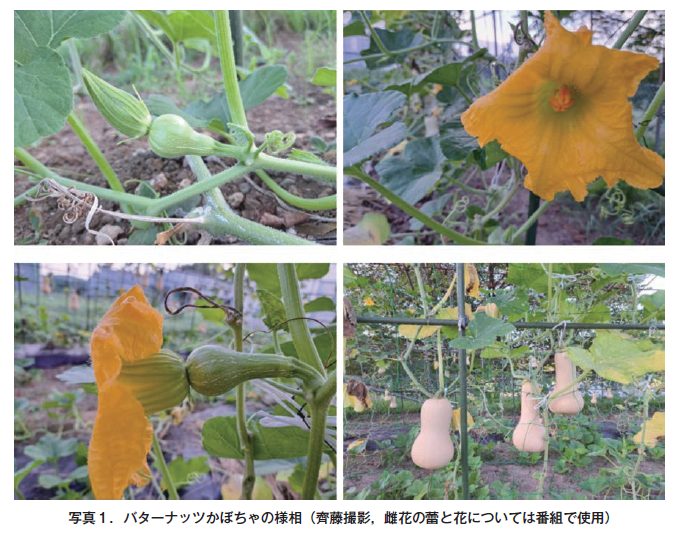
舞台となったのは東京都八王子市である。オープニングでは日本各地に個性的なカボチャがあることに触れ,‘宿儺かぼちゃ’〈すくな かぼちゃ〉(岐阜県高山市)や‘打木赤皮甘栗かぼちゃ’〈うつぎ あかがわ あまぐり かぼちゃ〉(石川県金沢市)が紹介された。いずれも個性的な形・色であるが,それらに勝るとも劣らない個性的なカボチャという位置づけで‘バターナッツかぼちゃ’が紹介された(写真1)。バターのようななめらかさとナッツのような風味が魅力との紹介が何度もなされた。形もひょうたん型で個性的である。
バターナッツかぼちゃは1940年代にアメリカで誕生したとされ,46年前の1977年にはじめて日本に輸入された。番組では触れられなかったが,当時は日本人好みのホクホク感がなかったため,市場関係者から失格の烙印を押された。しかし,現在ではその価値がみなおされてきている。時代の変化とともに価値が上昇してきたいわば「敗者復活」的な存在である。
On the other hand, in discussions with the production staff, the theme was why the unique gourd-shaped form shown in Photo 1 was obtained. In butternut pumpkins, the seeds are unevenly distributed in the gourd-shaped bulge. It is well known that auxin secretion from the seeds promotes the enlargement of the pulp around the seeds inside the seedlings, but we sought to create an easy-to-understand expression for the general public. In the program, a movie was made, and the closer to the seed, the more strongly the pulp wraps around the seed and the more it enlarges. This was a point of great difficulty. After discussions, it was also decided that the swollen part of the fruit would be sweeter because "nutrients for seed growth are concentrated in the swollen part.
Fortunately, we were also growing butternut pumpkins at the Tsubonuma Farm attached to Miyagi University, where I work.
The sweetness of the grapes increases during this period as the starch is converted to sugar, which is another point that was supervised. After ripening, the squash can be eaten raw, and when the MC and guests actually tried it raw, the sweetness and texture like oysters and the nutty aroma were emphasized. Even though it did not have the characteristic crunchiness of pumpkin, the "moist texture" that enhanced its deliciousness was emphasized, and the negative evaluation in 1977 was turned into a positive one.
熱を加えることでより甘み・食感が際立ち,本領が発揮されることに触れて,後半の料理の部に移行した。そのまま丸ごと焼くことからスタートした。その際,焼き芋と同様に遠赤外線の効果(甘みのアップ)が強調されたが,その点も放送はされなかったものの,科学的な根拠が確認された。ちなみにゲストによれば,スイートポテトに類似した食味であり,繊維質が感じられず,なめらかな食感であったという。他にもポタージュやプリン,キーマカレー等と種々の応用がなされた。
The producer of the show produces 80 to 100 kinds of pumpkins a year, including green eggplants and round okra, and the butternut pumpkin is one of them.
The first time I saw a new building, I was surprised to see it.
In a word, the farm itself seemed to add value in that it could meet all needs by producing many unusual vegetables.
(The following sections - leaf and stem vegetables, root vegetables, and fruit trees - will be continued in the next issue.)
No Soil - No. 34
危機に瀕する世界の土-その4
侵食による土の劣化
前 ジェイカムアグリ株式会社
北海道支店 技術顧問
松中 照夫
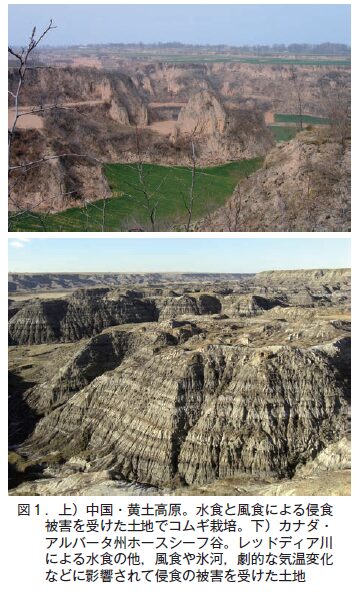
Following the previous three articles, the soil degradation discussed in this article is the damage caused by erosion. There are two types of erosion. One is water erosion, in which the topsoil is eroded from the surface by water, and the other is wind erosion, in which the topsoil is eroded by wind. This erosion is the most serious damage to soil in the world.
1. History of Soil Deterioration
「持続可能な開発」,すなわち「将来の世代の欲求(ニーズ)を満たしつつ,現代の世代の欲求も満足させるような開発」という概念が初登場したのは1987年だった。この概念は,1984年の国連総会で設立された環境と開発に関する世界委員会(委員長の名前からブルントラント委員会と略称)が発表した最終報告書「われら共有の未来」で提示されたものである。
この委員会の問題意識は「世界の人口爆発や貧困などの問題解決には,経済成長や開発が必要である」だった。しかし,それが環境破壊や資源の枯渇をもたらせば,持続性が失われる。それゆえ,この問題の解決には「持続可能な開発」が重要であるとの結論だった。
この環境破壊や資源の枯渇で最も注目されたのが土という資源だった。当時,すでに土の劣化が問題視され,とくに土の侵食が人類の将来の繁栄を損なうとの主張が出始めていたからである。しかし,そうした主張には土の劣化問題が深刻な場所と,そうではない場所がどこにどれくらいあるのか,土を劣化させた原因が何かということへの具体的な裏付けがなかった。その裏付けとなる情報収集のために,ブルントラント委員会の最終報告書が出されたとほぼ同時に,国連環境計画(UNEP)が国際土壌情報センター(ISRIC)と「土の劣化の地球規模評価(GLASOD)」というプロジェクト(3年間,1987~1990)を立ち上げた。
2. type and area of soil deterioration
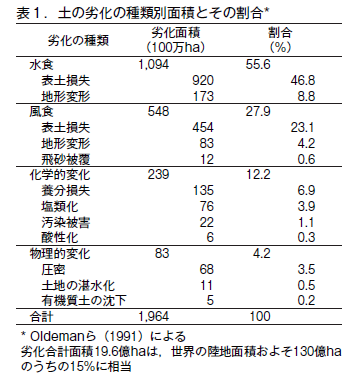
Many soil scientists from around the world participated in GLASOD, which covered approximately 13 billion hectares of the world's land area, and investigated the causes, types, extent, and degree of degradation. The results were published in 1991 as a map of the world at a scale of 1:10 million according to the type of degradation. The results for the area are shown in Table 1 (Oldeman et al., 1991).
Table 1 shows that 15% of the world's land area, or 1.96 billion hectares, was degraded by anthropogenic factors. The anthropogenic factors that contribute to soil degradation have already been described in the June issue of this series (Vol. 32). The main factors are inappropriate over-cultivation, overgrazing, and excessive deforestation.
GLASOD classifies degradation into four categories according to its status: water erosion, wind erosion, chemical change, and physical change. Of this total, 84%, or 1.64 billion ha, was soil erosion damage. Water erosion accounted for 1.094 billion hectares, and wind erosion for 548 million hectares. It is clear that the cause of soil degradation in the world at that time was erosion triggered by anthropogenic factors.
It should be noted that salinization accounted for only 0.76 billion ha of soil degradation at that time (Table 1). However, as previously mentioned, in 2015, 830 million ha were salinized worldwide (FAO, 2015), showing the tremendous progression of salinization from the end of the 20th century to the present.
3. natural and accelerated erosion
Soil erosion damage caused by human factors is often triggered by improper soil management. Even in the absence of such conditions, topsoil gradually moves downward on sloping land. This is called natural erosion and is a natural process that produces fertile lowland soil.
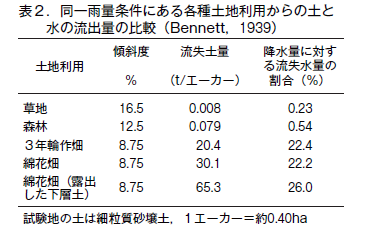
しかし,地面を覆う植物を人為的に除去して耕地化すると,土の侵食速度は自然侵食の数百倍もの早さで激しくなる。この人間活動の影響を受けた侵食を加速侵食という。自然侵食と比較してその被害は大きい。アメリカ土壌保全局ができた1935年からまもなくの研究は(Bennett,1939),表土の露出度の大きい綿花の栽培は侵食被害が大きく,抑制には草地としての土地利用が最も優れていることを明らかにしている(表2)。牧草が土を覆い,加速侵食を阻止するからである。
4. erosion and salinization damage observed in Central Asia
The history of soil degradation caused by erosion is long. In particular, the U.S. experienced large-scale erosion damage three times from the period of western settlement to the 1930s, and the Soil Conservation Service was established in the Department of Agriculture based on lessons learned from this experience. However, soil erosion in the U.S. continues to this day.
アメリカと同様に,大規模風食被害を経験したのが,中央アジアのカザフスタンとタジキスタンである。旧ソビエト連邦の全耕地面積の20%に相当する4,000万haの土が被害を受け劣化した。カザフスタンとウズベキスタンの国境地帯は,旧ソビエト連邦の「自然改造計画」によって,草原から綿花畑に改造された。乾燥地域につくられた綿花畑には灌漑水が必要で,パミール高原と天山山脈の融雪水を水源とするアムダリア川とシルダリア川から取水された。その結果,ウズベキスタンの綿花生産は世界5位になっている。
However, as a result, the Aral Sea (about 100 times the size of Lake Biwa), into which the water from both rivers poured, dried up. This is because the water supply to the Aral Sea was cut off by the intake of water from both rivers. The Aral Sea shrank to 10% of its original area and became the Aral Khan Desert. Wind erosion from the desert has scattered 75 million tons of dust and salt containing toxic chemicals annually (Hoshino, 2011). The water taken from the Amu Darya River has been inadequately used, and the soil has become salinated and degraded to the point that cultivation has been abandoned. This is truly the greatest environmental destruction of the 20th century.