

Site Search
Search within product
第764号 2024(R6).10発行
Click here for PDF version
§テレビ番組〈満天☆青空レストラン〉にみる
付加価値を意識した作物生産について
-葉茎菜類・根菜類・果樹編-
宮城大学 食産業学群
齊藤 秀幸
§土のはなし-第35回
危機に瀕する世界の土-その5
酸性雨による土の劣化
前 ジェイカムアグリ株式会社
北海道支店 技術顧問
松中 照夫
TV program "Manten☆Aozora Restaurant
付加価値を意識した作物生産について
-葉茎菜類・根菜類・果樹編-
宮城大学 食産業学群
齊藤 秀幸
(Continued from the previous issue - Fruits, Vegetables, and Legumes)
Chiba Prefecture, Shinshoga (broadcast October 22, 2022)
The setting was Yamatake City, Chiba Prefecture, an area famous for Kujukuri-hama (sea) and Yamatake cedars (mountains) (Saito, 2023). The producer who appeared in the film is a farmer who left his job 11 years ago, and now produces more than 150 kinds of vegetables a year, and has business with more than 40 restaurants. The producer emphasized that he grows his vegetables using rice bran and fishmeal.
New ginger is rarely seen in retail stores (Saito, 2023). In fact, ginger is rarely shipped immediately after harvest; it is stored in the soil after harvest and shipped as needed, and is called root ginger. Temperature control is important because low temperatures can cause rotting. This root ginger has a brownish appearance. Although it is called root ginger, it is not a root but an underground stem. It is generally grated and used as a condiment. On the other hand, fresh ginger is shipped immediately after harvest and is characterized by its whitish appearance with a reddish tinge at the top. It is fresh, moist, and mildly pungent.
One of the most interesting cultivation innovations was the use of taro to provide shade for ginger, which is susceptible to drought (Saito, 2023). It was also interesting that taro played the role of a "decoy crop" against soil-borne diseases, preventing them from spreading to the ginger plants.
In a word, it was thought that the value of the produce was increased by shipping earlier and freshening the product as new ginger.
Tottori Oyama Broccoli (November 26, 2022 broadcast)
The setting was Daisen-cho, Saihaku-gun, Tottori Prefecture (Saito, 2023). Broccoli has a very high vitamin C content and has become well established as a healthy food. In the filming, it was shown that harvesting is carried out from 10 pm to 9 am throughout the night. This is a pattern that has continued for about 50 years. During these hours, the temperature is around 10°C (50°F) lower, and the product temperature is lower, so respiration is suppressed and the sugar content is less depleted. Also, when harvested during the day, the flower buds tend to grow and loosen, which can lead to quality deterioration, but this risk is reduced when harvested at night. In the program, the guest cut the stems to show the high freshness of the flowers, and water dripped from the severed part of the stem. I thought this was an interesting performance.
On the other hand, the use of vacuum cooling tanks was introduced as an initiative of the production area (Saito, 2023). This is a collaboration with the local JA. The freshness of broccoli is preserved by storing it in a vacuum immediately after harvesting, and it lasts several days longer. In vacuum cooling, the air pressure is lowered to vaporize the water in the body, and the broccoli is cooled by depriving it of vapor heat. It was impressive that the region places an added value on freshness preservation. The Oyama Broccoli Cooking Study Group gave instructions on how to cook broccoli, and introduced kinpira (fried broccoli) that takes advantage of its high sugar content.
In a word, the production area as a whole was thought to be adding value to its produce by harvesting at night and pre-cooling to increase freshness.
Ebiimo, Osaka (Aired on Dec. 3, 2022)
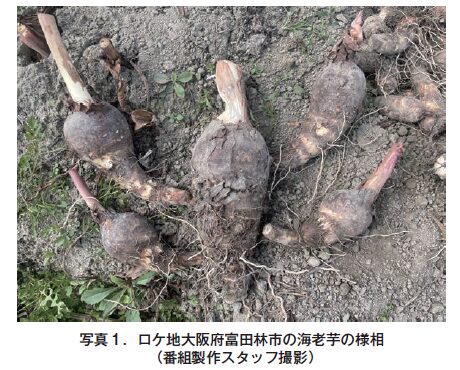
The setting was Tondabayashi City, Osaka Prefecture (Saito, 2023). Ebiimo is a type of taro, and its cultivation is said to have begun in Kyoto in the mid-Edo period. In Tondabayashi, it seems to have been cultivated for more than 100 years, and the fertile soil created by the repeated flooding of the nearby Ishikawa River, a first-class river, has greatly influenced the production of high-quality ebiimo. In fact, there are many cases of good quality taro production areas all over Japan where the soil seems to have become fertile due to river overflows. It is estimated that there are about 50 native species of taro in Japan. Ebiimo is considered a luxury food, characterized by its shrimp-like pattern and shape (Photo 1). The price is said to be more than three times that of common varieties.
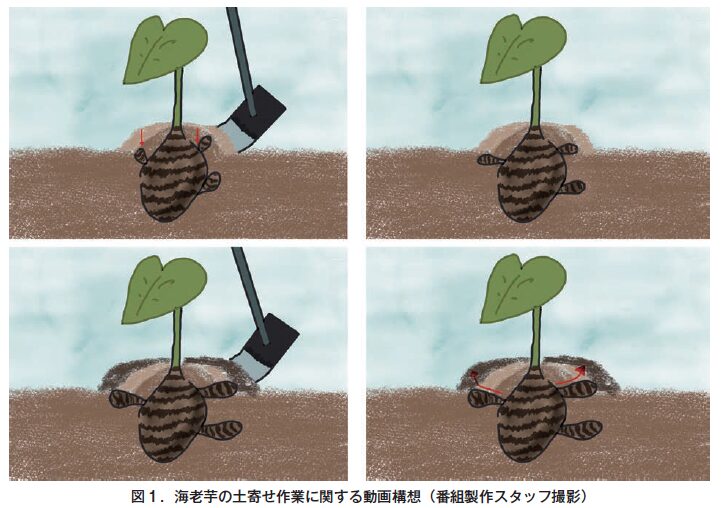
実は,十年ほど前,当方の宮城大学食産業学部附属坪沼農場でも海老芋を作付けしたことがあったが,あまり上手くいかなかった(齊藤,2023)。実は土寄せのやり方が独特であった。その点,アニメーションで分かり安く解説がなされた(図1)。まず,株上部に土寄せを行い,土中で芋を横に伸ばし,次に横方向から土寄せを行い,縦方向に湾曲させる。要するに土圧をかけながら順次湾曲させていくわけである。寄せる土の加減が難しく,経験を要すると思われる。湾曲した部分はトロトロの食感で,膨らんだ部分はホクホクの食感とのことである。
In a word, the cultivation of rare varieties was considered to add value to the products by giving them characteristics through their precise cultivation.
Komatsuna, Tokyo (aired April 15, 2023)
The setting was Edogawa Ward, Tokyo. Komatsuna is a typical leaf vegetable, and is an Edo vegetable named after Komatsugawa (the name of a town in Edogawa Ward). The field where the filming took place was located in a residential area. The komatsuna grown in the producer's field grows larger and thicker than ordinary cultivated products during the same growing period, and is said to be about 1.5 times larger. Originally, the soil in the field was hard clay-like Arakida soil brought from the Arakawa River, but the farmer has continued to improve the soil over the years by mixing it with red clay. The farmers in the past also mixed humus, fish meal, and oyster shells into the soil. The application of fish meal and oyster shells helps to grow calcium-rich komatsuna. In addition, they installed sprinklers to keep the soil dry, and they grow the plants so that they are fresh and have no bitterness in taste. According to the analysis by Associate Professor Xie Xiaonan of Utsunomiya University, who was the co-supervisor of the study, the komatsuna of the farmers in the study had about 1.5 times more glutamic acid content and about twice as much calcium content than the control komatsuna.
In a word, the farmers dared to ship their products in substandard sizes, and they were thought to add value to their products by selling their richness in calcium.
Basil, Shizuoka Prefecture (aired August 12, 2023)
舞台となったのは静岡県浜松市である。浜松市の日照時間は全国でトップレベルである。出演の生産者のバジルは露地栽培で十分な太陽光を浴びているため,香り高く,品質が良好とのことであった。日本ではバジル=スイートバジルとイメージされることが多いが,世界中には50種類以上ある。出演の生産者はそのうち19種類ものバジルを作付けしていた。バジルはインド原産のシソ科の1年草であり,夏に収穫される。番組では,特にホーリーバジル,ライムバジル,タイバジルおよびシナモンバジルの4種類が重点的に取り上げられた。もともと出演の生産者は有機農業を行っていたが,ふとしたことからホーリーバジルに出逢い,その香りに魅了されたことからバジルの栽培が始まったという。バジルの栽培歴は4年と決して長いとはいえないが,既に20軒以上の飲食店から注文を受けており,立派なバジル専門の生産者であった。番組ではMCとゲストが入れ立てのホーリーバジルティーの香りと清涼感を味わっていた。
Holy basil has a stronger aroma than sweet basil and is said to be noticeably cooler. Linalool, an aromatic component, is also secreted in large amounts from the flower spikes and has an appetite-promoting effect. Its strong coolness suppresses the odor of seafood, and it is often ordered by restaurants. Lime basil is popular among women for its citrus aroma, and its tender leaves are suitable for salads. Thai basil has a spicy aroma similar to that of octagonal herbs, and its bitterness is useful in Thai cuisine. Cinnamon basil has a sweet aroma similar to that of cinnamon, making it a good topping for sweets. Purple basil (purple leaves), Taiwanese basil, and French basil were also introduced. One of the key points of the supervision was the secretion of linalool in basil. Although not aired in the program, a detailed explanation of linalool was requested.
One of the main characteristics of the producers was that they planted not only the standard sweet basil, but also a variety of other basil varieties. In this respect, we felt the producers' playful spirit, and in effect, it was a risk hedge. In terms of handling many varieties, I was reminded of a Western eggplant producer in Yoshinogari-cho, Kanzaki-gun, Saga Prefecture. It must have taken extraordinary efforts to get so many orders from so many restaurants in just four years. The long hours of sunlight in this region make it an ideal location for basil cultivation.
In a word, the farm itself seemed to be adding value by planting many kinds of crops.
WAKAYAMA Prefecture, Momo (Aired August 19, 2023)
舞台となったのは和歌山県紀の川市である。本題は紀の川市特産のモモであった。重さ360g以上で糖度12度を超えるものしか出荷していないとのことだった(品種は‘川中島白桃’と‘清水白桃’の2品種)。しかし,私が監修したのはモモではなくバタフライピーだった。番組後半では素材を活かした料理・加工になるが,その際に登場した。ハーブティーに用いられるマメ科の青い花である。近隣のチーズ専門店でブルーチーズの着色に用いられていた。このバタフライピーを用いたブルーチーズはこの店のオリジナルチーズであり,バタフライ・ブルーと命名されていた。バタフライピーは,最近,耳にする機会が増えてきたハーブであるが,制作スタッフからは植物学的な特徴について尋ねられた。一見してモモとは無関係だが,モモとバタフライピーとを組み合わせて作ったブルスケッタがビールのおつまみとして美味しいと紹介された。ちなみに,今回のように本文の監修ではなく,一部素材に関する情報を確認する場合,「情報監修」という表現になるようである。
Asparagus, Mie Prefecture (aired August 26, 2023)
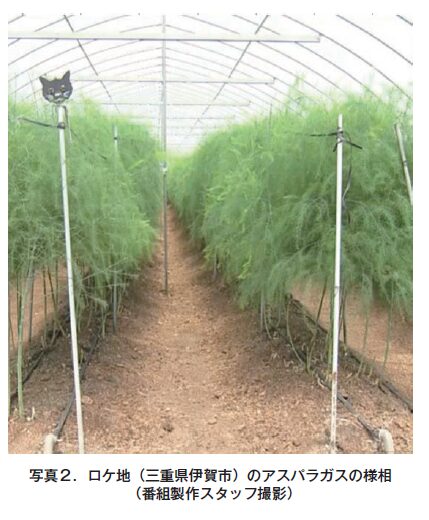
The setting was Iga City, Mie Prefecture. Asparagus is rich in aspartic acid, which is expected to relieve fatigue. Asparagus can be harvested twice a year, in spring, summer and fall, but this broadcast focused on the summer harvest (Photo 2). In the program, asparagus was introduced as "summer-harvested" instead of "summer-harvested," but this was done to respect the terminology used by the growers. The freshness and rapidity of growth were emphasized, with 20 to 30 cm of growth in one day. As far as I know, the standard is quite high (in reply to an e-mail to the production staff).
The producer is a housewife who inherited the will of her father-in-law, who passed away seven years ago, to "produce the best asparagus in Japan. Incidentally, this is the 14th year for the plant.
The freshness, sweetness, and fatness were emphasized, but the funky and fashionable hair and clothing of the producers, who at first glance did not look like agricultural producers, were impressive. As usual, a variety of dishes were prepared. The asparagus tea, made by drying and roasting asparagus, was an interesting innovation.
In a word, the producers' unconventional attitude (including the use of their products) itself was considered value-added.
Chiba, Negi (aired December 23, 2023)
The setting was Yokoshibamitsu-cho, Yamatake-gun, Chiba Prefecture. Chiba Prefecture is Japan's largest shipper of green onions, and the Yamatake area in particular is one of the largest green onion production areas in Chiba Prefecture. Yokoshibamitsu faces the Kujukuri coast, and during a typhoon in 2002, a large amount of seawater was swept up and poured into the fields, causing extensive salt damage to the crops. However, only the green onions remained healthy and green, and they were juicy and tasty. After much trial and error, they came to the conclusion that it is best to spray seawater diluted to one-tenth of its original volume at least five times before harvesting. This application of seawater overturned the common wisdom of vegetable cultivation. This is why they named it "Kujukuri Umikko Negi. It was a miracle leek born from adversity.
The following is a summary of the tickers confirmed by the supervision.
(1) "At 12 degrees sugar content, it is comparable to strawberries and considerably higher than the 9 degrees sugar content of common green onions."
(2) "Absorption of seawater from leaves and roots ⇒ (osmotic pressure) water is drained out."
(iii) "Stress effect of salt ⇒ accumulation of sugar ⇒ (leeks nearly killed by salt from seawater) actively photosynthesize to store nutrients ⇒ increase in sugar and other nutrients."
(iv) The line "It's more fun if it's a little stimulating" (analogous to the effects of salinity stress).
(5) "Supplement minerals (that tend to be lacking) with seawater => increase thickness as well."
(6) "The lower it is, the spicier it feels."
(7) Reason why water drips when you cut them (char-grilled leeks).
*Although it was not aired in the program, he responded that the heat may have destroyed the cells, eliminating their walls and facilitating water leakage.
(viii) "The thickening in the leaves is a sign of freshness and full of sweet ingredients."
*The respondents answered that various carbohydrates, including sugar, were present in abundance, although this was not aired in the program.
Since the program is popular with viewers of all ages, we prioritized ease of understanding, but we were often helped by the flexible ideas of the production staff, which taught us a great deal about "how to communicate.
In a word, the special cultivation method of seawater application seemed to have improved quality and added value.
At the end.
The various forms of value-added production of crops have emerged from the supervision of the various cases described above, together with the previous issue on fruits, vegetables, and legumes. As a basis for further discussion, we have attempted to formulate the following types of cases, albeit roughly.
(1) Value-added production through the production of a wide variety of products and commodities in the production field itself
(2) Value-added production through the selection of rare varieties and items
(iii) Value-adding regarding the quality of produce by changing cultivation methods and harvest time
(4) Value-added products through the character of the producer
(5) Value-added through cooking and processing
I will add my personal observations in turn.
(1) "Value-adding to the production field itself through the production of multiple varieties and items" can be applied to "Western eggplant from Saga Prefecture (broadcast on August 13, 2022)" and "basil from Shizuoka Prefecture (broadcast on August 12, 2023)". Recently, it seems that chefs themselves are increasingly visiting cultivation fields to check on the ingredients themselves, and the availability of various varieties should motivate chefs to place orders.
The second point, "value-adding of products through the selection of rare varieties and items," overlaps with the first point, and includes the "Osaka prawn (broadcasted on December 3, 2022)" and the "Tokyo butternut pumpkin (broadcasted on September 2, 2023). The "butternut pumpkin" was imported once in the past and was rejected because it lacked the crunchy texture typical of pumpkins, but the fact that it was revived by taking advantage of this texture was interesting.
(iii) "Value-adding to the quality of products by changing the cultivation method and harvesting time" is something that all producers are trying to do, but "Chiba Prefecture new ginger (broadcast on October 22, 2022)," "Tottori Prefecture Daisen broccoli (broadcast on November 26, 2022)," "Tokyo Metropolitan Government Komatsuna (broadcast on April 15, 2023)," and "Chiba Prefecture green onion (broadcast on December 23, 2023)" are particularly good examples. Komatsuna (broadcast on April 15, 2023)" and "Chiba green onion (broadcast on December 23, 2023)" were considered good examples. Particularly impressive was the "Chiba green onion (broadcast on December 23, 2023). The establishment of an unconventional cultivation method of applying seawater was very interesting from a horticultural viewpoint. The creation of added value by turning a negative into a positive may have great implications for the future.
The first case that comes to mind regarding the "value-adding of products through the character of producers" is "Mie Prefecture Asparagus (broadcast on August 26, 2023). The funky and fashionable hair and clothes of the producers, who at first glance did not look like agricultural producers, were impressive. The name of the farm, "Zuigumo Farm," was also unique. The name was said to be named after his late father, who was passionate about asparagus production, and the farmer's enthusiasm was evident as he expressed his respect for his late father. The funky signboard (portrait of the producer) that made me want to peek inside the greenhouse was also interesting. As a side note, the supervisors were not informed in advance of such interesting information about the producers, and they had to look forward to seeing who the producers were this time. In this respect, the situation is the same as that of ordinary viewers.
The point (5), "value-adding through cooking and processing," applies to all producers. I am always impressed and look forward to seeing the eccentric cooking and processing. Naturally, the contents are new to the supervisor (me). I believe that the goal of agricultural products is to prepare and process them. It is generally thought that a producer's work is only until shipping, but I noticed that many of the producers who appeared in the program were also enthusiastic about cooking and processing.
As mentioned above, I have been involved in program and information supervision a total of 12 times through a chance encounter, and I have learned a great deal. I have learned a great deal from them. I have been able to see what is going on in the field and what consumers need, which I could not see only from inside the laboratory, and I have learned how to make use of my knowledge and how to communicate in an easy-to-understand manner. I would like to thank the program production staff again.
No Soil - 35th
危機に瀕する世界の土-その5
酸性雨による土の劣化
前 ジェイカムアグリ株式会社
北海道支店 技術顧問
松中 照夫
In the latter half of the 20th century, air pollution became a serious pollutant as human economic activity increased. Acid rain generated by air pollution is another cause of soil degradation. Even today, when air pollution control measures have become widespread, there are still concerns about the damage caused by acid rain, especially in forested areas.
Acid Rain and Acid Fallout - Terminology
大気が清浄で汚染ガスが含まれていなければ,雨は空気中の二酸化炭素(CO2)を溶かしながら降ってくる。このため,雨水のpHは飽和炭酸水のpHである5.6程度になる。ところが現実には,大気にさまざまな汚染物質が含まれているため,pHは5.6より低いことが多い。このpH5.6より低い降雨を酸性雨という。
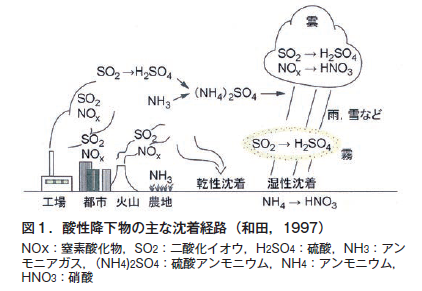
However, the commonly used term acid rain includes not only rain, but also fog, snow, and other forms of fallout (collectively referred to as wet deposition or wet fallout), as well as particulate (aerosol) and gaseous acids (collectively referred to as dry deposition or dry fallout) that are deposited by the wind even on sunny days. ) may also be included. Both wet and dry deposition are referred to as acidic fallout (Figure 1).
2. history of acid rain and air pollutants
The history of acid rain coincides with the history of human air pollution since the Industrial Revolution. The term "acid rain" was first used by Robert Angus Smith in 1872 in his book "Atmosphere and Rain: The Beginnings of Chemical Climatology. In this book, he pointed out that coal burning in and around Manchester, England, which had formed a large industrial area during the Industrial Revolution, was polluting the air and causing acid rain. The United Kingdom continued to suffer from air pollution for a long period of time. London in the 19th century was particularly severely affected, and even deaths occurred as a result of air pollution.
産業革命以降,産業活動が活発化し,石炭や石油など化石燃料の消費量が増加した。その結果,大気にイオウ酸化物(SOx)や窒素酸化物(NOx)が大量に放出されるようになった。これらの酸化物が大気中で複雑な化学反応を経て,最終的に硫酸(H2SO4)や硝酸(HNO3)などを生成し,よりpHの低い強酸性の雨となって地上に戻ってきたもの,それが酸性雨,酸性降下物である(図1)。
この他,酸性雨関連大気汚染物質には,図1の農地から発生するアンモニアガス(NH3,主に家畜ふん尿からの揮散に由来する)や,図1には示されていない海塩性の塩素(Cl,荒天で海水中に巻き込まれた空気の気泡が海面で破裂して粗大粒子が生じ,それが大気に巻き上げられて発生)なども含まれる。塩素は大気中で塩酸となって降下する。
3. Acid Rain in Japan
In Japan, the Environment Agency (now the Ministry of the Environment) has continued to observe acidic precipitation throughout Japan since 1983. According to the results of the latest acid rain survey in FY2022, the average pH of precipitation at 19 sites across Japan where wet deposition was surveyed was 4.95, a strong acidity, during the five years of the survey (FY 2018-2022). The lowest pH was 4.69 observed at Yaku Island, Kagoshima Prefecture, and the highest was 5.21 at Happo One, Nagano Prefecture (Ministry of the Environment, 2023).
4. environmental damage caused by acidic fallout
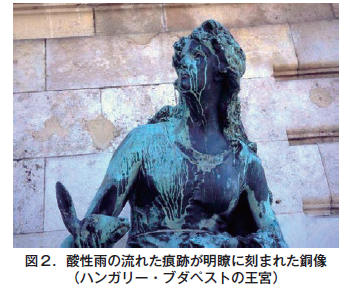
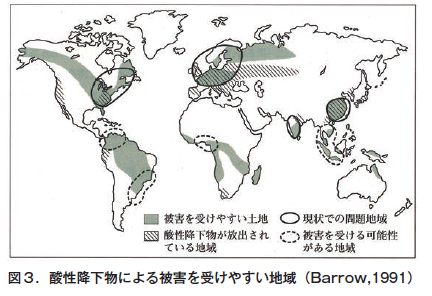
The damage caused by acid fallout is tangible (Figure 2). What is more worrisome, however, is the fact that the damage is invisible to the eye, but quietly escalates. Soil acidification is one of them. Strongly acidic acid rain washes away cations such as calcium and magnesium that are retained in the soil and promotes soil acidification. This leads to soil degradation and loss of biodiversity. The areas most susceptible to damage from acidic fallout were Europe, the eastern coastal areas of the United States, and the west coast of India and southeastern China (Figure 3).
The most serious damage caused by acidic fallout to forests, rivers, and lakes is called "acid shock" in rivers and lakes in Sweden, Norway, and Canada (Ishi, 1992). Snow that has accumulated as wet fallout melts at the same time as the snow melts, becoming highly acidic water that flows into rivers and lakes at once. The pH of rivers and lakes then drops sharply and becomes highly acidic, causing serious damage to aquatic animals. This is acid shock.
4. forest damage caused by acidic fallout
Forest damage is not only caused by direct damaging effects of acidic fallout, but also by nutrient enrichment derived from acidic fallout. Nitrogen derived from acid fallout in Japan was about 8 kg/ha per year (Murano, 1993). This amount is about 5 to 10% of the nitrogen given to crops and is not negligible. Originally, forests do not provide nutrients to crops. Therefore, when fallout rich in nutrients such as nitrogen falls on forests, tree growth is temporarily stimulated, and trees actively absorb nutrients from the oligotrophic forest soil. As a result, nutrients not supplied by acidic fallout are depleted from the soil and inhibit tree growth. In some cases, the supply of nitrogen from the fallout causes overgrowth of leaves and branches, resulting in a loss of nitrogen nutrient balance in the tree as a whole. Thus, nutrient enrichment by fallout disturbs tree growth based on natural material cycles, resulting in forest damage.
Other acidic substances are deposited on leaves in an acid fog-like state, and when the water gradually evaporates and becomes concentrated, the leaf surface is damaged. When acidic substances are deposited on the leaves again, the damage is expanded, and so on, in a chain reaction. As this progresses, the trees die. When forest soil is exposed due to such forest damage, it accelerates soil erosion damage and leads to soil degradation.
In Japan, the cedar dieback in the Kanto region and the fir dieback in Daisen in the Tanzawa mountain range attracted attention because the damage was similar to that caused by acidic fallout in coniferous forests in Europe. Subsequent studies, however, suggested that the damage may have been caused by gaseous air pollutants such as photochemical oxidants rather than acid rain damage (Furukawa, 1989). It is not possible to assume that all forest damage is caused by acidic fallout.