

Site Search
Search within product
第769号 2025(R7).04発行
Click here for PDF version
§ニホンナシにおける発芽不良発生抑制を目的とした施肥体系の開発
Fruit Tree Research Center, Shizuoka Prefectural Institute of Agriculture and Forestry
Department of Fruit Processing Technology
上席研究員 石川 隆輔
§土のはなし-第40回(最終回)
わが国農業者の高齢化は食料生産への不安要因
-高齢化歯止めの鍵は新規参入者支援-
前 ジェイカムアグリ株式会社
北海道支店 技術顧問
松中 照夫
Suppression of Germination Defects in Japanese Pear
目的とした施肥体系の開発
Fruit Tree Research Center, Shizuoka Prefectural Institute of Agriculture and Forestry
Department of Fruit Processing Technology
上席研究員 石川 隆輔
Introduction
In recent years, inconsistent flowering of Japanese pear (Prunus mume) due to poor spring germination has been occurring frequently, and has become a problem in Shizuoka Prefecture as well. This germination failure is caused by high temperatures from fall to winter, which do not increase the freezing resistance of the tree, and the tree suffers from frost damage when the temperature drops. It has also been shown that nitrogen fertilization in autumn increases the nitrogen content of flower buds, which prevents the increase in freezing tolerance and contributes to poor germination (Matsumoto et al., 2010; Sakamoto et al., 2017).
Koshigae et al. (2022) confirmed that fertilizer application in spring reduced the occurrence of germination defects and had no effect on fruit quality.
This study investigated the effects of a conventional fertilizer system and a fertilizer system without fall fertilization (October) on the occurrence of poor germination, fruit quality, and soil nitrogen content in Shizuoka Prefecture.
2. materials and methods
(1) Test material and cultivation management
Twelve-year-old Japanese pear 'Kosui' (as of 2022), planted in the garden of this research center in Shimizu-ku, Shizuoka City, Shizuoka Prefecture, was used for the tests.
The vigor of 'Kosui' was slightly weak, and it was trained with two main branches on a flat trellis. Fruits were picked at 20 cm intervals at the end of finishing picking.
土壌は黄色土であり,排水性は悪く土壌物理性は不良と考えられた。また,試験園地は土壌改良のために,牛糞堆肥を毎年2t/10a施用し,試験期間中もすべての処理区に牛糞堆肥の施用を行った。
Pest control was conducted according to the pear cultivation calendar published by the Shizuoka Prefecture Deciduous Fruit Tree Promotion Association.
(2) Fertilization method
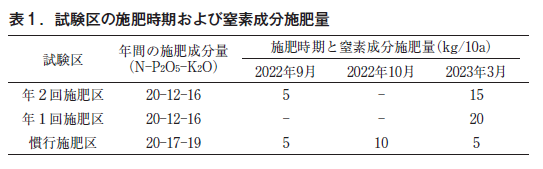
In this study, three areas were set up for twice-yearly fertilization (September and March), once-yearly fertilization (March), and conventional fertilization (September, October, and March), with three trees in each area as test trees.
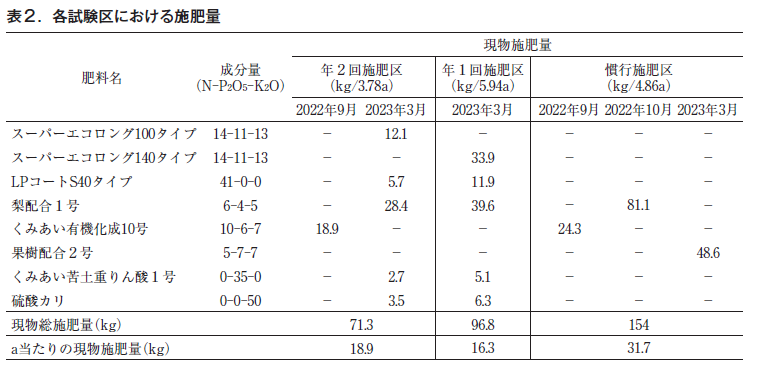
In the twice-yearly fertilizer application, organic chemical No. 10 was used in September, and Super Ecolong 100 type, LPS 40 type, and Pear blended No. 1 were used in March, with an annual nitrogen component fertilizer rate of 5 kg/10a in September and 15 kg/10a in March (Tables 1 and 2).
In the once-a-year fertilizer application, Super Ecolong 140 type, LPS 40 type, and Pear Compound No. 1 were used in March, and the annual nitrogen component fertilizer rate was 20 kg/10a (Tables 1 and 2).
慣行施肥区では,9月に有機化成10号,10月に梨配合1号,3月に果樹配合2号を使用し,年間窒素成分施肥量は9月が5kg/10a,10月が10kg/10a,3月が5kg/10aとした(表1,表2)。
In the twice-annual and once-annual fertilizer treatments, phosphoric acid and potassium sulfate were applied to supplement phosphoric acid and potassium (Table 2).
The fertilizer was applied manually to the inside of the canopy.
(3) Evaluation of the degree of germination failure
The study was replicated with three trees per site, and three long-fruited branches (current year branches with 8 to 15 axillary flower buds) were collected from each tree every month from November to March 2022.
採取した長果枝は0℃で3時間の予冷を行った後,-5℃で16時間の低温凍結処理をした。本処理後,長果枝は0℃で3時間と5℃で5時間の解凍処理を行い,20℃に設定した室内で水挿しを行い,保管した。
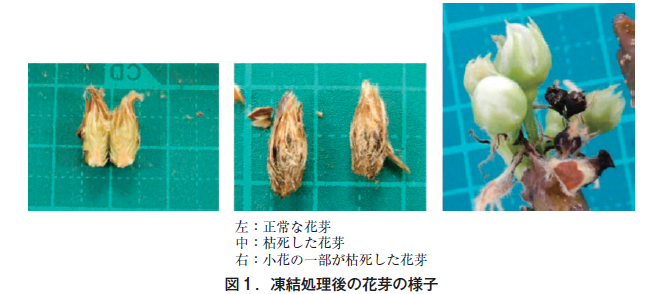
The survey was conducted two weeks after thawing treatment, and flower bud death was evaluated as "dead buds that have stopped growing," "buds that are likely to die in the future due to internal browning," and "buds with a portion of small flowers dead after budding" (Figure 1), and the percentage of flower bud death among all flower buds was calculated. The results of the survey were subjected to analysis of variance, and Tukey's multiple comparison test was performed for months in which there were significant differences.
(4) Evaluation of impact on flowering
The survey was repeated with three trees in each test plot. Ten long-fruiting branches were randomly selected from each tree, and the flowering of axillary flower buds was confirmed over time. Flowering was confirmed in clusters (flower buds), and the flowering date of a cluster was defined as the time when the first flower of the cluster flowered.
(5) Determination of inorganic nitrogen in soil
Soil samples were collected from three points in each test plot and inorganic nitrogen content was measured. Measurements were taken monthly from September 2022 to March 2023. The measured values for each treatment were subjected to monthly analysis of variance, and Tukey's multiple comparison test was performed for months in which there were significant differences.
(6) Determination of nitrogen content of flower buds
The survey was repeated with three trees in each test plot, and three shoots were randomly selected from each tree to measure nitrogen content. Measurements were taken monthly from November to March 2022. Measurements for each treatment were analyzed for variance on a monthly basis.
(7) Evaluation of fruit quality
調査は各試験区3樹反復し,各樹の単位樹冠占有面積(1㎡)当たりの収量(kg/㎡)と平均果実重を算出した。また,各樹10果を採取し,糖度,pHおよび果実硬度を測定した。
For sugar content and pH, about 1/8 of the fruit was pressed using a manual juicer, and the juice was examined using a pocket sugar meter PAL-1 (ATAGO Co., Ltd.) and a pen-type pH meter SK-670PH (Sato Measuring Instrument Manufacturing Co., Ltd.). Fruit hardness was measured by cutting the fruit in half lengthwise and examining two points at the equator using a fruit hardness tester FT011 (Fujihira Kogyo Co., Ltd.).
Measurements for each treatment were subjected to analysis of variance.
3. results
(1) Influence of different fertilization methods on the degree of germination failure
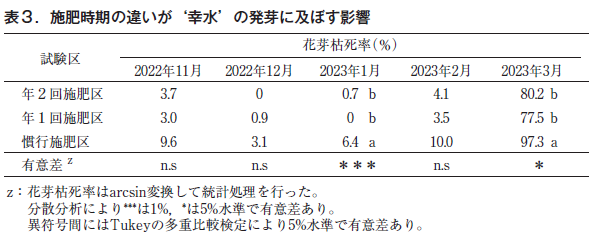
Table 3 shows the percentage of flower bud failure in 'Kosui'. However, no significant difference was observed for long branches collected in November, December, and February.
(2) Effect of different fertilization methods on flowering
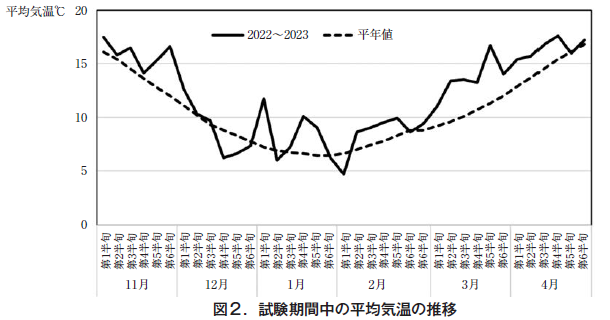
Average temperatures from November 2022 to April 2023 remained above normal overall, although they were sometimes below normal from mid-December to early February (Figure 2).
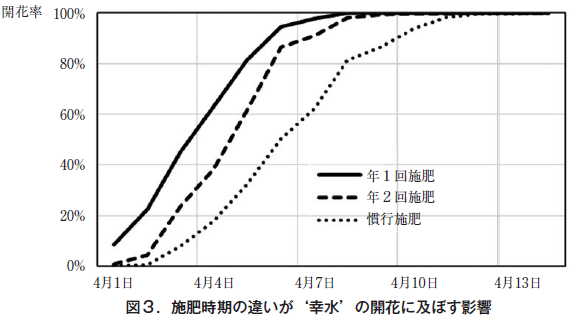
The time to reach a flowering rate of 20% to 80% was about 3 days in the biannual and annual fertilizer treatments, and about 5 days in the conventional fertilizer treatment (Figure 3).
No death of flower buds was observed in all the plots (data omitted).
(3) Changes in the amount of inorganic nitrogen in soil due to different fertilizer application
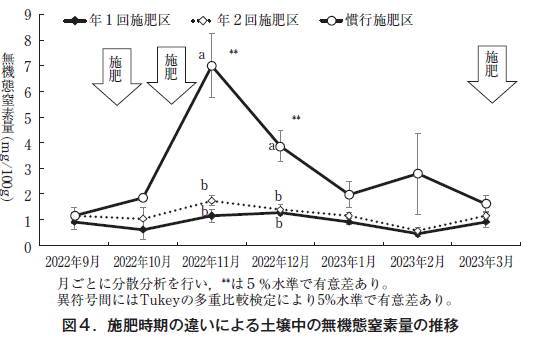
The amount of inorganic nitrogen in the soil was significantly higher in November and December in the conventionally fertilized area than in the twice- and once-annual fertilized area (Figure 4).
(4) Effect of different fertilizer application on nitrogen content of flower buds
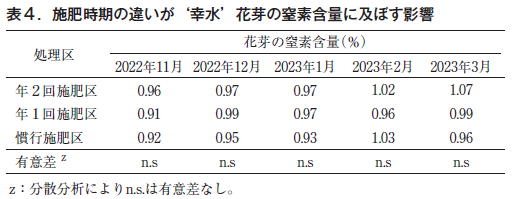
Nitrogen content of flower buds did not differ significantly among all treatment months (Table 4).
(5) Effect of different fertilizer application on fruit quality
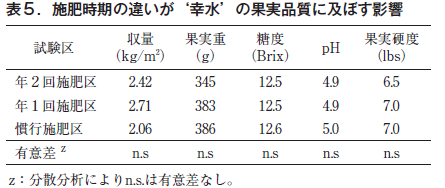
There were no significant differences in fruit quality at different fertilizer application times (Table 5).
Summary
In Japanese pear, it has been shown that the method of applying fertilizer once in spring is effective as a measure to reduce the occurrence of germination failure due to frost damage (Koshigae et al., 2022).
Currently, the incidence of poor germination of Japanese pear in this prefecture is less than in western Japan, but it is likely to increase in the future because of the trend toward higher temperatures in autumn and winter every year.
In this study, we investigated the effects of twice-yearly (September and March) and once-yearly (March) application of fertilizer on Japanese pear 'Kosui'. The results showed that the incidence of poor germination was lower (Table 3) and the variation in flowering was less (Figure 3). Fruit quality in the twice-annual and once-annual fertilizer application areas did not differ from that in the conventional fertilizer application area, indicating that a change in fertilizer application timing had no effect on fruit quality. Furthermore, the amount of inorganic nitrogen in the soil in the fall and winter, which is the cause of reduced freezing resistance, was lower in the twice-annual and once-annual fertilizer application areas than in the conventional fertilizer application area, suggesting that the change in fertilizer application timing can suppress the occurrence of germination defects.
These results suggest that a fertilizer system without autumn fertilization (October) is effective in reducing germination defects of Japanese pear 'Kosui' in this prefecture.
5. cited references
●松本和浩・加藤正浩・竹村圭弘・田辺賢二・田村文男(2010)秋季の窒素施肥量がニホンナシの耐寒性と脂質含量に及ぼす影響.園学研.9(3):339-344
●Sakamoto, D.,K. Fujikawa, T. Sakaue, H. Inoue,A. Ito, T.Moriguchi, A, Higashi and T. Sugiura.(2017)Application of livestock waste compost as a source of nitrogen supplementation during the fall-winter season cause dead flower buds in Japanese pear ‘Kosui’ Hort. J.86:19-25.
●腰替大地・坂上陽美・阪本大輔・杉浦裕義・木﨑賢哉・内野浩二・杉浦俊彦(2022)施肥時期改善による露地栽培ニホンナシの発芽不良発生軽減技術の検証.園学研.21(4):433-440.
No Soil - Vol. 40 (Final)
わが国農業者の高齢化は食料生産への不安要因
-高齢化歯止めの鍵は新規参入者支援-
前 ジェイカムアグリ株式会社
北海道支店 技術顧問
松中 照夫
This is the final article in this series. I would like to take a short break from the soil to discuss the possibility of Japanese agriculture becoming "senile" and the key to overcoming this situation is to support and promote the entry of young people into the agricultural industry.
1. less than 1% of the population is engaged in key agricultural activities
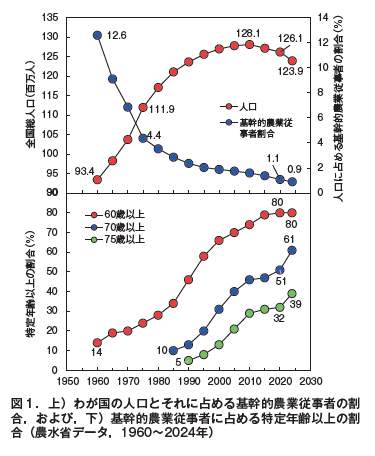
わが国は,高度経済成長時代(1955年から1973年ころまで)に人口が急増した(図1-上)。その後,2010年まで人口増加が継続し1.28億人でピークとなった後,減少に転じた。ところが,日常的に農業を自営する人(基幹的農業従事者。以下では基幹農業者と略)は1960年以降,一方的に減少している。とくに人口急増の高度経済成長期に著しい。すなわち,1960年の基幹農業者は1,175万人(人口比12.6%)だったが,75年には489万人(人口比4.4%)にまで大きく減少した(図1-上)。人口比でみると,75年は60年の実に3分の1にまで落ち込んだことになる。
It is clear that people moved from agriculture to industry during this period. At the same time, this period coincided with a sharp decline of more than 20% in Japan's food self-sufficiency ratio (on a calorie basis), from 79% in 1960 to 54% in 1975. This was the result of importing agricultural products and exporting industrial products to promote economic growth.
The declining trend of key farmers has not changed since then, and by 2024 there were 1.11 million people, only 9% of the 1960 figure, and less than 1% of the population (Figure 1-above).
2. aging of key farmers
Our country's population is aging at an accelerating rate. Key farmers are no exception. The percentage of key farmers aged 60 years or older in the key farmers has been declining and aging at the same time, reaching 80% in 2024, compared to 14% in 1960 (Figure 1-bottom).
The most recent change from 2020 to 2012 is particularly interesting. Unlike in the pre-2020 period, the percentage of those aged 60 and over stagnated for the past four years (Figure 1-bottom). On the other hand, the percentage of those aged 70 and over increased significantly during this period, and the percentage of those aged 75 and over also increased more than before. This fact indicates that the aging of the farming population progressed without sufficient replenishment of key farmers under the age of 60. Whether this is simply a temporary phenomenon or whether this trend will persist remains to be seen.
The average age of key farmers has increased consistently from 59.6 years in 1995, the year for which data are available, to 69.2 years in 2024. At this rate, there is a possibility that our country's agriculture industry will cease to function due to "senility" in less than 30 years.
3. the downward trend in the number of new farmers continues unabated
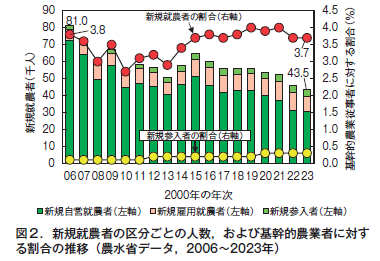
The only way to prevent the "decline" of Japanese agriculture is to increase the number of young farmers entering the farming industry. However, the number of new farmers has decreased by half from 81,000 in 2006 to 43,500 in 2011 (Figure 2). However, since the number of key farmers has also decreased, the ratio of new farmers to key farmers has not changed significantly since 2003, remaining within 3.8% (Figure 2).
新規就農者は,以下の3区分からなる。すなわち,
①新規自営農業就農者(個人経営の農家の世帯員で,調査前の1年間の生活が自営農業への従事を主とする者。以下,新規自営就農者と略),
②新規雇用就農者(調査前1年間に新たに法人等で常雇いとして雇用され,農業に従事した者),
③新規参入者(土地や資金を独自に調達し,調査前の1年間に新たに農業経営を開始した者)
である。
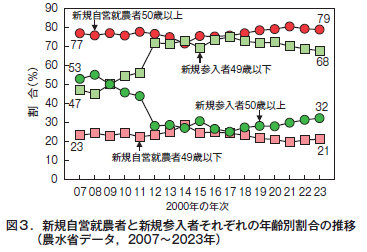
新規就農者の大部分は新規自営就農者である(図2)。新規自営就農者は親から継承した担い手とみなせる。新規自営就農者のうち50歳以上の割合は,2007年77%から23年の79%までほぼ変化していない(図3)。基幹農業者の親は高齢化しながらも,子への経営移譲時期に大きな変化がなかったのだろう。そもそも基幹農業者自体が減少しており,それを継承する新規自営就農者に増加傾向はない(図2)。しかも50歳以上が中心で,基幹農業者の高齢化の歯止めにならない。
4. very few new entrants
一方,新規就農者のうち新規参入者は比較的若年層(49歳以下)の割合が多い(図3)。新規参入者のうちの若年層割合は2012年以降,およそ70%内外で高止まりしている。したがって基幹農業者の高齢化を止めるためには,新規参入者の増加が必須である。しかし新規参入者は,2006年の2.2千人から23年に3.8千人になったに過ぎない(図2)。これは基幹農業者のわずか0.1~0.3%でしかない。これでは基幹農業者の高齢化を鈍化させることすらできないだろう。なぜ新規参入者が増えないのだろうか。
5. barriers to new entrants - financial and farmland issues
There are young people from the city who are not familiar with agriculture, but who yearn to become farmers. I have come in contact with many such young people. However, when they started farming, they had to face difficulties in raising funds and acquiring farmland.
Various support measures (e.g., funds for starting business, funds for young farmers, and business development support programs) are available from the national and local governments. However, there are conditions for approval to receive these funds, and in reality, it is not easy to procure funds. It is necessary to ease the requirements for receiving these funds to make it easier for newcomers to obtain loans and subsidies.
農地は国民の食料生産の基盤で貴重な社会資本である。それゆえ,農地を適切に保全するために農地法が制定されている。農地を取得するには,取得のための要件を満たした上で,農業委員会の許可をもらう。実際の取得で大きな課題は,土地価格である。わが国の農地価格は欧米各国に比べ7~30倍も高い(農水省,2010)。
The young people who have passed through these difficulties and made their dreams come true are the ones who will lead the rejuvenation of our country's key farmers. Their support is extremely important.
thanks
I would like to express my sincere gratitude to all the readers who have enjoyed reading this series of articles over the past four years. I would also like to express my deepest gratitude to all those who carefully reviewed my manuscripts and to the editorial staff who encouraged me in my writing. Thank you very much.